Jumaat, 22 Mac 2013

Malaysia Today - Your Source of Independent News

0 ulasan
Klik GAMBAR Dibawah Untuk Lebih Info
Sumber Asal Berita :-

Malaysia Today - Your Source of Independent News


Talking to a ten-year old

Posted: 21 Mar 2013 06:19 PM PDT

The NEP is not just about stocks and shares and listings on the stock exchange. The NEP is about the aspirations of a two-prong attack: reducing the gap between the haves and the haves-not and reducing the disparity between the different races. Hence, while the Bumiputera ownership of stocks and shares or listed companies may have met a shortfall, what about the rest of us, which the NEP is also about? Are we still short in those areas as well, as we may be in corporate wealth?

THE CORRIDORS OF POWER

Raja Petra Kamarudin

Never mind whether I write a short article (The Chinese and Indians screwed up) or a longer article (Conjecture, imagination and suspicion), the average Malaysian still does not understand what I am trying to say. This only goes to show the low comprehension level of most Malaysians. And these are the same people we are depending on to make the right decision in the coming general election.

God help Malaysia when we need to put the lunatics in charge of the asylum and the monkeys in charge of the zoo.

Now, allow me to speak to you as I would to a ten-year old. The events of 1982 and 1992 that I talked about in the two previous articles regarding the New Economic Policy (NEP) were specific to the Malay Chamber of Commerce, which I was not only a member of but I also sat in the Central Committee.

Hence the discussion focused on issues of concern to the Malay Chamber -- and that would be the Bumiputera share of the corporate wealth of Malaysia. It does not involve other issues such as land, housing, education, jobs, etc. The Malay Chamber represents the Malay business community and the job of the Chamber (just like in any Chamber of Commerce anywhere else in the world) is to focus on the needs and aspirations of its members.

Hence it speaks on behalf of only the members of the Chamber. It would not, for example, be speaking on behalf of the taxi drivers, trishaw pullers, lorry owners, petty traders, teachers, bank employees, civil servants, ex-servicemen, ex-policemen, etc., who all have their own associations to represent their interests.

It is like, say, the Association of Chinese Barbers. This association does not represent all Chinese or all barbers. It represents only its members. So to say that the association should not speak on behalf of all Chinese or on behalf of all barbers (the Malay and Indian barbers included) is silly. And in that same spirit to say that the Chinese Chamber of Commerce does not represent all the Chinese in Malaysia is equally silly. Of course it does not. If you are not a member of that Chamber then it does not and cannot represent your interest or your views.

Now, what Tun Dr Mahathir Mohamad tried to do in 1982 was to act as matchmaker between the Malay and Chinese Chambers of Commerce so that both Chambers can work closely to resolve issues of concern to the Malay businessmen and women. If the business community can work together to resolve their issues, then the government can ease off and not get involved with what were clearly 'business issues'. And if the relationship works and there is close cooperation between both business communities, then the government can leave the businessmen and women alone and not force policies down their throats.

When it did not work, ten years later in 1992, the government organised a Bumiputera Economic Congress where everyone can get involved. This was not to be a Congress where the Malays make demands and hold the government to ransom. It was to be a Congress where everyone can come to a mutual agreement on what to do. This is not about what the Malays want. It is about what the Malays, Chinese, Indians and others jointly want. It was to seek a consensus of all the races and not listen to the demands of just the Malay business community, and only those who are members of the Malay Chamber on top of that.

The Malay argument was that after so many years of the NEP the Malay share of the corporate wealth increased from just 1% to 4% while that of the Chinese increased from 30% to 60%. The Chinese, however, argued that, in terms of percentage, the Chinese corporate wealth only doubled while that of the Malays increased four times. Hence the Malays saw four times the growth that the Chinese saw.

In terms of growth the Chinese are, of course, correct. The Malay wealth increased four times while that of the Chinese only doubled. In absolute figures, though, the Chinese are far ahead of the Malays at 60% compared to only 4% for the Malays.

Then there was another issue that the Chinese raised. Are you looking at Malay wealth based on par value at the time the shares were issued or at market capitalisation? At par value, say RM1.00 per share, the figure would be lower compared to market capitalisation, say, RM10.00 per share. Hence, are we comparing apples to apples?

The second point was: are you looking at Malay wealth based on what they currently still hold or based on what they were originally given, which had already been sold and at a huge profit on top of that. In other words, is your calculation based on current shareholdings or based on what has passed through the hands of the Malays? What the Malays currently hold in terms of stocks and shares may be only 10% or less of what they originally received. And the 90% or more, which the Malays have since sold, would have been sold at a profit, which is not reflected in the calculation of the corporate wealth of the Malays.

Hence, in short, what formula do we use to decide how wealthy the Malays are? And unless we can agree on that formula, and hence arrive at the correct bottom-line, how do we even begin to resolve the problem when we do not even know what the problem is.

(Now do you see why short articles do not work? There are many issues to an argument that need to be raised).

Now, remember that we are still talking about just the corporate wealth or corporate share of the Malays in comparison to the other races. But not all of us have stocks and shares or own companies listed on the stock exchange. Hence this debate, argument, disagreement, or whatever, does not involve all of us. What if you are a makan gaji (salaried employee), student, farmer, smallholder, fisherman, trishaw puller, food stall operator, etc? Whether it is 4%, 19%, 30% or 60% is of no concern to you. This is merely the concern of the Malay, Chinese and Indian Chambers of Commerce, and in particular to the members of those Chambers.

The NEP is not just about stocks and shares and listings on the stock exchange. The NEP is about the aspirations of a two-prong attack: reducing the gap between the haves and the haves-not and reducing the disparity between the different races. Hence, while the Bumiputera ownership of stocks and shares or listed companies may have met a shortfall, what about the rest of us, which the NEP is also about? Are we still short in those areas as well, as we may be in corporate wealth?

Yes, those are social issues that the social scientists need to address and which the Chambers of Commerce does not talk about. Do more Malays receive an education now than before? Do more Malays get to go to university now than before? Are more Malays employed now than before? Are more Malays living above the poverty level now than before? Do more Malays own homes now than before? Do more Malays own cars now than before? Do more Malays live in the urban areas now than before? Are there more Malay professionals now than before? And so on and so forth.

So there is more to the NEP than just stocks, shares and listed companies. But the story I told you in the previous two articles concerns the Malay and Chinese Chambers of Commerce and even then specific to events in 1982 and 1992. But it appears like many of you just do not understand this. And this is why many of you posted comments that had nothing to do with the issue.

First understand what is being written and then comment. And the issue was regarding the Malay and Chinese Chambers of Commerce and the events of 1982 and 1992 and what Dr Mahathir tried but did not work out mainly because the Malays and Chinese could not agree on the formula to apply and hence what the solution should therefore be.

And instead of trying to find the middle ground -- as in any 'peace process' there would always be a middle ground -- the Chinese chose to remain silent and not participate and allowed the government to do what it wanted.

That, in a nutshell, is the message I am delivering. However, those wearing blinkers would be hard-pressed to see this message.

 
Kredit: www.malaysia-today.net

Malaysia Today - Your Source of Independent News

0 ulasan
Klik GAMBAR Dibawah Untuk Lebih Info
Sumber Asal Berita :-

Malaysia Today - Your Source of Independent News


Sabah claim: History on Malaysia’s side

Posted: 21 Mar 2013 08:46 PM PDT

A scholar gives three reasons why the Sulu Sultanate cannot assert sovereignty over the state. 

Anisah Shukry, FMT

A scholar has urged Putrajaya to reject any call for a negotiation on the Sulu claim over Sabah, saying the issue was settled decades ago.

"Neither the Sulu Sultanate nor the Filipino government has a claim over the North Borneo state," said DS Ranjit Singh, an expert on Southeast Asian political history who is now a visiting professor at Universiti Utara Malaysia.

"The moment we negotiate with them, we compromise our sovereignty," he said in a talk at Universiti Malaya today.

He said the Sulu claim was futile for three reasons: the Philippine government's predecessors renounced all claims over the state, the Sulu court has never administered the state, and the people of Sabah agreed to form Malaysia.

He said the sultanate lost its status as an independent entity after its capture by the Spaniards, which happened six months after the signing of the 1878 treaty stipulating that the British administrators of Sabah must pay cession fees to the Sulu court.

"Instead, the Spaniards became the sovereign rulers of the Philippines and it was they who renounced all claims of sovereignty over the territory in Borneo."

When the United States took over the Philippines from the Spaniards, the American administrators in turn signed documents defining the international boundary of the country, Ranjit added.

"The Republic of the Philippines then inherited the Philippines from its predecessor, the US. So how can they claim in 1962 that Sabah is theirs when the predecessor has renounced that claim?"

According to him, these circumstances also give good reason for Malaysia to stop the monthly cession payment of RM5,300 to the sultanate. He urged Putrajaya to do so immediately.

Principle of effectivity

Ranjit also cited what he called the "principle of effectivity" as a reason why Sabah belonged to Malaysia and not the Philippines.

READ MORE HERE


Anwar ‘running away’ from defeat in Permatang Pauh, says Dr M

Posted: 21 Mar 2013 06:53 PM PDT

(TMI) - Tun Dr Mahathir Mohamad chided today opposition leader Datuk Seri Anwar Ibrahim's plan to possibly contest away from his Permatang Pauh seat in Penang, saying his archrival is "running away" from possible defeat.

The former prime minister said the PKR de facto leader's decision to contest a different seat stemmed from his "doubts" that he could defend Permatang Pauh, a known Anwar stronghold since he first took up the seat in the 1982 national polls. 

"This is a free country, he is free to go and contest anywhere... If he wants to, run away from Permatang Pauh.

"Yes, he is running away. Maybe he's not confident of winning the seat," a news portal quoted Dr Mahathir as saying.

Two days ago, Anwar said he may not defend his Permatang Pauh federal seat and instead may stand in Perak or Selangor in the coming general elections.

"There is a likelihood, but it means… I haven't made a definite decision because there have been suggestions that I should go down to Perak or Selangor, and I'm weighing the possibility of going down to Perak," the PKR advisor said. 

Anwar did not say, however, who would replace him in Permatang Pauh, which has traditionally been his political stronghold.

READ MORE HERE


Sulu Sultanate to sue KL in International Court

Posted: 21 Mar 2013 04:30 PM PDT

A spokesman for the sultanate says there is no basis for Malaysia to file charges against eight Filipinos because it does not own Sabah.

(Agencies) - MANILA: The Sulu Sultanate will sue the Malaysian government before the International Court of Justice in response to its filing of terrorism charges against eight of the sultan's followers who were captured in Sabah, a crime punishable by death.

The spokesman of the sultanate, Abraham Idjirani, said their legal team was preparing to file a complaint of usurpation of authority and illegal development of natural wealth in Sabah against Malaysia.

"There is no basis for Malaysia to file charges against those eight Filipinos because it does not own Sabah. We are the rightful owners," Idjirani said at the residence of Sultan Jamalul Kiram III in Taguig City.

This will be the third time the Sulu Sultanate will file a lawsuit against Malaysia. The first was filed in 1992 before the United Nations and the second was filed in 2004 before the International Court of Justice.

Idjirani said both cases were still pending because the ownership of Sabah had not been resolved.

Maintaining that the Malaysia's move was illegal, Idjirani said the moves to file terrorism charges against the sultan's followers violated the 1963 agreement signed by the heads of Malaysia, the Philippines and Indonesia.

The 1963 Manila accord states that "the inclusion of Sabah into the Federation of Malaysia will not prejudice the interest of parties concerned until the issue of the Sabah claim is finally resolved by the United Nations."

"Malaysia is only an occupant of Sabah, so they have no right to file charges against those Filipinos," Idjirani added.

He said the sultanate had no way to confirm whether the eight Filipinos were indeed members of the Sulu Royal Army that occupied Lahad Datu.

President Benigno Aquino III on Thursday said the government would help the eight Filipinos charged with terrorism and waging war in Sabah.

"It is our obligation to protect the rights of our citizens," the President said.

Aquino said he had already instructed the Foreign Affairs and Justice Departments to give the Filipinos legal assistance.

Under Malaysian laws, terrorism charges carry a jail term of up to 30 years while waging war against the King is punishable with death.

A group of Sabah-based lawyers have also expressed their intention to help the eight followers of the sultanate.

The Sabah Law Association, in a report carried by the Malaysian press, said it was ready to ensure that the eight Filipinos are accorded due process.

Aquino earlier ordered an inter-agency team led by Executive Secretary Paquito Ochoa Jr. to come up with a roadmap to resolve the Sabah conflict peacefully.

Aquino said the Philippines was open to negotiating with Malaysia and embarking on a rules-based approach to resolve the Sabah claim similar to the case filed by Manila against Beijing to address the territorial dispute over Panatag Shoal.

The sultanate on Thursday slammed the Palace for dismissing an alleged assassination plot against the sultan and his family.

Idjirani said President Aquino should have at least ordered an investigation into the reported arrival in the country of the Malaysian hit squad to liquidate the sultanate officials.


Singapore MOF: Lawyer’s claim ‘simply false’

Posted: 21 Mar 2013 04:27 PM PDT

'Contrary to what was claimed in the video, Singapore has to date provided fully the information requested by Malaysia for tax purposes,' says Monetary Authority of Singapore.

(FMT) - Singapore has categorically denied video allegations that Sarawak Chief Minister Taib Mahmud and his family hid their illicit wealth, spawned from "illegal" land deals, in the island republic.

In the covertly shot video by London-based NGO Global Witness, Kuching-based lawyer Alvin Chong had allegedly spoken about "ways" to dodge Real Property Gain Tax (RPGT) in Malaysia and how to circumvent the local laws involving a mandatory 51% Bumiputera stake.

Chong had candidly spoken about "two contracts" to be drawn – one which details minimum payments in Malaysia and the other for the bulk disbursements made in Singapore.

He further allegedly said that Singapore was the next Switzerland and that the republic's administration "will not tell the Malaysian government nothing…" eventhough the transactions were illegal.

The video, which has gone viral and garnered 440,000 viewers, drew a strong response from Singapore's Ministry of Finance (MOF) and the Monetary Authority of Singapore (MAS). Both have described the claims in the "sting video" as "simply false".

Singapore daily Today Online, quoting a statement from the authorities, reported that both Malaysia and Singapore governments had a good working relationship on tax matters.

Singapore, they said, had provided full information on tax matters whenever requested by Malaysia.

"The allegation is simply false. Contrary to what was claimed in the video, Singapore has to date provided fully the information requested by Malaysia for tax purposes.

"In addition, Singapore has designated a wide range of crimes as predicate offences to money laundering — including corruption, bribery and fraud. This is in line with the recommendations of the Financial Action Task Force."

Singapore "has been and remains able to provide mutual legal assistance to the fullest extent permitted under our laws where there are requests from Malaysia", they added.

READ MORE HERE


‘Sabah affairs a cruel joke’

Posted: 21 Mar 2013 04:24 PM PDT

Sabahans can no longer rely on Malaya for welfare and must stand up and be counted, says SAPP

Queville To, FMT

KOTA KINABALU: Sabah Progressive Party (SAPP) is not letting up on hammering home its message that Sabah will remain a losing proposition as long as Malaya-centric politics holds sway in the state.

"Because of Malaya, Sabah is today the poorest state in Malaysia. Such is our pathetic state of affairs. This is so shameful and a cruel joke against Sabah," said Wilfred Gaban, the party's Progressive Institute of Public Policy Analysis (PIPPA) director.

Speaking at a political gathering in Luyang here on Wednesday, Gaban urged Sabahans to reject all the peninsula-based political parties as they had done nothing much for Sabah except siphon off its wealth.

He said that it was time for Sabahans to stand up to fight for their rights and for a better future.

"It is time for Sabahans to wake up. We cannot rely on Malaya for welfare. We must take the initiative to do a better job of running our own government. Malaya should not interfere in the affairs of Sabah governance," he said.

A potential candidate for the coming general election, Gaban also blamed federal leaders for causing Malaysia to lag behind economically as compared to other Asean nations such as Indonesia, Thailand and Singapore.

"As a very tiny nation, barely the size of Keningau, Singapore managed to surpass Malaysia GDP by over five billion dollars," he pointed out.

Gaban also reminded that in 1970, Malaysia had even sent technical experts to South Korea to assist the Koreans.

"But today, South Korea's economy has eclipsed Malaysia's economy 10-fold. Today, South Korea is a global player whose manufacturing industries are some of the top producers in the world.

"What has happened to Malaysia? Why has Malaysia lagged so far behind even when Malaysia gets help from the vast natural resources output of Sabah?" he asked.

READ MORE HERE


Cracks appearing in Sabah Umno?

Posted: 21 Mar 2013 04:19 PM PDT

A Sabah NGO - United Suluk Community Organisation (USCO) - has, strangely enough, decided to move into 'active' politics. 

Luke Rintod, FMT

KUDAT: Speculation is high that former deputy chief minister under a PBS-plus government, Amir Kahar Mustapha, is about to quit Umno and join an opposition group.

The former Banggi assemblyman, who is the eldest son of ex- Sabah chief minister, the late Tun Mustapha Harun, is said to have been approached by the members of the Suluk community here to represent them in the opposition in the coming election.

Sources said there had been calls for Amir Kahar to stand again in Banggi which is currently represented by Umno's Mijul Unaini.

"We may join a party soon if everything is alright," a source said, adding that they preferred a local party as vehicle but have not ruled out a national party.

Sources close to the politician also said that apart from Banggi, four other state seats and one parliamentary constituency in the west coast – Tanjung Kapur, Karambunai, Likas, Tanjung Aru and Sepanggar respectively – are being eyed by those in his circle.

There has also been talk that Amir Kahar had met with State Reform Party (STAR) chairman Jeffrey Kitingan recently.

Amir Kahar could not be reached for comment.

A younger brother of Amir Kahar, Badarudin, who heads Usno club, has already teamed up with Jeffrey under the United Borneo Alliance (UBA) and is likely to stand in one of the east-coast seats on a STAR ticket.

Another Usno leader, Abdullah Sani Mohd Salleh, is likely to stand in the Bugaya state seat which is currently held by Umno's Ramlee Marahaban.

Suluk group moves in

Meanwhile, a NGO catering for the Suluk community, United Suluk Community Organsition (USCO), has decided to move into 'active' politics.

READ MORE HERE


A two-year election campaign nears its climax

Posted: 21 Mar 2013 02:05 PM PDT

http://media.economist.com/sites/default/files/imagecache/full-width/images/print-edition/20130323_ASP020_0.jpg 

(The Economist) - That he still has some chance of becoming prime minister is testimony to widespread anger at the corruption endemic in Malaysia.  

WITH a tight election coming up, it is politics as usual in Malaysia—only more so. This month alone has seen the opposition accused of colluding in a foreign invasion of the state of Sabah in Borneo; the death of a private investigator, reviving stories of the grisly murder in 2006 of a beautiful Mongolian woman linked to a friend of the prime minister, Najib Razak; the leader of the opposition, Anwar Ibrahim, denying that he was one of two men appearing in grainy pictures online in an affectionate clinch; and a film shot on hidden cameras that appears to show large-scale corruption in the government of the other Malaysian state in Borneo, Sarawak.

Sailing blithely above the mud and filth that make Malaysian political waters so murky, Mr Najib went on national television on March 19th to deliver the scorecard on the "transformation programme" his government has implemented. He had a good story to tell, of robust economic growth of 5.6% in 2012, poverty virtually eliminated, inequality reduced and 400 legal cases against corruption initiated. And he was able to announce that a scheme to give cash handouts to poorer households will become an annual event.

All should be set fair, you might think, for Mr Najib's ruling coalition, the Barisan Nasional (BN), to romp home again at the election, as it has done in every ballot since independence in 1957. Mr Najib is expected to dissolve parliament any day now, with the voting to follow in mid-April after a brief official campaign period (the unofficial one has now lasted two years or more). If he does not dissolve parliament, its term will expire at the end of April, and the election must then be held by the end of June.

In fact, the outcome is in doubt, for the first time in Malaysia's history. In the election five years ago the opposition coalition, the Pakatan Rakyat, for the first time deprived the BN of the two-thirds majority that allows it to change the constitution. That led to the downfall of the BN prime minister of the day, Abdullah Badawi. His replacement by Mr Najib was decided by their party, the United Malays National Organisation (UMNO), which represents the Malays (who make up about 55% of the population) and dominates the BN. In 2008 Pakatan actually won a slight majority of the popular vote in peninsular Malaysia (ie, excluding Sabah and Sarawak). Affirmative-action policies introduced more than 40 years ago to favour Malays and other indigenous groups over the Chinese and Indian minorities were no longer enough to ensure an overwhelming victory for the ruling coalition.

The BN says it would like to campaign on Mr Najib's record of relative economic success, modest liberalising reform and statesmanship. The opposition wants to keep the focus on issues of fairness and corruption. It can boast of good performances by governments in some of the four (out of 13) states it controls in Malaysia's federal system. But its best hope is that, after more than five decades of BN rule, many Malaysians want change.

Read more at: http://www.economist.com/news/asia/21574013-two-year-election-campaign-nears-its-climax-video-nasties 


Only crumbs left for MIC in Perak

Posted: 21 Mar 2013 01:05 PM PDT

http://www.freemalaysiatoday.com/wp-content/uploads/2013/03/MIC-Zambry-Palanivel-300x202.jpg 

(Free Malaysia Today) - The party, under G Palanivel, is being given the cold shoulder and told to stand in queue for the leftovers of state seats in Perak.

The MIC is facing an uphill battle in its struggle to secure four state seats in Perak. In the 2008 general election, the party lost in Sungkai, Hutang Melintang, Pasir Panjang and Behrang.

That miserable performance provided grist to Umno's mill to flex its muscles, and the long-time Barisan Nasional component party is now fighting to pick up whatever is left of the crumbs.

As an equal partner of BN during the tenure of S Samy Vellu, the party enjoyed cordial relationship with former premier Dr Mahathir Mohamad and had some measure of respect.

Samy Vellu's combative personality and aggressive nature ensured that he got what he wanted but the political equation has changed with his exit.

The MIC, under G Palanivel, is being given the cold shoulder and told to stand in the queue for the leftovers of state seats in Perak.

Umno has taken over the Malay-majority state seats of Pasir Panjang and Behrang and the MIC is being compensated for these seats with the promise of the posts of senator and state speaker.

MIC, realising that with the loss of these two seats to Umno, it may be politically vulnerable, has demanded another two state seats as replacements from Menteri Besar Zambry Abdul Kadir.

Umno obliged with the state seats of Sungkai and Tronoh held by MCA, which had earlier agreed to give up its Buntong seat, which has the highest number of Indian voters, to MIC.

But the giving away of these two MCA seats did not go down well with its (MCA's) grassroots and state leaders, and they started to demand back these two Chinese-majority seats.

According to MIC sources, Umno has agreed to MCA's demand, but has offered the Gerakan-held Aulong state seat and MCA-held Sitiawan state seat as alternatives to MIC.

Gerakan chief Koh Tsu Koon made a hurried trip down to Taiping to cool frayed nerves of Gerakan Aulong branch members who refused to let go of the state seat to MIC.

Read more at: http://www.freemalaysiatoday.com/category/nation/2013/03/22/only-crumbs-left-for-mic-in-perak/  

Agbimuddin a ‘hero’ to Muslim Filipinos, says columnist

Posted: 21 Mar 2013 01:00 PM PDT

http://www.freemalaysiatoday.com/wp-content/uploads/2013/03/Agbimuddin-Kiram-300x202.jpg 

(The Malaysian Insider) - Agbimuddin Kiram is now a revered legend and hero among Muslim Filipinos as he continues to elude capture despite being vastly outnumbered by Malaysian security forces, a columnist with the Philippine Daily Inquirer has said.

In his "As I see It" column, veteran newsman Neal H. Cruz likened the Sulu "crown prince" and the alleged persecution of Filipinos in Sabah to the struggles of the American Indians and African Americans, who suffered decades of mistreatment at the hands of immigrant settlers from Europe.

Cruz said if Agbimuddin were to be found dead, the millitant leader would become an even bigger hero, anointed the crown by the Malaysian and Philippine governments due to their handling of the sensitive and emotive Sabah issue.

He singled out Philippine President Benigno Aquino(picture) as the one to blame, saying his behaviour regarding the Sabah crisis was "really infuriating".
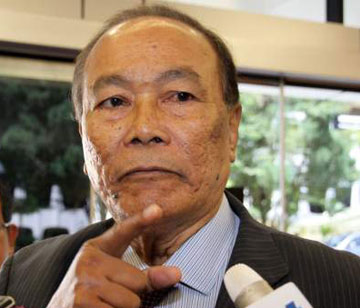
"Years from now, the story of the Sultanate of Sulu and its heroes and how they were oppressed and persecuted by the Malaysian and Philippine governments will be told and retold in Muslim Filipino homes," the columnist wrote.

"Books will be written about them and movies will be filmed about them, the same way the plight of the American Indians and African Americans in the past has been told."

Read more at: http://www.themalaysianinsider.com/malaysia/article/agbimuddin-a-hero-to-muslim-filipinos-says-columnist/ 


EC: Some parties giving wrong info on voting process

Posted: 21 Mar 2013 12:54 PM PDT

https://encrypted-tbn1.gstatic.com/images?q=tbn:ANd9GcTPaPE5rcnKLVITDEy78ZiqdnNyEhl36c1vPnQ4mZ0ubBSDWJv4 

(The Star) - Several political parties and non-governmental bodies have been providing people with wrong information about the entire voting process, said deputy Election Commission chairman Datuk Wan Ahmad Wan Omar.

Labelling it as "ajaran sesat(misleading information)", he said the EC had received news that some groups were giving such misinformation during their ceramah.

"There are voters who come to the polling stations and question certain procedures. But we are merely acting based on rules and regulations. So, voters should follow the necessary instructions, procedures and laws for the general election.

"It only takes three minutes for a person to vote, unless he or she creates chaos and refuses to follow instructions," he told reporters after chairing a special session with election and police officers in the state here yesterday.

He also warned voters not to create problems at polling centres, adding that voting was a simple process.

The EC, stressed Wan Ahmad, had nothing to hide when it came to the election process, pointing out that 17 NGOs had been appointed as observers for the polls.

"These are professional and credible NGOs, who will be monitoring the entire election process. So, what else is there to question?

"Besides, we are also allowing observers from foreign countries. The EC is doing its level best to ensure the highest level of transparency when it comes to the election process.

"If there are people who don't follow rules and regulations, leading to a dirty election, it will be not due to the EC or the process but because there are those with bad intentions."

Tunku Aziz asks ROS to suspend DAP over party polls

Posted: 21 Mar 2013 12:52 PM PDT

https://blogger.googleusercontent.com/img/b/R29vZ2xl/AVvXsEjY1fTCN4n0tVuSAljTq2tSwyT24I1IoGDYA0DR10UFUQfOCaePcn-4sb5U1LOsX-zkqVEGbrfTmbWgaaXLz6jzvnZksFIv5xSDQ4C8GqOMaosxmdTmCT3qhuHaC31Ji1-G68BDqSP8rxQ/s1600/Tunku+Aziz+01.jpg 

(The Star) - Former DAP vice-chairman Tunku Aziz Tunku Ibrahim has urged the Registrar of Societies (ROS) to suspend DAP pending its investigations into the party's central executive committee elections in December.

"The ROS has a duty to protect the interests of the membership as a whole and can direct DAP to hold fresh elections so that a legal committee can be constituted," he said yesterday.

Tunku Aziz, who quit following "irreconcilable differences" with the party leadership last May, said the alleged irregularities were of public interest.

He also claimed that investigation by ROS was being hampered by the reluctance of party secretary-general Lim Guan Eng to cooperate in the matter.

"His cavalier approach towards his duty and his feet-dragging have given rise to imputations of motives, which affects the standing and reputation of the party," he alleged.

Tunku Aziz was commenting on several complaints lodged by DAP members to the ROS since January, urging for action against the party over the CEC election debacle.

On Jan 14, two DAP life members submitted a similar request to the ROS, followed by former Taman Megah branch chairman Lee Chee Cheng, who lodged a police report on Jan 24 and subsequently to the ROS on Feb 8, claiming that the election results were invalid.

In January, the party had admitted to a tabulation error in the results, which saw Zairil Khir Johari move up from the 39th to 20th position, giving him the last spot in the CEC. He is the sole Malay candidate in the CEC.

Lim, said Tungku Aziz, could no longer come out with glib answers for the unsuspecting public to explain the conduct of the CEC election.

"If Lim cannot take the heat (of the complaints), he must get out of the kitchen," he said.

Tunku Aziz said although there were 2,576 delegates who were eligible to attend the convention to elect the 20 CEC members, only 1,823 were given the opportunity to vote.

"We want the party to ensure that the remaining 753 delegates would also be given the right to take part in the voting process again," he said. 

Jackie Chan to join PM in fund-raising programme

Posted: 21 Mar 2013 12:35 PM PDT

http://starstorage.blob.core.windows.net/archives/2013/3/22/nation/jackie-chan-filepic-AFP-n08.jpg 

(The Star) - Action superstar Jackie Chan(pic) will join Prime Minister Datuk Seri Najib Tun Razak in a fund-raising programme at the Stadium Darul Makmur tomorrow.

Chan is expected to auction off three watches and a painting at the event to raise funds for SM Chung Hwa here.

He is also slotted to perform on stage.

A host of performances, including those by local artistes and Taiwan singers, have been lined up.

Some 20,000 people are expected to attend the event. Entrance tickets as well as those for the 1,000 tables have been snapped up since last week.

The organiser hopes to raise RM10mil for the construction of the school. To date, some RM6.5mil has been collected from various quarters, including MCA, private firms and individuals.

Meanwhile, scores of contract workers are working around the clock on the final touches for the Jelajah Janji Ditepati roadshow at the Padang MPK2 field here, also scheduled for tomorrow.

As of 6pm yesterday, some 130 canopies of various sizes had been erected by the Kuala Lumpur-based contractor.

Najib and Pahang Mentri Besar Datuk Seri Adnan Yaakob are expected to officiate the programme at 9pm.

A fireworks display is also scheduled near the end of the programme.


Kredit: www.malaysia-today.net

Malaysia Today - Your Source of Independent News

0 ulasan
Klik GAMBAR Dibawah Untuk Lebih Info
Sumber Asal Berita :-

Malaysia Today - Your Source of Independent News


Political rivals in a strategic battle

Posted: 21 Mar 2013 04:37 PM PDT

Based on BN's election preparation progress, the changes in Pakatan Rakyat's strategy and Najib's cautious style, the date to dissolve the Parliament might be further postponed as the BN wants to make a sally only when it has greatest confidence. 

Lim Sue Goan, Sin Chew Daily

BN has made an all-out effort to create a feel-good atmosphere but its political strategy is not as flexible as Pakatan Rakyat's.

Pakatan Rakyat has started to unveil its candidates and display its strength. BN, meanwhile, is still carefully selecting candidates and considering constituency exchanges, causing election campaign activities in some constituencies to now lag behind.

Take the DAP as an example. Some candidates have been decided such as Negri Sembilan DAP chairman and Lobak state assemblymen Anthony Loke, who will be contesting the Chennah state seat, party parliamentary leader Lim Kit Siang will contest the Gelang Patah parliamentary seat and Himpunan Hijau chairman Wong Tack will contest the Bentong parliamentary seat.

Opposition Leader Datuk Seri Anwar Ibrahim had also announced on Wednesday some PKR parliamentary candidates. His daughter Nurul Izzah will seek re-election in Lembah Pantai and PKR strategic director Mohd Rafizi Ramli will contest the Pandan parliamentary seat. Also, five Sarawak parliamentary candidates have also been decided.

There are also some signs showing the deployment of PAS candidates, including party vice-president Salahuddin Ayub who will be contesting in Johor while former Perak Mentri Besar Datuk Seri Mohammad Nizar Jamaluddin will be contesting the Changkat Jering state seat.

As for the BN, the candidate list remains unclear. It was reported that MCA vice-presidents Datuk Seri Dr Ng Yen Yen and Gan Ping Sieu would not be contesting in their original or preferred parliamentary constituencies. Gan's supporters even rushed to the MCA headquarters with the hope to change the situation.

There might be undercurrents in Kluang forcing Gan to shift and contest in Tebrau. However, he has been rejected by members of the local division.

Umno is eyeballing the Wangsa Maju parliamentary seat while the MCA is not willing to make a concession. Regardless of who is going to be fielded to contest the seat, it will trigger discontentment of the other party. If this is not suppressed, it would be unfavourable to BN, and PKR candidate Datuk Dr Tan Kee Kwong could then wait for redemption.

In addition, there are also different views on whether former MCA president Datuk Seri Ong Tee Keat will seek re-election in the Pandan parliamentary constituency under the BN banner.

Pakatan Rakyat leaders are also taking the strategy of making a breakthrough to drive its election campaign. The decision to field Lim Kit Siang in Gelang Patah has disrupted the MCA's original plans. Who would be fielded by BN to counter the DAP's attacks in Chinese-majority constituencies? No one among MCA candidates can rival Lim. The MCA is now hastily defending against the DAP's strong attack.

Lim has started to canvass for votes in Gelang Patah and once the Parliament is dissolved, he can then help his compatriots in other states or constituencies.

After Lim shifted to contest in Johor, Anwar said he might not seek re-election in Permatang Pauh and instead may contest in Perak or Selangor.

Permatang Pauh is the political base of Anwar and thus, regardless of who is contesting, the seat will be kept. It can help to create a momentum and seek an additional seat if Anwar contests in other states.

It might be a move to confuse BN when Anwar said he might leave Penang to contest in other states, but it has reflected that the Pakatan Rakyat's strategy is more flexible. If Pakatan Rakyat leaders disperse to different frontline states, BN will have to develop a different strategy to cope.

Basically, the three component parties of the Pakatan Rakyat have placed their leaders in different states, while Umno's mentri besar candidate for Selangor remains a mystery. BN has been too dependent on coalition chairman Datuk Seri Najib Razak's personal charm while the image of individual leaders is not obvious enough.

Another example showing that Pakatan Rakyat's election preparation progress is ahead of BN's is that Pakatan Rakyat revealed its election manifesto on February 25.

Based on BN's election preparation progress, the changes in Pakatan Rakyat's strategy and Najib's cautious style, the date to dissolve the Parliament might be further postponed as the BN wants to make a sally only when it has greatest confidence.


ASEAN non-interference and the Sabah conflict

Posted: 21 Mar 2013 02:08 PM PDT

http://asiapacific.anu.edu.au/newmandala/wp-content/uploads/2013/03/Leaders-of-ASEAN-during-the-opening-of-the-21st-ASEAN-Summit-in-Phnom-Penh-e1363922364408.jpg 

Yet while the regional organisation has trumpeted its 'central role' in maintaining peace, security and stability in a region which has experienced both internal and intra-member conflicts since post-independence, it is has so far been 'silent' on the Sabah crisis.  

Imelda Deinla, New Mandala

The recent incursion into Sabah of more than 200 armed groups styling themselves as the Royal Army of the Sultan of Sulu has put another challenge to ASEAN's claim to its centrality in the region.

There seems to be consensus that the Sabah conflict has become another flashpoint that has broader regional security implications for members of ASEAN. Yet while the regional organisation has trumpeted its 'central role' in maintaining peace, security and stability in a region which has experienced both internal and intra-member conflicts since post-independence, it is has so far been 'silent' on the Sabah crisis. The United Nations through Ban Ki Moon issued a statement two weeks after the incursion urging parties to end the violence through dialogue and to seek a peaceful resolution of the conflict. Member countries were more adamant in not expressing their views with the exception of Indonesia's President Susilo Bambang Yudhoyono who remarked during a state visit to Hungary on 6 March 2013 that a diplomatic approach must be pursued in the future and called on ASEAN's current chair, Brunei Darussalam, to take a proactive move to resolve the conflict peacefully.

There are two ways to interpret ASEAN's lack of visibility in the Sabah crisis. One is that there is no willingness among member countries to 'regionalise' the conflict and a preference for treating it purely as an internal security matter primarily for Malaysia. In this way, the principle of non-interference on sovereignty is maintained. The fact however that the conflict involves cross-border actions and personalities from Malaysia and the Philippines belies its characterisation as an 'internal' matter. However, this is also indicative of an evolving pattern following the failure to reach a consensus on the South China last year, and the muted statements of ASEAN involving the skirmishes between Thai and Cambodian forces at the Preah Vijear temple in 2011.

Read more at: http://asiapacific.anu.edu.au/newmandala/2013/03/22/asean-non-interference-and-the-sabah-conflict/ 


Ini Kali Kah? It's touch-and-go for the Opposition

Posted: 21 Mar 2013 01:34 PM PDT

https://blogger.googleusercontent.com/img/b/R29vZ2xl/AVvXsEgG2ZbzS09zwWBhZxb6n1mf-u8Lrt0PSkq4ddahjlcbh7xaWkBAfWDo4ywNWWM5Q2XDtBvBGwt6rGHpA-TEEly7m8gZyEWTDAJ5Ph1vqAKhpKLt0dNnQT7hVUe7i2x8PCB48cDwB4v3kLo/s1600/BN+vs+PR.JPG 

Between Umno and PKR/Pas, the great majority of the older generation Malays would vote for the former. The majority of the younger generation and new voters remain to be seen. Will they buy the pemimpin yang di sanjung tinggi crap? 

Joe Fernandez


We are forgetting the older generation Malays who want 100 per cent the NEP to be retained although the majority of them have nothing but their two you know what.

But like gamblers or lottery ticket buyers or alcoholics, they all hope to benefit someday when they become YBs or even PM and can put their hands in the National Cookie Jar under the guise of affirmative action and/or bringing so-called development to the people.

East is East and West is West and never the twain shall meet.

The great majority of the Malays in Malaya will not vote the same way as the great majority of non-Malays.

Malays think that to vote as the non-Malays would only benefit the latter and thereby it's a loss to them somehow.

Between Umno and PKR/Pas, the great majority of the older generation Malays would vote for the former. The majority of the younger generation and new voters remain to be seen. Will they buy the pemimpin yang di sanjung tinggi crap?

The Indians, who decided in 67 of the parliamentary seats in 2008, remain an unknown quantity this time except for the younger generation and new voters who are all largely anti-government.

In 2008, 85 per cent of the Indians voted against BN. Yet BN still managed to form the Federal Government with the help of Sabah and Sarawak where they lost only two parliamentary seats.

This time BN can lose 14 parliamentary seats in Sabah and Sarawak in a delayed tsunami provided the Opposition -- read Anwar -- can get their act together. Anwar's thinking in Sabah: "Never mind if I lose. Jeffrey must not win so that Muslim domination of Sabah can continue." He expects Umno in Sabah to cross over to PKR if PR seizes Putrajaya.

Sarawak is one-to-one but what about Sabah?

Anwar is being bull-headed in Sabah instead of withdrawing gracefully in favour of the local parties.

Sabah does not need PR or BN.

PKR and Pas will not win even one seat in Sabah.

In Sarawak, PKR will win only one parliamentary seat -- Mas Gading -- if Star doesn't take it, Dap six and Pas none.

If PKR and Pas withdraw from Sabah, the Opposition can win seven parliamentary seats including two by Dap.

At the same time, if left alone or ignored by PR, less Indians can be expected to vote against BN this time. The Indians should vote against all incumbents. They don't need MIC or Hindraf because the Indians will not benefit whoever -- whether BN or PR -- is in power. Hindraf should remain an NGO and apolitical.

Even more Chinese this time will vote for the Opposition. The Chinese don't need the BN or its development.

What is important is that the ruling party does not get a two-third majority.

The Opposition will retain Kelantan and Penang but what about their other two states and Perak? It's 50:50. That's why Kit Siang is moving to Johor and Anwar may move to Perak, if not Selangor. There's a need to rattle Umno. The Opposition has a chance to seize Terengganu, Perak and Negri Sembilan.

Change in Malaysia will depend on the younger generation and new voters, the Indians and Sabah and Sarawak. At least BN in Malaya can be wiped out. Umno will survive.

BN's free money policy is merely saving some of the money that would have otherwise been lost to corruption. Better to make the majority happy than the corrupt minority. BN will not stop the corruption completely because that's why they are in politics.

The GE will be sometime between May 10 and mid-Oct after Parliament expires on April 28 undissolved.

Just as not more than six months must lapse between one parliamentary sitting and another parliamentary sitting, not more than six months must lapse between one parliament and another if it expires undissolved.

The GE needs to be called within two months only if Parliament is dissolved.

The longer the GE is delayed, the better for Umno in Malaya but not in Sabah and the worse for BN in the country.

The longer that the GE is delayed, the worse for PR including Dap in Sabah and the better for the local Opposition parties.


Never a Suluk Filipino for CM

Posted: 21 Mar 2013 01:01 PM PDT

http://www.freemalaysiatoday.com/wp-content/uploads/2013/03/Anifah-Najib-Musa-300x202.jpg 

Even if there are circumstantial cases against the Amans in Sabah, Prime Minister Najib Tun Razak is unlikely to rock his 'fixed deposit'.

Selvaraja Somiah, FMT

The Suluk Filipinos are after Musa Aman's head in their renewed bid for the Chief Minister's post. But this time, Musa is not alone. He is taking Foreign Minister and brother Anifah Aman along for the ride.

Many want to see Anifah destroyed along with Musa to minimise any possibility of the younger brother taking up the challenge of being the chief minister if ever the opportunity presents itself.

Anifah is getting closer by the day to the chief minister's post as he has since chalked up an enviable record as foreign minister.

Having made his money and tonnes of it before he went into politics, Anifah has since stayed out of business and professional dealings which would cast aspersions on his character and his integrity in public service.

So, the critics would appear to be barking up the wrong tree on Anifah.

Both the Suluk Filipinos and opposition PKR have alleged that Anifah is Musa's "real nominee", who is involved in all sorts of shady dealings involving timber.

Even the recent arrest of Manuel Amalilo aka Mohammad Suffian Syed, who scammed 15,000 Filipinos of 12 billion pesos (RM895 million) in a ponzi scheme in the Philippines, is purportedly engineered by the Aman brothers.

But those who know Anifah will swear that the Kimanis MP is one shrewd operator and scrupulous about the way he arranges his public and private life.

Aside from Anifah, Deputy Chief Minister Joseph Pairin Kitingan is the only other leader who will get Musa's support as his successor.

But Pairin was chief minister from 1985 to 1994 and is unlikely to accept his old post even if offered.

So even if there are circumstantial cases against Musa and Anifah, current Prime Minister Najib Tun Razak is unlikely to rock his "fixed deposit" state of Sabah just because some Suluk Filipino (read: Semporna MP Shafie Apdal) got too big for his boots and wants to be chief minister.

Dream on

It is common knowledge here that Shafie, who is also a federal-level minister and an Umno vice- president, is eyeing the chief minister's seat.

Shafie is a Suluk and his "turf" Semporna is undoubtedly infested with illegal immigrants, from the nearby Sulu Archipelago in the Philippines.

But be assured no Suluk Filipino will ever become chief minister of Sabah.

Why? Because the local native Dusuns in particular — including the Kadazans and Muruts – would not allow it.

Read more at: http://www.freemalaysiatoday.com/category/opinion/2013/03/22/never-a-suluk-filipino-for-cm/ 

Muzzling the judiciary

Posted: 21 Mar 2013 12:37 PM PDT

http://dawncompk.files.wordpress.com/2012/06/court-hammer-scales-670.jpg?w=670&h=350 

Over the past half a century the lines of separation of powers between the three have been blurred by numerous amendments to the constitution affecting some 700 pieces of legislation. 

Bob Teoh, Sin Chew Daily

Is our parliament muzzling the judiciary or the judiciary muzzling itself? This poser was highlighted by a recent High Court ruling where the court itself decided it has no power to review or provide remedy to bad laws made by the legislative.

We are taught in a parliamentary democracy there are three branches of government, the legislative, executive and the judiciary, all acting to keep each in check and balance so none encroach into the sanctity of the Federal Constitution as the supreme law in the country.

However, over the past half a century the lines of separation of powers between the three have been blurred by numerous amendments to the constitution affecting some 700 pieces of legislation.

Some of these seemed to go beyond the scope or ultra vires the constitution. These are mainly in the areas granting powers of absolute discretion to executive action. To make matters worse, these executive powers are not subject to judicial review. In other words, the judiciary is muzzled. This is no doubt a violation of the supremacy of the constitution.

But this did not stop the judiciary from playing its role in providing remedies to those seeking it. It is not uncommon then to see that the judiciary in some instances has refused to be muzzled. We have seen the courts intervening and providing remedies even in cases under the draconian (now defunct) Internal Security Act.

In the area of press licensing under the Publications and Printing Presses Act (PPPA), the minister has the absolute discretion to grant or to revoke such licenses. This executive action is not open to judicial review. However, in rare instances, the courts have intervened and provided remedies in the public interest.

A case in point is the high profile Catholic Herald case. The High Court in Kuala Lumpur decided in 2009 that the minister was wrong in imposing a condition that the Malay version of the publication is not allowed to use the word 'Allah' otherwise its publishing licence would not be renewed. The judgement is currently under appeal.

There have been some attempts at law reforms. For instance the ISA has been replaced by another law. The PPPA has also been amended, where among other things, the absolute discretion of the minister in press licencing has now been removed.

The decision of the High Court in Shah Alam recently is indeed a setback. Has the judiciary muzzled itself?

In an application brought Klang MP Charles Santiago for a review of the principal and supplementary electoral rolls for his parliamentary constituency was dismissed by the court.

He said that he had raised sufficient grounds to show the existence of phantom voters in the electoral rolls.

The court said it was bound by the Section 9A of the Elections Act 1958, in that it cannot review a gazetted electoral roll. It said the Federal Court previously ruled that a gazetted electoral roll is final and cannot be questioned in court.

Responding to the decision, Santiago said the court had failed to address the key issue that Section 9A is ultra vires the Federal Constitution.

Section 9A, which was introduced into the Elections Act 1958 after the High Court in Kota Kinabalu declared the Likas by-election of 2001 null and void as there were discrepancies in the electoral roll. As a result, former Sabah Chief Minister Datuk Seri Yong Teck Lee lost his seat but he regained it with a larger majority in a subsequent by-election.


Kredit: www.malaysia-today.net

Malaysia Today - Your Source of Independent News

0 ulasan
Klik GAMBAR Dibawah Untuk Lebih Info
Sumber Asal Berita :-

Malaysia Today - Your Source of Independent News


Penang Forum Opposes Tunnel Vision

Posted: 21 Mar 2013 04:48 PM PDT

(The tunnel would be the fourth cross-channel link, after the ferries and the first and second Penang bridges.)

There are just too many unanswered questions (see the list below) that throw the viability of this mega project into doubt.

While it is true that public transport comes under the jurisdiction of the federal government, we feel that 'do-the-wrong-thing' approach (promoting dependency on private motor vehicles over the long term) is worse than the 'do-nothing' approach.

A more sensible and visionary approach would be to come up with a comprehensive plan for sustainable transport while educating the public and pressuring the federal government to realise that change.

It is true that the federal government now has overbearing jurisdiction over public transport but that may not be the case if there is a change of government in the coming general election or the one after that. Jurisdiction over public transport would then be decentralised.

In the meantime, the state government should lay the ground work for integrated sustainable public sustainable transport in the state. The state government can do the following now:

  • Kick off a campaign to promote the widespread use of public transport among ordinary commuters. State government leaders could show leadership by example by taking the bus or cycling to work wherever possible.
  • Prevent illegal parking (by clamping) to decongest key routes so that bus lanes can be created along certain stretches. A trial run could be carried out at Burma Road, for instance. These bus lanes may also be used by taxis, emergency vehicles and multi-occupancy vehicles.
  • Buy RapidPenang season tickets in bulk and distribute them to target groups such as school children, working adults and senior citizens. Alternatively, the state government could provide full or partial reimbursements to those who show proof of purchase of these season tickets.
The public can be enlisted to do the following:
  • Pressure the federal government through petitions and letter-writing campaigns to increase the number of buses in the state and decentralise public transport decision-making.
  • Turn the quest for improved public transport in the state into a major general election campaign issue.
  • Take public transport to work at least once a week for a start.
Here are our reasons for opposing the tunnel project and our reservations about the highway building spree.

Questions

About the vision:

Shouldn't important public policies be based on evidence and analysis?
Will building more roads solve traffic problems?

Is the public being given an alternative based on sustainable transport?

Are we moving to the 21st century or moving back to the 20th century with the state government's emphasis on building infrastructure for private motor vehicles?
Does creating dependency on private transport help the poor?

About the process of making public policy

The formal agreement for the (Transport Masterplan) TMP was signed in mid 2011. In the same week, the CM announced the signing of MOUs for four major road projects with Chinese companies. Does it make sense to have the solution before the study has started? Does this not ignore evidenced based analysis and policies?

Concurrent negotiations for the tunnel and highway projects started in 2011 held while the TMP study was underway. Why were awards for the projects given out even before the TMP is finalised and made public? Doesn't this pre-empt the significance of the report's recommendations?

TMP calls for a balanced approach to solving transport problems. It suggested short and medium term measures and recommended major road construction as longer term solutions commencing after the short/medium-term measures. Are we putting the cart before the horse by reversing the priorities suggested in the TMP?

Have there been independent feasibility studies, cost benefit analysis, traffic demand simulation etc done for ALL the four projects before they were tendered? Isn't it standard best practice to conduct such studies BEFORE tender and award, rather than after?

The TMP is based on the assumption that the population will be 2.5m by 2030 and that by this time a sea tunnel may be justified. The Department of Statistics released a population projection last year which projects a population of 1.8 million by 2030. It appears that Halcrow has not done any modelling of the population; they have just assumed historical growth rates will continue, which would suggest that the tunnel will not be required even by 2030.

How is the public expected to provide meaningful feedback when they are hazy about the precise alignment of the routes? All the precise proposed alignments should be displayed to the public for their comments. The state government should practice transparency especially now that the Freedom of Information Act has been passed?

READ MORE HERE


Why it is kinda stupid to compare Malaysia with Korea

Posted: 21 Mar 2013 12:47 PM PDT

 
Some of our politicians and their supporters are perhaps using this comparison to win votes through half-truths.

Let us just for a while suspend our intelligence and agree with them. Let us list down what we need to have in order to become like South Korea.

1.    We need a communist North Korea (complete with Soviet back-up) to taunt us so that America will adopt us like a favourite son. Being an ally to the USA, Korea received enormous sum of aid, first from the US and then from another ally, Japan. Accordingly from 1946 to 1978 they received USD 60 billion from the US. During the same period the entire African continent received only USD 68.9 billion. Indirect aids and support were also forthcoming with preferential treatment in most areas between the two countries, in trade, social and cultural.

2.    We need to almost completely disregard the environment in the first 20 – 30 years of industrialization. Many do not know that until recently, the tap water in Seoul is completely unsafe for consumption! While we in Malaysia can still boast about our 'oldest rainforest', Korea has almost completely destroyed their original forestry. Air quality has been a major challenge for decades with acid rain, sulphur oxides, and annual yellow dust .The environmental degradation was made worst by the damage done by US military bases – from oil spills, noise pollution, water contamination from waste water and chemical.

3.    We need to throw away democratic rule till about the 80s. In South Korea, the civilian government took over the military one rather recently, in 1987.  Yes we need an authoritarian military to rule the country with 'kuku besi' type of management. It was bloody. Assassinations of head of states and all that would have become part of our political history.


Is Chandra Muzaffar evil when he speaks sense?

Posted: 21 Mar 2013 12:45 PM PDT

The trouble is, he mixes the common-sense words with an apologia for the current Barisan Nasional, together with his series of attacks on Anwar Ibrahim's integrity. And every time he does, there is an explosion, in various forms.

The latest attack by Choo Sing Chye, widely reproduced around the opposition web, is an attempt to hoist Chandra by his own petard by recalling what Chandra the social reformer had written in years before. Other attacks on Chandra come with reminders that this widely-respected social reformer of the 1970s and 1980s turned his back on Anwar Ibrahim and Parti Keadilan and wheeled into the embrace of Mahathir Mohamad and the Barisan Nasional.

In trying to look up the background about this latest attack (Chandra's work is very low on the personal horizon, there's too much going on), I came across Chandra's piece in February:

…when a government is overthrown in a democracy there is no guarantee that its successor will be able to ensure the triumph of good, clean governance partly because the scope for radical, holistic change in a competitive party system with deep, vested interests is limited…


A little bit of common sense

A little bit of common sense

Makes sense to me.


If Pakatan Rakyat takes power this year, it will inherit a government system that has been morally, institutionally and personally corrupted by half a century of twisted Barisan Nasional rule. Changing the system will take time.

Pakatan leaders will need to change the workings of the civil service, get anti-corruption agencies to work professionally, get lawyers and judges to restore honour in the judicial system, restore honesty in the workings of the federal and state governments, and at municipal councils.

It's a huge mountain to climb.

On top of that, every Pakatan politician getting into power must face their own challenge to personal honesty and integrity. Because nothing succeeds like success, Pakatan politicians will be wooed and sweet-talked by new business and corporate friends, people with money to spend and the will to spend it when it matters, in order to make more money.

To take one example, every arms merchant will try to take advantage of public anger about Altantuya and Scorpene submarines to push out DCNS. Is Pakatan angry about DCNS, about Altantuya's murder, about RM580mil kickbacks — or is Pakatan being supported by competitors of DCNS?

That's how the world works. It is only common sense to always keep that in mind.

Chandra is not the first to observe that changing the people in power does not automatically mean an end to corruption. All through history, people have found that the revolution is eventually perverted by the very people who rode the wave into power.

Thus, the people must remain on their toes.

Read more at: http://uppercaise.wordpress.com/2013/03/21/chandra-muzaffar-speaking-sense/ 


Kredit: www.malaysia-today.net
 

Malaysia Today Online

Copyright 2010 All Rights Reserved