Khamis, 3 Januari 2013

Malaysia Today - Your Source of Independent News

0 ulasan
Klik GAMBAR Dibawah Untuk Lebih Info
Sumber Asal Berita :-

Malaysia Today - Your Source of Independent News


Local tabloid marks Bieber as a country

Posted: 03 Jan 2013 12:16 PM PST

http://sin.stb.s-msn.com/i/52/305B5D59CDFB5A578CE65AE226A3.jpg 

(MSN News) - A tabloid pullout called Mega from the local Malay newspaper Utusan even quoted Justin Bieber as the ninth biggest country in the world.

http://sin.stb.s-msn.com/i/52/305B5D59CDFB5A578CE65AE226A3.jpg 

Reader Firdaus Hassan captured a snapshot of a column that ran in a tabloid pullout named Mega from local Malay newspaper Utusan, which carried a short write-up entitled 'Interesting facts about Justin Bieber'. The write-up was published today. The snapshot went viral on Facebook today as the column showcased eight 'facts' about Bieber, as a country. The first 'fact' read as Bieber was 'freed from the ruling of Communist Party of the Soviet Union on 16 December 1991', whilst the second 'fact' listed Bieber as 'the ninth biggest country in the world with a population of 16.6 million (as of the year 2011)'.

Another 'fact' read as there were 130 ethnic groups in Bieber country, including Kazakh, Russia, German and Ukraine.

Many users find the error as amusing, calling it an 'epic typo' and that the editor must have been a 'Belieber'. 

Role of Sabah and Sarawak in nation-building

Posted: 03 Jan 2013 12:08 PM PST

http://fz.com/sites/default/files/styles/mainbanner_645x435/public/Sabah-Sarawak-040113-fzgraphics_1.jpg 

If Sabah and Sarawak did not contribute the 56 seats to the national parliament, would they receive the same treatment today? Would the BN withdraw its fixed deposits (special treatment) when Sabah and Sarawak could no longer offer better interest rates (electoral support)? 

Arnold Puyok, fz.com

TO BUILD a nation is not easy. It took the Americans more than 200 years to finally find their identity. Hence, there surely is a lot of work to be done to transform Malaysia into a solid nation.
 
It is indeed a work-in-progress. We must remember, Malaysia is just 49 years old (from its founding in 1963), way too young compared with major countries, such as the United States, China and India, just to name a few.
 
In order to build a successful Malaysian nation, Malaysians must be willing to put aside their political and cultural differences. However, this will be an enormous challenge as not only are Malaysians divided politically and culturally, they are also divided regionally.
 
A case in point is Sabahans and Sarawakians who are separated from their peninsular Malaysian counterparts by the South China Sea.
 
The main challenge confronting the government of the day (and any government to come) is to bridge what I call the political and cultural gap in Malaysian society. This endeavour must start with the effort to truly integrate Sabah and Sarawak into the Federation of Malaysia.
 
Since 2008, Sabah and Sarawak are considered by many as the ruling party Barisan Nasional's (BN) "fixed deposits". The label came after the East Malaysian states helped the BN return to power by contributing 56 parliamentary seats in the 2008 general election.
 
These seats were crucial in ensuring the BN's slim electoral victory. Many analysts (including this writer) have predicted that the BN will return to power but not necessarily with Sabah and Sarawak as its fixed deposits anymore, depending on changes in the dynamics of local politics.
 
Sabah and Sarawak's fixed deposits status has brought them to national prominence. Sabah, in particular, has been receiving numerous development assistances from the Federal Government.
 
Under the Ninth Malaysia Plan Sabah received the largest financial allocation of more than RM16 billion. More Sabahans were also appointed to hold important positions in the federal cabinet.
 
Datuk Seri Anifah Aman, for instance, was appointed by Prime Minister Datuk Seri Najib Razak to helm the influential Ministry of Foreign Affairs and Datuk Seri Mohd Shafie Afdal, the Ministry of Rural Development. These cabinet portfolios are normally reserved for key Umno leaders from peninsular Malaysia.
 
Despite the special treatment given to Sabah and Sarawak, many are not happy with the fixed deposits label.
 
They ask: if Sabah and Sarawak did not contribute the 56 seats to the national parliament, would they receive the same treatment today? Would the BN withdraw its fixed deposits (special treatment) when Sabah and Sarawak could no longer offer better interest rates (electoral support)?
 
When the democratically elected PBS (Parti Bersatu Sabah) was in power, it was pushed into the political wilderness by the Mahathir administration simply because the party was championing state rights and autonomy.
 
This caused Sabah to lag behind in terms of infrastructural development. Despite peninsular Malaysia's marked development progress, Sabah and Sarawak are still way behind.
 
It is important for the government to set politics aside for the sake of nation-building. Sabah and Sarawak must not be regarded as fixed deposits anymore.
 
Sabahans and Sarawakians have suffered a lot due to "bad politics" played by self-serving leaders. The Federal Government must not alienate Sabahans and Sarawakians just because they are politically and culturally different.
 
Sabahans and Sarawakians are loyal Malaysian citizens who want to be treated equally as their fellow Malaysians in the peninsular Malaysia.
 
If the government is serious about building a strong Malaysian nation, Sabahans and Sarawakians teach us that we all can live in peace and harmony if we are willing to accept each other's political and cultural differences.
 
In Sabah and Sarawak, ethnic tolerance is high. There have never been any ethnic riots in Sabah and Sarawak throughout Malaysia's 49 years of history. Ethnic harmony is intact thanks to inter-ethnic marriages.
 
Regional identity plays a more important role than do ethnicity and religion. It does not matter whether one is Kadazandusun, Bajau, Murut, Lundayeh or Bisaya, racial identity is not as strong as in peninsular Malaysia.
 
While many of the indigenous people in Sabah and Sarawak have embraced either Islam or Christianity, they take pride in their cultural roots. That is why when the "Allah" issue came about, Sabahan Muslims came to defend the right of their Christian counterparts to use the word "Allah", including the Muslim chief minister. The same with Sarawak and its chief minister too.

Read more at: http://fz.com/content/role-sabah-and-sarawak-nation-building  

Will the Indian Muslim wish come true?

Posted: 03 Jan 2013 11:59 AM PST

http://www.freemalaysiatoday.com/wp-content/uploads/2013/01/Kimma.jpg 

Since the inception of Malaysia, the Indian Muslim community has been in search of an identity that will associate it with BN and the Malay-Muslim community.

Ali Cordoba, FMT 

The rumour mill is spinning fast in Kuala Lumpur, with the business circle among the Indian Muslim community gearing for a massive Barisan Nasional victory in an apparent late January polls.

Will this 13th general election be the one that will grant the Indian Muslims, lost in Malaysia's political doldrums, their silent wishes?

These rumours, which are spreading like wild fires in Masjid India, for example, put the Indian Muslim community in perspective while several of the community leaders are said to be campaigning in favour of BN.

Pro-BN banners are seen along the overcrowded Masjid India street. Some of the leading business outlets in the area have showed their preference for BN, with large banners erected on some buildings.

Since the inception of Malaysia, the Indian Muslim community has been in search of an identity that would associate it with BN and the Malay-Muslim community.

The formation of the Malaysian Indian Muslim Congress (Kimma) in the mid-1970s – a group to represent the Indian Muslims in the political scene – had little impact in the community's quest for recognition.

A recent flurry of activities by Kimma and its very recent association with BN did not altogether help the cause of the Indian Muslims.

Although left in the lurch, a majority of the community would probably stick to the rule of supporting BN in order to maintain the favours and prevent a backlash against its businesses.

With Kimma unable to press BN for the granting of the "Bumiputera" status to the Indian Muslims, the latter group is said to have fallen in a dilemma.

From an Umno-BN point of view, not granting the demands of Kimma and sidelining the Indian Muslims as "others" in the Muslim community actually secures their blind support for the ruling coalition.

The ruling government is aware that Kimma would never abandon BN or force the Indian Muslims to vote for Pakatan Rakyat. They would have too much to lose if they dropped BN for Pakatan at the last moment, thus the delaying tactics in the "talks" between Umno and Kimma on the fate of the "Mamak".

Read more at: http://www.freemalaysiatoday.com/category/opinion/2013/01/04/will-the-indian-muslim-wish-come-true/ 

Non-Muslims can use ‘Allah’, Mat Sabu insists

Posted: 03 Jan 2013 11:53 AM PST

http://www.themalaysianinsider.com/images/uploads/mugshots/matsabu400px.jpg 

(The Malaysian Insider) - PAS maintains that non-Muslims are allowed to use the word "Allah" to describe their gods, says PAS deputy president Mohamad Sabu, in a bid to allay fears among the religious minority that the Islamist party may be reversing its president's stand ahead of polls.

He insisted that the latest polemic over the use of "Allah" by non-Muslims was limited to peninsular Malaysia and was never an issue among Muslims and Christians in Sabah, Sarawak and the Middle East.

"The PAS' president had issued the statement in 2010 to not forbid any religious adherent apart from Muslims to use the word 'Allah'.

"PAS maintains that stand," the 58-year-old told The Malaysian Insider, weighing in on the religious row after the party information chief Datuk Tuan Ibrahim Tuan Man issued a statement last month seemingly contradicting his president Datuk Seri Abdul Hadi Awang's previous remarks on the hot-button topic in mainly Muslim Malaysia.

The leader popularly known as Mat Sabu (picture) noted that Abdul Hadi had already spoken out on the matter three years ago, when the debate first raged.

Abdul Hadi, a respected Islamic scholar, had in a statement dated January 7, 2010 said: "In conclusion, we cannot forbid them from using the word 'Allah' among themselves, in their worship and practice, even though the meaning deviates from the original according to our language."

Many Muslim Malaysians, who form 60 per cent of the 28 million population, argue that the Arabic word is a proper noun that refers exclusively to their god despite a December 31, 2009 High Court judgment saying otherwise, and ruled to allow the Catholic Church to publish the word to describe the Christian god in the Malay section of its weekly newspaper, Herald, which caters to its Bahasa Malaysia-reading congregation who mostly hail from Borneo.

Read more at: http://www.themalaysianinsider.com/malaysia/article/non-muslims-can-use-allah-mat-sabu-insists/ 


Despite Raja Ropiaah’s land deal, Puspahanas not in sight

Posted: 03 Jan 2013 11:44 AM PST

http://www.themalaysianinsider.com/images/uploads/2013/january2013/m_carpark31.jpgThe carpark near the Health and Higher Education ministries in Precinct 1 of Putrajaya, which is the only known point on a map for the Puspahanas project. 

(The Malaysian Insider) - Senator Datuk Seri Raja Ropiaah Abdullah might have settled her legal suit and sold hotly-contested land to Boustead Holdings Bhd (BHB) but questions remain whether the Selangor Wanita Umno chief's firm has delivered a RM100 million defence education building to the government.

The National Defence Education Centre or Puspahanas project ground breaking was done on November 21, 2008 but the exact location of the building is a mystery, with the only known point on a map shown to be a carpark near the Health and Higher Education ministries in Precinct 1 of Putrajaya.

The unfinished Puspahanas is akin to an earlier scandal that engulfed Raja Ropiaah's Wanita Umno chief, Datuk Seri Shahrizat Abdul Jalil, when her family was accused of using a RM250 million government soft loan for personal investment instead of the National Feedlot Centre (NFC) project.

There are no street signages in Putrajaya for the project, which her development company Awan Megah Sdn Bhd agreed to build in 2005 in exchange for some 80 hectares of land in Bukit Raja, Selangor and RM27 million.

The other mystery is how BHB could buy the Bukit Raja land as the government had stipulated the land couldn't be sold by Awan Megah, which had earlier worked out a complicated deal with carpet dealer Deepak Jaikishan to finance the Puspahanas construction.

The controversial businessman had taken Raja Ropiaah to court when the deal fell through and she instead went into a joint-venture development with a plasticware maker.

His revelations before the civil suit, which was heard at the same time as the last Umno annual general assembly, later led to a settlement where his company, Astacanggih Sdn Bhd had its 80 per cent majority stake sold to a BHB unit for RM30 million.

Astacanggih has also proposed to buy Raja Ropiaah's land for RM130 million, although the deal could not be secured earlier due to restrictions from the government, which had yet to receive the Puspahanas facility.

BHB yesterday cited expanding its landbank as the reason to buy into Astacanggih, adding today it was purely a commercial decision.

In a filing to Bursa Malaysia, BHB said economies of scale can be achieved by combining the land with the adjacent 283.28ha land held under Jendela Hikmat Sdn Bhd, which the Boustead Group and Lembaga Tabung Angkatan Tentera (LTAT) jointly hold a 60 per cent equity interest.

Based on its experience, BHB said it is confident the acquisition of the development land will be able to generate a return on development cost of 25 per cent from the RM160 million investment.


An artist's impression of the Puspahanas project.


Deputy Defence Minister Datuk Dr Abdul Latif Ahmad declined to comment yesterday on the project, saying he did not have any information about the project that was first mooted in 1971.

Read more at: http://www.themalaysianinsider.com/malaysia/article/despite-raja-ropiaahs-land-deal-puspahanas-not-in-sight/ 


Embassy confirms huge compensation paid to Malaysian govt

Posted: 03 Jan 2013 11:38 AM PST

qSdxYDRFmy0 

(Harakah Daily) - The Embassy of Japan has today confirmed that it had paid money to the Malaysian government being compensation for families of victims of the so-called 'Death Railway' project in the 1940s.


http://en.harakahdaily.net/images/stories/newslocal/deathrailway.jpg


Jejak, the PAS-backed secretariat led by Bukit Gantang member of parliament Nizar Jamaluddin, visited the embassy today in a bid to unravel truth over some RM207 billion in unpaid compensation. Also present were PAS Youth vice  chief Raja Iskandar Al-Hiss and Jejak operation chief Safarizal Saleh.

The secretariat was formed to track down next-of-kins of those forced to work in the 'Death Railway'.

Jejak quoted the embassy's second secretary Takaharu Suegami as saying that the money was transfered in the 1990s, but added that his office would have to consult Tokyo to get further details. 

Suegami however said Japan had no details about how the money was distributed by the Malaysian government.

Nizar had claimed that he had received documents proving that the RM207 billion from Tokyo was received as far back as 2004.

The money was meant to be distributed to some 30,000 Malaysians who had been recruited as forced labourers. The RM207 billion in compensation means each affected family is entitled to receive between RM2.8 and RM3 million.

Nizar meanwhile urged the Japanese government to provide names of Malaysians who worked in the 'Death Railway' project.

Or watch at: http://www.youtube.com/watch?v=qSdxYDRFmy0 

-----------------------------------------------------------------------

Kedutaan Jepun sahkan serah wang pampasan

Kedutaan Jepun di Malaysia mengesahkan kerajaan negara itu telah menyerahkan sejumlah wang pampasan kepada kerajaan Malaysia untuk diserahkan kepada buruh paksa pembinaan landasan keretapi Thailand Myanmar.

Setiausaha Kedua Kedutaan Jepun ke Malaysia, Takaharu Suegami, ketika mengesahkan penyerahan wang itu berkata,

"Berdasarkan maklumat yang dikaji, kami dapati wang tersebut diserahkan sekitar tahun 1990an.

"Kami akan merujuk kepada Tokyo selepas ini (untuk maklumat lanjut)," kata beliau.

Ketika ditanya, siapa penerima pampasan ini, pegawai kedutaan Jepun itu berkata, "Kami tidak tahu macam mana kerajaan Malaysia mengagihkan wang pampasan itu." 

Bagaimanapun, Takaharu berjanji akan merujuk balik dengan Tokyo berdasarkan dokumen yang diberikan hari ini.

Sekretariat Jejak mencari bekas buruh paksa dan waris landasan maut Siam Burma  yang diketuai oleh Datuk Seri Mohamad Nizar Jamaludin mengunjungi Kedutaan Jepun di Kuala Lumpur hari ini bagi mendapatkan maklumat lebih mendalam tentang pampasan itu.

Turut bersama dalam kunjungan itu, Naib Ketua Pemuda PAS Dr Raja Iskandar Al-Hiss, Ketua Operasi Jejak Safarizal Saleh, Penolong Pengerusi Persatuan Kebajikan Bekas dan Warisan Binaan Landasan Kereta Api Siam Burma 1942-1946 dan beberapa orang lagi wakil dari Jejak. 

Dalam sidang Dewan Rakyat sebelum ini, Nizar mendakwa, kerajaan Jepun telah membayar RM207 bilion kepada kerajaan Malaysia sebagai pampasan kepada buruh paksa pembinaan keretapi itu.

Namun sehingga kini, tidak ada sebarang wang diberikan oleh kerajaan Malaysia kepada mangsa atau waris mereka.


(Rombongan bergambar di perkarangan kedutaan selepas berjumpa pegawai kedutaan)


Dalam kunjungan hari ini, Sekretariat Jejak juga meminta pihak negara Jepun memberi maklumat bila dan berapa jumlah pampasan kepada buruh binaan itu di hantar ke negara  ini dan siapa yang mengesahkan penerimaan itu.

Dalam pertemuan sejam itu, Nizar turut meminta pihak Jepun menyerahkan senarai nama rakyat Malaysia yang menjadi buruh binaan landasan kereta api Siam-Burma 1942 hingga 1946 itu.

"Kita jumpa dengan pihak kedutaan Jepun petang ini, untuk mengesahkan maklumat yang kita perolehi itu benar atau sebaliknya.

"Sekiranya pihak Jepun masih menyimpan senarai buruh atau mangsa-mangsa dari Malaysia ini sila majukan kepada kami," katanya ketika ditemui. 

Nizar yang juga Ahli Parlimen Bukit Gantang turut mendedahkan beberapa surat pengesahan dan dokumen rasmi kepada wakil Kedutaan Jepu berkenaan.

Salah satu surat tersebut dari Kementerian Kewangan bertarikh 29 Mac 2011 menjelaskan,  "kertas pertimbangan bagi kelulusan pengeluaran wang pampasan kepada buruk paksa  ke Burma 1942 hingga 1946. Sukacita dimaklumkan peruntukan sejumlah RM207 billion telah diangkat oleh kelulusan kerajaan di mana prosesnya dimaklumkan kepada pejabat Peguam Negara dan di peringkat Kementerian Sumber Manusia".

Menurut Nizar, pihaknya sehingga kini tidak tahu di mana pampasan itu berada sama ada masih disimpan di dalam Perbendaharaan Negara atau Amanah Raya kerana tidak ada sebarang penjelasan dibuat kerajaan sehingga kini.

"Kita tidak tahu. Kalau wang itu masih ada dalam simpanan kerajaan kenapa tidak diberi balik kepada mangsa. Mangsa ada 30,000 yang boleh balik semula ke Malaysia walaupun ada yang meninggal dunia tetapi mereka masih ada waris melalui Persatuan Kebajikan Bekas dan Warisan Buruh Binaan Landasan Kereta Api Siam Burma 1942-1946".

Mengikut rekod persatuan bekas buruh paksa ini, jumlah 30,000 buruh ini melibatkan 60 peratus bangsa Melayu, 20 peratus India, 15 peratus Cina dan 5 peratus bangsa lain.

Nizar yang juga Ajk PAS Pusat berkata, dengan jumlah RM207 bilion itu setiap keluarga dianggarkan layak menerima sehingga RM3 juta wang pampasan.

"Banyak! pemberian pampasan ini kepada mangsa lebih baik dari ETP yang dibuat oleh kerajaan, sekurang-kurangnya dapat mengatasi sedikit masalah ekonomi orang Melayu," katanya.

Sejak didaftarkan secara rasmi pada 11 Januari 2011, persatuan terbabit telah memohon beberapa kali untuk mendapatkan wang pampasan dari kerajaan Malaysia tetapi hingga kini masih gagal. 


B-D, the new G-D of 'Truth'

Posted: 02 Jan 2013 08:30 PM PST

KTemoc Konsiders

'Tis the season of faith, but 'tis also the season for realizing that faith is not based on evidence or logic, and wherein, truth is subjective, which is precisely why religion requires faith.

RPK tells us this in his guest column at Free Malaysia Today, in an article titled Standards of evidence.

RPK wrote: Beliefs, in particular religious beliefs, are called faiths — religious faith. The reason they are called religious faiths is because you need to believe based on faith, not based on evidence.

Faith, in a way, can be described as the word to explain lack of evidence. Hence, whenever you fail to prove your beliefs with supporting evidence you classify it under faith. And you can get away with whatever beliefs that lack evidence by calling it faith. It would be considered quite acceptable. [...]

... because faith does not need proof. And I will just have to take your word for it and believe that without question.

And they tell me that slavery has been abolished. Actually religion is slavery.

Joining him on the topic of 'faith' but in a separate article has been Adelyn Yeoh, an undergraduate student in Mount Holyoke College, USA, who also writes for CEKU at http://www.ceku.org. Her article poignantly titled Leaving god informed us:

Faith is the act of believing and religion is the institution through which faith sometimes operates through. Faith can operate without religion. [...]

There were numerous things that did not sit right with me; things that did not seem just or fair, despite what religion claimed. Teachers would often use God as their trump card to get students to do their bidding. [...]

... Religion is used as an additional divisive tool, not just by politicians but also by the average Joe. Overeager evangelical actions carried out by the average person working in the name of faith, despite having good intentions, often upset other parties. The reason for this is often because the evangelist has a presupposed notion of superiority.

I too posted my views more than a month ago in Faith & salvation, a kaytee special wakakaka on the subject of 'leaps of faith', those of gi-normous Grand Canyon-ish dimensions as required particularly by the Abrahamic religions and those of teeny weeny longkang-size lompat for Buddhist and Jainist beliefs, ...

... while the tricky Chinese (non Abrahamic) religionists have their even more trickier religions, tap-dancing around the issue of faith, wakakaka.

From the above discussions, I think we have four words to consider in religions (except those tricky Chinese religions), faith, evidence, logic, truth - or indeed, the absence of the latter three.

Whatever, if any blame needs to be apportioned, well, let's blame it on those ancient Egyptians. Note I stated 'ancient' Egyptians, not the current Egyptians who are Arabs. The ancient Egyptians were not Arabs.

An aside, once I had toyed around with a series of posts questioning mainstream biblical narrations, titled 'who was Abrahim?'. I went up to 21 posts but wearied of the amount of reading and cross referencing I had to do, decided to switch to and focus on socio-politics in this blog. But if you like to read them, provided you won't be offended by the liberal discussions of Old Testament biblical characters, you will find all 21 posts filed in Back to Abraham soon! (which I may, that is, return to finish/complete the series)

angel stopping Abraham from sacrificing his son Isaac to god

alan yeap at Malaysia Today should note this was another case of an angel talking to a prophet

and the angel was not even an archangel, wakakaka

Anyway, why should we blame those ancient Egyptians for the issue of faith versus evidence (proof), logic or truth in religions?

That's because the Hebrews (supposedly the patriarch Abraham) started the Abrahamic religions, with the Hebrews-Israelites-Judeans-Jews inheriting from the ancient Egyptians four things (4 only since we're into stuff of 4 like the above-mentioned faith, evidence, logic, truth), which were:

(a) circumcision - yes, the royalty in ancient Egypt started this, not the Hebrews;

I don't like the look of what appears to be a pair of pliers (on right)

(b) a matriarchal lineage - the Pharaoh's daughter inherits the throne of ancient Egypt which was why the royal brother incestuously married the royal sister in order to keep the kingdom under his rule, as did daddy Pharaoh. Whether they did you-know-what has never been specifically mentioned.

The Hebrews,-Israelites-Judeans-Jews followed/follow the ancient Egyptian system, thus orthodox Judaism practises matrilineal descent for more than 2000 years, where anyone with a Jewish mother has irrevocable Jewish status, regardless of whether mum has converted to another religion. Despite it being under orthodox Judaism, the lineage was obviously more of a racial rather than a religious consideration.

Some reforms occurred in the early 1980's to include patrilineal descent, but by 1986, the Conservative Movement's Rabbinical Assembly rejected patrilineal descent and even warned that any rabbi who does so would be expelled from the Rabbinical Assembly.

Maybe one of the 'lost 10 tribes of Israel' migrated to and took up residence in Negeri Sembilan (or perhaps Padang)? wakakaka.

(c) monotheism - again yes, it was the heretic Pharaoh, Akhenaten (formerly Amenhotep IV) who was the first person to worship only one creator god, way way before the Hebrews knew about YVWH.

Pharaoh Akhenaten was called 'heretic' because in polytheistic ancient Egypt, one was considered a heretic for crazily worshipping only one god, wakakaka;

Pharaoh Akhenaten and Queen Nefertiti and daughters

praying to their One G-D, Aten

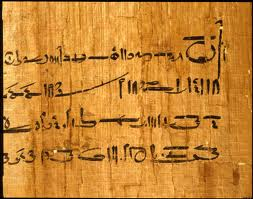
(d) while the general scholarly position thus far has been that the Hebrew script came from the Phoenicians, some have asserted that it was from the ancient Egyptians, who possessed three types of scripts, namely hieroglyphs, hieratic and demotic. Whichever, the ancient Egyptian script doesn't have vowels which the Hebrew Torah (bible) seems to follow, where a striking example would be the Tetragrammaton YVWH.

hieroglyphs

The story has it that when Moses was instructed by his god to see the Pharaoh, he asked who should he say sent him? His god then revealed his name as Yahweh. But the Jews didn't want to take the name of their god in vain, so they refused to say aloud Yahweh, but instead Adonai (Lord). Subsequently when the Jews introduced vowels into their script, they used those from the Adonai word, a, o and again a, in YVWH, giving them Yahowah (Jehovah). The Torah remains vowel-less.


hieratic script


Thus the Hebraic vowel-less script for god sometimes is seen in English as G-D, probably the work of Hebrew wannabes.

demotic script

... which brings us to my post title of B-D.

Okay lah, I am t'ng k'oui (chong hei), meandering like a lazy willow & bamboo-lined Karnafuli* river across the Plains of Chitchat-tagong (no, not the one in Bangladesh), wakakaka.

* polite mispronunciation, wakakaka

Now, what does B-D stand for or tell us?

Firstly, we may assume that the vowel-less letters has god-like qualities because of their resemblance to the Hebraical G-D. Please have a bit of faith here lah, wakakaka;

faith as taught by the church

Secondly, remember that having faith obviates the need for evidence, proof, logic etc, including the truth, wakakaka;

Thirdly, B-D has assumed a disproportionate significance in the politics of Malaysia right at this moment and we should pay heed to it;

Fourthly (the final of our four thingy's), sceptical kaytee as usual wishes to examine the political evangelism that's promoting the new 'god' B-D, wakakaka.

Okay, let's start off with the D of B-D where D, placed second, is more recent that B.

D = Deepak or Deepak Jaikishan, the carpet bagger seller who was once a figure meeting up covertly and furtively with B = Balasubramaniam, and allegedly also doing various 'odd jobs' for Rosmah and Najib, and at times variously Rosmah's toy boy, godson, best friend, confidante, aide, Mr Fix-it, gifts giver, confidential-private majordomo, etc.

READ MORE HERE


Seeing things from the right perspective

Posted: 02 Jan 2013 07:42 PM PST


Actually I know who that third party is but I am not sure whether I should reveal his name. What happens if that person sues me? No one is going to help pay for my legal costs and if I lose the case no one is going to help pay for whatever damages the court awards to the person suing me. So I have to think carefully whether to help Rafizi out by revealing the name of the person. Since Rafizi has the party behind him maybe I should leave it to him to reveal the name of this third party -- although he also appears to be reluctant to do so.

THE CORRIDORS OF POWER

Raja Petra Kamarudin

Over the last few days I have read a few comments calling Rafizi Ramli a liar and accusing him of politicising the Deepak Jaikishan issue. First of all, so what if Rafizi is politicising issues? Is that not what politicians are supposed to do? You mean all those others in Pakatan Rakyat are not also politicising issues? You mean all those Umno and Barisan Nasional people are not also politicising issues?

Accusing Rafizi of politicising issues is so stupid. It is like accusing a fox that is hanging around the chicken run of trying to whack the chickens. That is why God made foxes, to whack chickens. Whacking chickens is in the job specification of foxes. Why else do you think God made foxes? Do you think God made foxes so that sugar daddies can buy a fox fur coat for their mistresses?

Foxes were created so that they can whack chickens. And politicians were created so that they can politicise issues. And all this talk that politicians are the result of anal sex is utter bullshit and very unfair because you cannot get pregnant from anal sex and for sure no one can get born through the arsehole.

Politicians are born just like you and me, the normal way, and politics is a career just like any other career.

In fact, politics allows postmen and railway crossing guards attain career heights that postmen and railway crossing guards could never attain if they did not become politicians. It is like going to America, the land of opportunity. Where else can simple farmers or descendants of slaves become 'big people' if not in America? And if you can't migrate to America to become a 'big person' then you become a politician and get called Yang Berhormat or The Respected One.

We must remember that everything in Malaysia is politicised. Even the Omnipotent, Omniscient, Omnipresent, Omnibenevolent, etc., God is politicised. Even with all that power that God possesses He cannot prevent his name from being politicised. And if the all-powerful God cannot stop his name from being politicised do you think Deepak Jaikishan can prevent his name from being politicised even if he imagines himself as a Sex God?

Now, why do you say that Rafizi Ramli lied? What did he say that makes you come to a conclusion that he lied? Did Rafizi say he was there, say, when Deepak Jaikishan was alleged to have bought RM13 million worth of jewellery for First Lady Rosmah Mansor? Did Rafizi say he personally saw the jewellery and/or held them in his hand?

He never said that. What he said was he has seen the documents and the documents were handed to him by someone he personally knows. He apparently trusts this person and probably has a relationship of sorts with this person. And this person handed him some documents that were supposed to be evidence that Deepak had bought RM13 million worth of jewellery for Rosmah. So, based on this, he held a press conference to reveal the existence of these documents and that these documents are evidence that Deepak had bought RM13 million worth of jewellery for Rosmah.

And the purpose Rafizi held that press conference to reveal the existence of these documents is so that the MACC or PDRM can investigate the matter and find out whether all this is true or false. It could be true or it could be false. But Rafizi would not know whether it is true or false. He can only hold a press conference to reveal the existence of these documents and leave it to the authorities to authenticate the documents and tell us whether the allegations are true or not.

Some of you ask: why hold a press conference? Why not make a police report or sign a Statutory Declaration instead? If you are really sincere about seeing justice done then you should make a police report or sign a Statutory Declaration. Holding a press conference makes it appear like all you want to do is to politicise the issue.

True, a police report or Statutory Declaration would be better than a press conference. A police report or Statutory Declaration looks less political than a press conference. But maybe you have forgotten that back in 1998 Anwar Ibrahim made a police report and he ended up getting arrested and was sent to jail for a long time. Ten years later, in 2008, I signed a Statutory Declaration and I too was arrested and charged for that. I was also detained without trial.

So, do you really think a police report or Statutory Declaration is wise? So far no one has been arrested and sent to jail for holding a press conference. At worse you may be subjected to a civil suit. However, since the press conference is a party press conference, then when you get sued the party will come out with the money to pay for a lawyer to represent you in court.

Can you remember that I was sued by many people -- UUM V.C. Nordin Kardi, Umno lawyer Muhammad Shafee Abdullah, Lt Col Abdul Aziz Buyong and Lt Col Norhayati Hassan, etc. And I was sued because I made allegations against them.

Now I have been declared bankrupt and yet still more civil suits are piling up against me. Has any Malaysian from 28 million Malaysians offered to help me out financially?

When you write bad things about the government or about those who walk in the corridors of power everyone will clap and cheer you on. But when you get sued you have to carry that problem all by yourself. No one from all those people who clapped and cheered you on is going to come forward to volunteer to help you out financially.

I am fortunate that I have some friends who are lawyers who volunteered to help represent me free of charge. In the Nordin Kardi case, however, no one came forward to help me out. So the court awarded him an uncontested win and I now have to pay Nordin Kardi RM2.5 million. But I do not have RM2.5 million and can't pay that amount. So I have to be declared a bankrupt, as I was in the earlier case involving an Umno Minister where the court asked me to pay RM1.3 million.

Actually, it is now no longer worth anything to help me out unless you can afford to pay RM60 million, which is what I have hanging over my head -- and which is increasing every time I lose a case.

Do you know I recently had to pay the government RM215,000 to get my house released? In the end, with tax and legal fees included, I had to pay about RM250,000 or else I would lose my house.

And none of those people who clapped and cheered when I whacked the government came forward to help me settle that RM250,000. So my daughter had to go to the bank to borrow the money to help me out. Luckily I have a daughter who can qualify for a bank loan of RM250,000 or else my house would be gone.

So you face a great risk when you whack the government. No doubt people will clap and cheer when you whack the government. But that is all you receive -- claps and cheers. If you make a police report, sign a Statutory Declaration, or write an article in your Blog, you will get arrested and will get sent to jail. And you not only get arrested but will get sued as well and then will be hit with millions in damages. Hence the safest thing to do would be to do what Rafizi Ramli did -- hold a press conference in the party's name.

So I think you have to be a bit fair with Rafizi. He has no choice but to politicise the issues so that he can get the protection of the party when people sue him. If not Rafizi would end up like me if he does things outside the party. And he did not lie. He never said he was there or that he saw everything. What he said was that he was reliably informed, like what I said on my Statutory Declaration.

And I know it appears like Rafizi has done a U-turn. Yesterday he never said that the information or documents he received came from a third party. But now that Deepak has denied meeting him and/or denied giving him any documents, Rafizi turns around and says that the evidence came from a third party.

Actually I know who that third party is but I am not sure whether I should reveal his name. What happens if that person sues me? No one is going to help pay for my legal costs and if I lose the case no one is going to help pay for whatever damages the court awards to the person suing me. So I have to think carefully whether to help Rafizi out by revealing the name of the person. Since Rafizi has the party behind him maybe I should leave it to him to reveal the name of this third party -- although he also appears to be reluctant to do so.

Maybe Rafizi is worried that if he declares that he was not actually a witness but that the evidence was given to him by a third party then people will accuse him of doing a U-turn. Rafizi knows that that happened to me when I explained during my TV3 interview that I was not a witness but was informed about the matter by a third party. Everyone accused me of doing a U-turn even though I did not. Hence, understandably, Rafizi needs to be very careful here or else he will suffer the same fate that befell me.

Rafizi is not only a product of the Malay College Kuala Kangsar (MCKK). He is also a product of a UK university education. That makes him very clever. Most MCKK cum UK educated people are very clever. And, being very clever, he would most certainly be aware that most Malaysians are not very bright. In fact, some Malaysians -- those not from MCKK and a UK education -- can sometimes be downright stupid. Hence Rafizi has to be very careful with what he says. People will even accuse him of saying what he never said -- unless you are from MCKK and armed with a UK education (then you will not be stupid enough to accuse people of saying what they did not say).

I am sorry if I sound like I am defending Rafizi. Even if I am defending Rafizi so what? Is it a crime to defend someone from your alma mater? Yes, I am defending Rafizi. I do not deny that and I am not apologetic or embarrassed about it. When someone deserves defending then you must defend that person.

And if you are not happy with that then sue me. It is, after all, a free country. Anyone can sue anyone.

Even the Christians are free to sue the government for not allowing them to use the name Allah in the Bahasa Malaysia Bible. And if Pakatan Rakyat comes out with a statement next week also agreeing that Christians should not use the name Allah in the Bahasa Malaysia Bible then the Christians should sue Pakatan Rakyat as well.

But wait first until next week and see what Pakatan Rakyat has to say because they will be meeting only next week to make a decision as to whether Christians can use the name Allah in the Bahasa Malaysia Bible. And if Pakatan Rakyat were to agree with the government that Christians should not use the name Allah in the Bahasa Malaysia Bible only then sue them. But I am confident Pakatan Rakyat will not agree with the government.


Musa Hassan zips lips in latest scorcher on Altantuya murder

Posted: 02 Jan 2013 04:47 PM PST

Amin Iskandar, The Malaysian Insider

Tan Sri Musa Hassan has refused to be drawn into the latest controversy over the 2006 murder of Altantuya Shaariibuu, following the publication of a book claiming the former Inspector-General of Police (IGP) has inside information.

The retired policeman reiterated that Prime Minister Datuk Seri Najib Razak was uninvolved in the explosive case that had been linked to several politicians from the ruling Barsian Nasional (BN) and had resurfaced recently in the run-up to the 13th general election.

"I have nothing to comment," he told The Malaysian Insider when contacted yesterday for a response on allegations he has knowledge of the events surrounding the death of the Mongolian translator, for which two elite police commandos have been convicted and are facing death sentences.

"I have said it many times: Najib is not involved with the murder of Altantuya. This is (Abdul) Razak Baginda's work," he said, referring to the PM's former political advisor who once had an affair with the Mongolian.

"I had briefed Pak Lah that Najib was not involved in this case," Musa said, referring to the then-PM, Tun Abdullah Ahmad Badawi.

A 26-page book titled "The Black Rose ― Black Rose 1.0", which describes the tangled web of high-profile personalities purportedly involved in the murder conspiracy, has been circulating on the Internet over the past few days.

Carpet dealer Deepak Jaikishan, who is at the centre of the controversy surrounding P. Balasubramaniam's conflicting sworn testimonies on the case, yesterday admitted to being the book's author. He also said he will release a sequel.

Balasubramaniam, a former policeman-turned-private investigator who was at that time hired by Abdul Razak Baginda to keep an eye on Altantuya, is seen to be a key witness to the whole saga.

Deepak recently revealed his involvement in getting Balasubramaniam to make the second statutory declaration (SD), reversing an earlier statement linking Najib to Altantuya's murder.

The Bar Council was chided on Tuesday for dragging its feet in investigating the identity of the mystery lawyer behind Balasubramaniam's controversial second SD.

Lawyer Americk Singh Sidhu, who is acting for the former private detective, said that the Bar Council should speed up its inquiry on the high-profile case that had previously been linked to several high-ranking government officials and resurfaced recently in the run-up to the 13th general election.

The Bar Council has said it is investigating the possibility of misconduct in the drafting of Balasubramaniam's second SD, which contradicts his previous sworn statement made just a day earlier over the death of the Mongolian translator.

A cloud of mystery has been hanging over the identity of the lawyer who had drawn up Balasubramaniam's second SD, dated a day after his first on July 3, 2008, regarding the Altantuya murder case.

Last month, Musa accused politicians, including Home Minister Datuk Seri Hishammuddin Hussein, of interfering with police work.


Deepak denies link to documents

Posted: 02 Jan 2013 04:38 PM PST

He said he never met Rafizi and is uncomfortable with the way PKR has exposed the matter using his name to gain political mileage.

(The Sun Daily) - Businessman Deepak Jaikishin has denied that he has anything to do with bank documents produced to the press by PKR strategic director Rafizi Ramli that allegedly incriminates him.

He said he never met Rafizi and is uncomfortable with the way PKR has exposed the matter using his name to gain political mileage.

"The documents... are not my documents. I have never seen the documents. If he (Rafizi) said he got it from an intermediary, then who is he?

"I would like him (Rafizi) to come forward and explain how he got the documents," he told a press conference at a hotel here yesterday.

Deepak also called on PKR de facto chief Datuk Seri Anwar Ibrahim to meet him to discuss the truth and not ask a 'third party' like Rafizi to politicise the matter.

He said he is standing alone in the matter and is 'feeling the heat' following the expose he made recently.

"If the truth matters, I invite Datuk Seri Anwar to come and present the facts of what they really are (with me).

Deepak said he will consult his lawyers to give notice to Rafizi in order to know who disclosed the documents.

In an immediate response, Rafizi told theSun that Deepak's denial is expected.

He said that the documents were circulated by Deepak himself and as a company director he must be aware of the documents which are actually bank statements and receipts of his two companies.

"We can prove that the documents come from Deepak.

"He has to convince the public that the documents are not his. He gave the same documents to several people," he told theSun.

Rafizi said Deepak is 'playing a game' and trying to put the media highlight onto himself for his "expose" which came on the eve of the Umno general assembly last month.


Pakatan plays down Allah issue

Posted: 02 Jan 2013 04:29 PM PST

(The Star) - Pakatan Rakyat leaders have tried to play down the controversial use of the word "Allah" by Christians, with PAS saying that the matter has been closed.

The leaders of the opposition parties have yet to meet to resolve the differing stand on the issue, although Opposition Leader Datuk Seri Anwar Ibrahim had proposed the meeting to resolve the matter.

"There has been no discussion on the matter. We (PAS) feel that it has already been resolved as all that needs to be spoken about it has been spoken," said the Islamist party's secretary-general Datuk Mustafa Ali after attending a Pakatan secretariat meeting here yesterday.

Asked if a decision had been reached by Pakatan partners over the issue, Mustafa replied that he did not want to add anything to the matter.

Controversy over the "Allah" issue cropped up when Penang Chief Minister Lim Guan Eng urged the Federal Government to allow Christians to use the word "Allah" in their Malay version of the Bible in his recent Christmas message.

Lim's message caused an uproar among Muslims, while some Muslim NGOs held protests in front of his office in Komtar, Penang, last month.

PAS also hit out at Lim, stating firmly that the word "Allah" should not be used by Christians to refer to God as it would only lead to confusion for both Muslims and Christians.

On Dec 27, Anwar conceded that an urgent meeting to discuss the matter was needed to resolve the issue although discussions were held by the Pakatan leadership when the controversy surfaced in 2010.

On a separate issue, Mustafa said PAS president Datuk Seri Abdul Hadi Awang would decline the air-time offer by RTM to explain his "Amanat Haji Hadi" if no live coverage was given.


Group demands jewellery expose probe, Rafizi wants to meet Deepak

Posted: 02 Jan 2013 04:03 PM PST

The carpet dealer, however, has denied seeing the jewellery bills but Rafizi claimed today the documents were provided by Deepak himself through a third party linked to PKR

By Boo Su-Lyn and Syed Jaymal Zahiid, The Malaysian Insider

A journalists group wants an investigation of PKR's Rafizi Ramli revelations about carpet dealer Deepak Jaikishan's purported US$4 million (RM12.4 million) jewellery purchases for dignitaries although the controversial businessman has denied the documents.

In turn, Rafizi is willing to meet the carpet dealer about the documents which were handed over to the PKR strategy director through a third party.

"The Young Journalists Club of Malaysia (KWMM) is very worried about the trend of the federal opposition exposing private and confidential documents, whether owned by individuals or the government, for insidious purposes," club president Dzulkarnain Taib said in a statement today.

"KWMM takes the irresponsible behaviour of an opposition leader like Rafizi (picture) very seriously, who has made baseless assumptions and allegations without strong evidence. This was done merely for political purposes and to get more votes, since the 13th general election will be held soon," he added, using the club's Bahasa Malaysia acronym.

Rafizi was charged last August with violating the Banking and Financial Institutions Act (BAFIA) for allegedly exposing confidential banking details of NFCorp.

The NFCorp runs the National Feedlot Centre (NFC), a RM250 million federal-funded cattle-farming project that has been at the centre of a major national scandal.

Yesterday, Rafizi provided the media copies of transaction records, including one for a US$115,000 purchase of polished diamonds from Dehres Ltd, a fine jewellery supplier from Hong Kong.

Another document detailed transactions worth US$3.9 million involving the purchases of rings, necklaces and earrings from Firestone Co Ltd, another Hong Kong-based fine jewellery supplier.

Rafizi has said that Deepak was acting as a jewellery middleman for a local dignitary.

The carpet dealer, however, has denied seeing the jewellery bills.

Deepak also accused Rafizi of making the exposé for political mileage.

But Rafizi claimed today the documents were provided by Deepak himself through a third party linked to PKR and suggested that the carpet dealer's outburst yesterday was caused by the party's initial refusal to "champion" the issue.

READ MORE HERE


Dr M: Beware the one who hoodwinks

Posted: 02 Jan 2013 03:53 PM PST

The former premier warns Malaysians not to fall prey to Anwar Ibrahim as he once had in the past.

RK Anand, FMT

More than a decade ago, he was considered the protege of and heir apparent to Dr Mahathir Mohamad. But in 1998, the ties turned sour. And the rest, as they say, is history.

In his latest blog posting, Mahathir claimed that he was once hoodwinked by the religious piety of Anwar Ibrahim and warned Malaysians not to fall prey as well.

Now as his nemesis leads the opposition charge for the coming general election, where for the first time in more than five decades a change of government was considered possible, the former premier once again issued a dire warning.

Targeting Anwar, he pointed out that the former deputy premier had not brought about positive changes during his tenure with the government.

"Now as leader of the opposition, he is claiming to bring about changes. What good change did he introduce when he was in the government?

"All he was interested in was getting up the leadership ladder of Umno in order to become prime minister. How he achieved his objective does not bear scrutiny," he added.

Recalling the 1997-1998 financial crisis, Mahathir said Anwar, who was also finance minister then, had attempted the International Monetary Fund (IMF) solution without IMF loans.

"Banks and companies were faced with the threat of bankruptcy from non-performing loans. Imports cost more. Cost of living shot up.

"The track record of the minister of finance then was bad although there is a fondness of claiming success brought about by others as his success. PNB, UIA and Islamic banking were part of the claim," he added.

Pakatan aping Obama

Mahathir warned Malaysians that experimenting with change and placing federal power in the hands of Anwar and PAS president Abdul Hadi Awang-led government would be perilous.

"Many things can be destroyed in five years. We have some experience of this," he said, alluding to his handpicked successor Abdullah Ahmad Badawi, whose one term in power witnessed the opposition making significant gains in the 2008 polls.

"Besides, the opposition as government will ensure that there will be no return for BN [Barisan Nasional]. Officers in the government will be used to 'gempar' [threaten] whoever tries to change the government. We know this has happened before," he said.

"Already we see this person who claims to fight for free speech suing and resorting to the courts to shut the mouths of his critics. Other powers of the government will be similarly abused. Nepotism and cronyism will be employed as indeed they are in the party he now heads.

"The record is there. Malaysians must not allow themselves to be hoodwinked as I was hoodwinked by the appearance of religious piety in the past," he added.

Mahathir also accused Pakatan Rakyat of aping US President Barack Obama in terms of making unkept promises of change in the run-up to the elections.

"Making promises during campaigns for elections is easy. Keeping them is a different matter. The best hope is that people's memory is short. They will normally forget the promises.

"Give them a chance, they [Pakatan] say. BN has ruled this country for 55 years. It is time to change. They will change this into a welfare state. Everything will be free. No fees for education, no tolls, large subsidy for petrol, 20% royalty to oil-producing states etc..etc," he said.

READ MORE HERE


Pakatan to decide on ‘Allah’ issue next week

Posted: 02 Jan 2013 03:34 PM PST

Anwar says the matter would be deliberated at the opposition pact's leadership council meeting scheduled for next Tuesday.

G Vinod, FMT

The Pakatan Rakyat leadership will be holding a meeting on Jan 8 to deliberate on use of the word "Allah" to represent God in Malay language Bibles, said PKR supremo Anwar Ibrahim.

"We have will be holding our leadership council meeting next week and I believe the matter will be raised. We will discuss this," said the former deputy prime minister.

Last month, DAP secretary-general Lim Guan Eng urged the government to allow Christians to use the word "Allah", to address God in the Malay language Bibles.

However, his suggestion drew criticism from several Muslim-based NGOs which cautioned Lim not to provoke the Muslims.

Lim was also rebuked by his ally within Pakatan when PAS information chief Tuan Ibrahim Tuan Man said that non-Muslims should abstain from using the word Allah in their holy books as reference to God.

Meeting with Bank Negara confirmed

Touching on the Global Financial Integrity report (GFI), Anwar said that Bank Negara had agreed to meet him to discuss the latest report by the financial watchdog on the illicit outflow of funds from Malaysia.

"We have proposed to meet on Jan 17, which they have tentatively agreed. They promised to get back to us," said Anwar.

The US-based financial watchdog reported that Malaysia ranked number two in terms of illicit outflow of funds in 2010, ranking second to China.

The report indicated that Malaysia lost RM200 billion in that year alone. Between 2001 and 2010, Malaysia lost about RM871 billion in capital outflow.

Describing it as "alarming", Anwar had since offered to meet Bank Negara governor Zeti Akhtar Aziz to offer solution to the matter.

READ MORE HERE


Musa: IGP, top brass avoided me

Posted: 02 Jan 2013 03:30 PM PST

The ex-top cop defends his open criticism of the police force, saying that he had reached a dead end when trying to engage with the top brass and his successor the inspector general of police. 

Anisah Shukry and Teoh El Sen, FMT

Each time Musa Hassan approached his successor Inspector General of Police (IGP) Ismail Omar, the latter would "walk away" from him, making all communication between the two impossible, the ex-IGP said.

"I don't have the chance to talk to [Ismail] because whenever we meet even in public, he just walks away from me," said Musa in a recent interview with FMT.

"I don't know [why]. Maybe they think I am no longer relevant," he said.

Musa said this when asked if he had raised the issue of criminal elements and political interference in the police force with the IGP before announcing it to the public.

Musa had dropped the bombshell two months ago during a press conference with crime watchdog MyWatch, which coincided with the opening of the Umno general assembly.

His timing, as well as his new role as the patron of the NGO lead by PKR members, had led many to grill him on his motives.

While the question on most people's lips is "why now?" (Musa's reply: the timing was a coincidence), others have expressed disgust at what they perceive as efforts that could destroy the police force's credibility.

Musa's rival, former top cop Ramli Yusuff had slammed him for turning to the media instead of discussing the issues with Ismail in private.

"You don't have to say these kind of things in the open. These are internal matters. Musa could have discussed it discreetly with Ismail, meet up with him, tell him nicely," the former commercial crimes investigation department (CCID) chief had told FMT last month.

But Musa told FMT that not only did Ismail deliberately avoid him, but the top brass also refused to speak with him on the matter.

"I have spoken to some police officers. But of course they are lower rung, they can't do anything about it. But the bosses, they refuse to talk to me," claimed Musa.

When asked whether the current leadership of the police was open to discussing such issues head-on in a transparent manner, he said: "I don't think so."

"I see Ismail [as] only a ceremonial IGP. He would only attend ceremonies," Musa remarked.

Encouraging transparency

He also dismissed claims by his detractors that his bombshells would destroy the credibility of the men in blue.

Instead, Musa said, open criticism of the police force would encourage transparency and enhance its credibility.

"I don't think so, [that making claims publicly would erode confidence in the institution]. You have to be open about this…

"If you keep quiet and keep things this way… there will always be the perception of the public that you are not doing anything," Musa pointed out.

"[Then] it would erode the credibility of the police and also the confidence of the people [towards the police]."

'People still want me to be involved'

Ramli had also criticised Musa, now technically a civilian after having retired in 2010, for "disturbing" the police with his allegations.

"When you have retired, your days are over. You don't disturb. Your successors have their own way of doing things. You are gone, so why do you want to disturb?" Ramli had said.

But Musa told FMT that he still received text messages and even visits from people asking for his help in matters related to crime.

He said that when people contacted him for advice or help, it meant that they still wanted him to be involved in crime-fighting.

"The question mark is why people still give information to me even though I am retired, when they can give it straight to the police officer?

"That's why I feel sometimes that something is wrong here. Why should people trust me? They should trust the police because I am already retired," stressed Musa.

He said that despite being a civilian, he could not bring himself to deny them help as they would come to his house asking for advice.

READ MORE HERE


‘Jewellery documents are from Deepak’

Posted: 02 Jan 2013 03:25 PM PST

The PKR leader claims that the documents showing purchases of expensive jewellery supposedly for Rosmah Mansor came from Deepak himself, through a third party.

G Vinod, FMT

PKR has claimed that the documents implicating businessman Deepak Jaikishan in the purchase of expensive jewellery was from the latter himself.

"Few months back, Deepak himself gave the documents to some PKR leaders. The documents were later handed to me for further deliberation," said party strategic director Rafizi Ramli today.

Yesterday, Rafizi produced several documents claiming that two carpet companies linked to Deepak had purchased 19 types of jewellery worth about RM13 million in 2009.

The jewellery was said to be purchased on behalf of Prime Minister Najib Tun Razak's wife, Rosmah Mansor.

Deepak, however, was not pleased with Rafizi's exposé and said that the documents were not his.

"I've never seen the documents Rafizi is producing. Those are not my documents. He has to come forward and tell us where he got these documents from," Deepak was reported as saying.

However, the businessman did not rebut the allegations made by Rafizi, saying he would seek legal advice on the matter.

Rafizi said that while Deepak could claim what he wanted, the latter should however explain why his company purchased the jewellery.

"If he believes the documents produced are forged, I urge Deepak to lodge a report with the authorities," he added.

However, Rafizi insisted that the documents came from Deepak and PKR leaders would lodge a report with the police and the MACC on the matter on Monday.

"I will cooperate with the authorities on the matter. In fact, the individual who received the documents from Deepak has agreed to vouch that he received it from the businessman," he said.

Rafizi also explained why he did not pursue the matter earlier, saying that at that point of time, it was not a matter of public interest.

"But when the government announced that RM160 million from Lembaga Tabung Angkatan Tentera (LTAT) would be used to purchase Deepak's company and a land belonging to Awan Megah Sdn Bhd, the whole situation changed," he said.

READ MORE HERE


Kredit: www.malaysia-today.net

Malaysia Today - Your Source of Independent News

0 ulasan
Klik GAMBAR Dibawah Untuk Lebih Info
Sumber Asal Berita :-

Malaysia Today - Your Source of Independent News


Ex-IGP thinks his exposés will bear fruit

Posted: 01 Jan 2013 05:11 PM PST

MyWatch patron Musa Hassan is optimistic that the police force will eventually improve.

Anisah Shukry and Teoh El Sen, FMT

VIDEO INSIDE

Former Inspector-General of Police Musa Hassan has come under attack from several quarters for his recent revelations about corruption in the force, political interference in its work, and criminal elements infiltrating it at the highest levels.

The government has ignored his allegations, and his successor, Ismail Omar, has dismissed his claims as "unimportant".

However, the patron of anti-crime watchdog MyWatch said he remained optimistic that his exposes, which he claimed were aimed at improving the police force, would bear fruit.

"You shouldn't be downhearted when people don't want to listen," he told FMT in an exclusive interview. "We still have to tell the truth."

Musa spoke well of Ismail's deputy, Khalid Abu Bakar, calling him a "capable leader". But he dismissed a suggestion that he was ganging up with Khalid to overthrow Ismail.

When asked whether there had been attempts by the Prime Minister Najib Tun Razak or Opposition Leader Anwar Ibrahim to meet him, Musa said no political leaders had met him.

In a new year message to Malaysians, Musa said: "I hope this country will prosper, and there won't be any political problems. I hope the police will improve themselves. People are now more aware of integrity. That's a good sign. All agencies should be of high integrity, and avoid themselves from being corrupted, that's the wishes of the people, and that's my wish also."

MyWatch chairman R Sri Sanjeevan, who was with Musa during the interview, said the organisation's objective was to make Malaysia crime-free society, adding that this required good leadership in the police force.

Excerpts from the interview

READ MORE HERE


For BN and PR, fresh candidates a must in Election 2013

Posted: 31 Dec 2012 05:17 PM PST

New voters make up one in five among Malaysia 13.1 million registered voters, with a total of 2.9 million registering between this year and 2008, when the last general election was held. This new breed of voters, armed with free access to information through the Internet and social media, will most likely be more demanding of the MPs who can relate to them through forward-thinking policies and not rely on the old politics playbook.

Zurairi AR, The Malaysian Insider

Both Barisan Nasional (BN) and Pakatan Rakyat (PR) need to present fresh faces in their lineup of candidates for this year's general election in order to attract the rising number of new voters, say political analysts.

They agreed with arguments for both coalitions to drop veteran politicians who are waning in popularity and carrying with them political baggage, or risk a backlash from voters who are tired of underperforming and scandal-ridden MPs.

"It is a must for BN that they present a new line of candidates to replace the old ones who should have retired. If not it will stop the public from giving their support," said Universiti Putra Malaysia (UPM) political scientist Professor Dr Jayum Jawan.

"For BN, the focus naturally will be on the states which are currently ruled by PR. We will see a lot of changes (in candidates) there, especially in Selangor and Penang," offered Asri Salleh, political science lecturer at Universiti Teknologi Mara (UiTM) Terengganu.

New voters make up one in five among Malaysia 13.1 million registered voters, with a total of 2.9 million registering between this year and 2008, when the last general election was held. 

This new breed of voters, armed with free access to information through the Internet and social media, will most likely be more demanding of the MPs who can relate to them through forward-thinking policies and not rely on the old politics playbook.

Both Asri and Jayum also agreed that unlike BN, PR's list of candidates will need to be shuffled for the next polls because most of those who contested in 2008 were parachute candidates brought in from out of their constituencies.

Asri gave the example of PKR's Balik Pulau MP Yusmadi Yusoff, who he claimed was one of the many idealists fielded by PR who had failed to warm up to the locals.

"The eyes of the public have been opened ... national issues, although still a big part, can no longer guarantee a party's win. Candidates play a more important factor," said Dr Azizuddin Mohd Sani, a political analyst from Universiti Utara Malaysia (UUM).

Azizuddin pointed to the concept of "winnable candidates" which is constantly on the lips of BN leaders lately, signalling that candidates are now more prized for their ability to win seats rather than for their seniority and political clout.

He gave the example of former MCA president Datuk Seri Ong Tee Keat, who he claimed is loved by his Pandan constituents but not by his party's leadership, which will present a dilemma to the party in Election 2013.

Recently, Malaysian Anti-Corruption Commission (MACC) Consultation and Corruption Prevention Panel chief Datuk Johan Jaafar had proposed that election candidates be vetted by the agency to ensure that they are "clean" from corruption.

With Prime Minister Datuk Seri Najib Razak throwing his backing behind the suggestion, many now feel that being cleared by the MACC will boost a candidate's winning chance.

Therefore, Jayum urged BN to drop its veteran politicians, pointing out that they carry a lot of political baggage and will be under the scrutiny of the MACC, causing concern for members of the coalition.

"If they are not dropped, they will be liabilities for BN. If Najib is brave, he will replace them with new faces," Jayum said.

However, Azizuddin and Asri disagreed, saying said that it will be hard to unseat veteran lawmakers who will still be kept by the coalitions, especially BN, since they carry with them immense political influence and support.

"When these old politicans are dropped, they themselves will lose their influence," Jayum said, urging Najib to not fear sabotage if the old names are not picked to contest.

BN leaders contacted by The Malaysian Insider could not disclose the number of fresh faces who will contest in Election 2013, but promised that there will be new names in the candidates list which is currently being vetted by BN chairman Najib.

"In every election there must be new faces," said MCA president Datuk Seri Dr Chua Soi Lek.

READ MORE HERE


Umno looks to penetrate Permatang Pauh

Posted: 29 Dec 2012 05:07 PM PST

Party insiders say Najib may opt for a more credible candidate with strong oratory skills and sound financial background.

Athi Shankar, FMT

PENANG: Local Umno is quietly confident of penetrating into PKR's virtually impregnable Permatang Pauh parliamentary fortress in the forthcoming 13th general election.

Confidence is said to be running high among Permatang Pauh Umno leaders that they can re-capture the constituency's Penanti and Permatang Pasir, and retain Seberang Jaya state seats.

Permatang Pauh Umno leaders also believe that this time they have an outside chance to upset incumbent MP and the Malay heartland "tribal king" Anwar Ibrahim, the Opposition Leader.

But observers believe Umno must apply the right candidacy jigsaw if the party is to realise its dream.

Sources said currently the division chairman and former Penanti assemblyman Abdul Jalil Abdul Majid had been earmarked to challenge Permatang Pauh favourite son Anwar for federal duel.

In Permatang Pasir, a PAS seat since 1999 general election, Umno is expected to field its constituency coordinator and division vice chairman Rahim Man.

Barisan Nasional's constituency coordinator and division committee member Ibrahim Ahmad has been listed for Penanti.

In Seberang Jaya, incumbent assemblyman Arif Shah Omar Shah, who won by a mere 553-majority largely thanks to postal votes against PKR's Rahim Bulat in 2008, is the choice.

However political observers and local leaders from BN component parties believe that the Umno division deputy chief and local corporate figure Mohammad Nasir Abdullah should be included in the candidature list.

Grassroots leader Mohammad Nasir was overlooked for 2008 general election and subsequent by-elections in Permatang Pauh, Permatang Pasir and Penanti.

Insiders said this was largely due to Abdul Jalil uneasiness with Nasir's political presence.

Seberang Jaya Umno branch chief Nasir rose from rank and file in the division, from being an ordinary member when Anwar was then its chief, to youth chief, then vice chairman and now deputy chief.

Observers said Jalil sensed that his position would face grave danger if Nasir, who has strong grassroots support among Permatang Pauh 17,000 Umno members from 95 branches, were to win a seat in general election.

They said that Jalil knew that Nasir, who has no political baggage, can topple him in the next party election.

Good ground support

A random survey showed many Umno branches, particularly among 44 branches in Seberang Jaya constituency, and BN local leaders backed Nasir as an election candidate.

Many want local boy Nasir (photo), who operates a Petronas petrol station in the constituency, to replace Arif Shah, in Seberang Jaya.

But Arif Shah is not expected to give up his seat with a strong fight.

After all if BN were to regain Penang, he stands a strong chance to become a deputy chief minister.

Seberang Jaya has 29,397 voters with Malays 18,882, Chinese 6,677 and Indians 3,682. In 2008, the constituency had 22,678 voters.

Postal votes in Seberang Jaya have also leapt drastically from 405 in March 2008 to 1,200 in mid-2012.

Insiders said it was time to replace Arif Shah with Nasir as the former had been a two-term assemblyman.

Recent vernacular press reports revealed Arif Shah, who speaks fluent Mandarin, would not be able to muster enough Chinese votes, a decisive factor to retain Seberang Jaya.

Local observers believe a fresh local born candidate like Nasir would be an ideal winnable replacement.

Grassroots sentiments are that Arif should be moved to Permatang Pasir which has 22,733 voters with Malays 16,643, Chinese 5,691 and Indians 363. In 2008, the constituency had 20,350 voters.

They feel Rahim would be a better candidate in Penanti, which now has 18,537 registered voters with Malays making up 13,194, Chinese 4,124 and Indians 390. In 2008, the constituency had 15,421 voters.

They said Arif Shah would be an ideal candidate in Permatang Pasir and Rahim had stronger grassroots backing Penanti.

Party grassroots want Umno president and Prime Minister Najib Abdul Razak to give a strong consideration to their sentiments.

"This would give Umno a winnable electoral jigsaw," they said.

In the August 2008 parliamentary by-election, Anwar defeated Arif Shah by 15,671-majority to mark his national political comeback after 10 years absence.

Strangely though, as of June 2012, Permatang Pauh now has 70,667 registered voters, a huge leap by 12,208 votes within four years from 58,459 voters in 2008.

READ MORE HERE


Dubious backers of regime change

Posted: 29 Dec 2012 02:04 PM PST

AS Malaysia prepares for a general election, distrust of the political opposition and accusations of foreign interference have been major talking points in the political frequencies emanating from Kuala Lumpur.

Premesh Chandran, the chief executive officer of the nation's most prominent alternative media outlet, Malaysiakini, is a grantee of Soros' Open Society Foundations and launched the news organisation with a US$100,000 (RM300,000) grant from the Bangkok-based Southeast Asian Press Alliance, another organisation with dubious affiliations to the US State Department.

Nile Bowie, RT 

Umno leads the ruling coalition, Barisan Nasional, and has maintained power since independence in 1957.

One of Malaysia's most recognisable figures is former prime minister Tun Dr Mahathir Mohamad, who has been credited with ushering in large-scale economic growth and overseeing the nation's transition from an exporter of palm oil, tin and other raw materials, into an industrialised economy that manufactures cars and electronic goods.

The opposition coalition, Pakatan Rakyat, is headed by Datuk Seri Anwar Ibrahim, who once held the post of deputy prime minister in Dr Mahathir's administration, but was sacked over major disagreements on how to steer the economy during the 1997 Asian financial crisis.

Today, the political climate in Malaysia is highly polarised. Malaysia's current leader, Prime Minister Datuk Seri Najib Razak, has pursued a reform-minded agenda by repealing authoritarian legislation of the past and dramatically loosening controls on expression and political pluralism.

Najib has rolled back the Internal Security Act, which allowed for indefinite detention without trial, and has liberalised rules regarding the publication of books and newspapers. During Malaysia's 2008 general election, the Barisan Nasional coalition experienced its worst result in decades, with Pakatan Rakyat winning 82 parliamentary seats.

For the first time, the ruling party was deprived of its two-thirds parliamentary majority, which is required to pass amendments to the Federal Constitution.

In the run up to elections scheduled to take place before an April next year deadline, figures from all sides of the political spectrum are asking questions about the opposition's links to foreign funders in Washington.

Dr Mahathir has long captured the ire of officials from Washington and Tel Aviv, and though he's retired, he has channelled his energies into the Perdana Global Peace Foundation, which recently hosted an international conference in Kuala Lumpur calling for a new investigation into the events of 9/11 and has sought to investigate war crimes committed in Gaza, Iraq and Afghanistan.

Dr Mahathir has been an ardent critic of Israel and organisations, such as AIPAC, and has recently accused US-based organisations, the National Endowment for Democracy (NED) and the Open Society Institute (OSI), of holding a concealed intention to influence Malaysia's domestic politics through the funding of local non-govrnmental organisations (NGOs) and groups directly linked to Anwar's Pakatan Rakyat coalition.

In an article the former prime minister published in the New Straits Times, a leading mainstream newspaper, Dr Mahathir accuses financier George Soros and his organisation, OSI, of "promoting democracy" in eastern Europe to pave the way for colonisation by global finance capital. Dr Mahathir acknowledges how OSI pumped millions into opposition movements and independent media in Hungary, Ukraine and Georgia under the guise of strengthening civil society, only to have like-minded individuals nominated by Soros' own foundation come to power in those countries.

The former prime minister has also pointed to how Egypt (prior to Mohamad Morsi taking power) had cracked down on NGOs affiliated with NED, namely groups such as the National Democratic Institute, the International Republican Institute (IRI) and Freedom House, which are all recipients of funding from the US State Department.

In Malaysia, high-profile NGOs and media outlets have admittedly received funding from OSI and satellite organisations of NED.

Premesh Chandran, the chief executive officer of the nation's most prominent alternative media outlet, Malaysiakini, is a grantee of Soros' Open Society Foundations and launched the news organisation with a US$100,000 (RM300,000) grant from the Bangkok-based Southeast Asian Press Alliance, another organisation with dubious affiliations to the US State Department.

Malaysiakini has come under pressure from local journalists for the lack of transparency in its financial management and hesitance in revealing the value of its shares. Additionally, Suaram, an NGO promoting human rights, has borne heavy criticism over its funding and organisational structure. The Companies Commission of Malaysia launched investigations into Suara Inisiatif Sdn Bhd, a private company linked to Suaram, and found it to be a conduit for money being used to channel funds from NED.

The German embassy in Kuala Lumpur had reportedly admitted that it has provided funds to Suaram's project in 2010. Foreign Affairs Minister Datuk Seri Anifah Aman followed by making strong statements to the German ambassador and declared that Germany's actions could be viewed as interference in the domestic affairs of a sovereign state.

Since 2007, Bersih, an association of NGOs calling itself the Coalition for Clean and Fair Elections, staged three street protests in which thousands of yellow-clad demonstrators took to the streets in Kuala Lumpur demanding electoral reform. After coming under heavy scrutiny for obfuscating funding sources, Bersih coalition leader Datuk Ambiga Sreenevasan admitted that her organisation receives funding from the National Democratic Institute and OSI.

Ambiga herself has been the recipient of the US State Department's Award for International Women of Courage, and was present in Washington in 2009 to receive the award directly from the hands of Michelle Obama and Secretary of State Hillary Clinton.

While  Ambiga's organisation claimed to be non-partisan and apolitical, members of  the political opposition openly endorsed the movement, and some were even present at the demonstrations.

While a large percentage of urbanites with legitimate grievances are quick to acknowledge the government's shortcomings, many are hesitant to back Anwar because of his connections with neo-conservative thinkers in Washington and general disunity within the opposition. Anwar maintains close ties with senior American officials and organisations such as NED. In 2005, Anwar chaired the Washington-based Foundation for the Future, established and funded by the US Department of State at the behest of Elizabeth Cheney, the daughter of then vice-president Dick Cheney, thanks in large part to his cozy relationship with Paul Wolfowitz.

While Anwar was on trial for allegedly engaging in sodomy with a male aide (of which he was acquitted some time later), Wolfowitz and former US vice-president Al Gore authored a joint opinion piece in the Wall Street Journal in support of Anwar, while the Washington Post published an editorial calling for consequences that would affect Malaysia's relations with Washington if Anwar was to be found guilty. Anwar enraged many when he stated that he would support policy to protect the security of Israel in an interview with the Wall Street Journal; this is particularly controversial in Malaysia, where support for Palestine is largely unanimous.

Malaysian political scientist Dr Chandra Muzaffar writes: "It is obvious that by acknowledging the primacy of Israeli security, Anwar was sending a clear message to the deep state and to Tel Aviv and Washington that he is someone that they could trust. In contrast, the Najib government, in spite of its attempts to get closer to Washington, remains critical of Israeli aggression and intransigence. Najib has described the Israeli government as a 'serial killer' and a 'gangster'".

Members of BN have addressed Anwar's connections to NED in Parliament, including his participation in NED's "Democracy Award" event held in Washington in 2007. Independent journalists have uncovered letters written by Anwar, two of which were sent to NED president Carl Gershman in Washington that discussed sending an international election observer team to Malaysia and general issues related to electoral reform.

A third letter was sent to  Soros, expressing interest in collaborating with an accountability firm headed by Anwar. Pakatan Rakyat's communications director Nik Nazmi Nik Ahmad verified the authenticity of the documents. This should come as little surprise as Anwar's  economic policies have historically aligned with institutions such as the International Monetary Fund and World Bank, in contrast to Dr Mahathir, whose protectionist economic policies opposed international financial institutions and allowed Malaysia to navigate and largely resurface from the 1997 Asian financial crisis unscathed.

An issue that concerns secular and non-Muslim voters is the role of Pas as part of the opposition. In sharp contrast to the moderate brand of Islam preached by Umno, the organisation's primary objective is the founding of an Islamic state.

Pas has spoken of working within the framework of Malaysia's parliamentary democracy, but holds steadfast to implementing syariah on a national scale, which would lead to confusing implications for Malaysia's sizeable non-Muslim population. The debate around the implementation of hudud is something that other Pakatan Rakyat coalition members, such as figures in the Democratic Action Party, have been unable to agree on.

Pas  enjoys support from rural Malay Muslims in states such as Kedah, Kelantan and Terengganu, though  it has limited appeal to urbanites. While certain individuals in Pas have raised questions about NGOs receiving foreign funding, Dr Mahathir has insinuated that Pas' leadership has been largely complicit: "They (foreign interests) want to topple the government through the demonstration and Nik Aziz (the spiritual leader of Pas) said it is permissible to bring down the government in this manner. They want to make Malaysia like Egypt, Tunisia, which were brought down through riots and now Syria. When the government does not fall, they (Pakatan Rakyat) can appeal to the foreign power to help and bring down, even if it means using firepower."

It must be acknowledged that the current administration led by Najib  has made great strides towards improving relations with Washington. At a meeting with President Barack Obama in 2010, Najib offered Malaysia's assistance to cooperate with the United States to engage the Muslim world; Najib also expressed willingness to deploy Malaysian aid personnel to Afghanistan, and allegedly agreed on the need to maintain a unified front on Iran's nuclear programme.

Najib has employed a Washington-based public relations firm, Apco, to improve Malaysia's image in the US and has embraced American economic leadership of the region through his support for the Trans-Pacific Partnership trade agreement. Some would argue that Najib is perhaps the most pro-American leader Malaysia has ever had.

Despite Najib having good rapport with formal Western leaders, it is clear with whom the think-tank policy architects, Zionist lobbies, and foundation fellows have placed their loyalties.

Sentiment among Malaysia's youth and "pro-democracy" activists, who constitute a small but vocal minority, tend to be entirely dismissive of the "regime change" narrative, viewing it as pre-election diversionary rhetoric of the ruling party. While bogeymen of the Zionist variety are often invoked in Malaysian political discourse, it would be negligent to ignore the effects of Washington-sponsored "democracy promotion" in the global context, which have in recent times cloaked mercenary elements and insurgents in the colours of freedom fighting, and successfully masked geopolitical restructuring and the ushering in of neo-liberal capitalism with the hip and fashionable vigour of "people power" coups.

As the United States continues to increase its military presence in the Pacific region in line with its strategic policy shift to East Asia, policymakers in Washington would like to see compliant heads of state who will act to further American interests in the Asean region.

Let's not ignore the elephant in the room; the real purpose of America's resurgence of interest in the Asean bloc is to fortify the region as a counterweight against Beijing.

The defence ministries of Malaysia and China held a landmark defence and security consultation in September, in addition to frequent bilateral state visits and enhanced economic cooperation. It was Najib's father, second prime minister Tun Abdul Razak, who made the landmark visit to Beijing to normalise relations in 1974, and under his son Najib, Sino-Malaysian relations and cooperation have never been better.

Following the global economic crisis of 2008, Najib looked to Beijing to revive Malaysia's export-oriented economy, emphasising increased Chinese investment in Malaysia and expanding the base of Sino-Malaysian trade in areas like education and student exchange, finance, infrastructure development, science and technology, yielding lucrative and mutually beneficial results. In asking the question of regime change in Malaysia, Chandra reflects on Washington's moves to bolster its military muscle and dominance over the Asia-Pacific region:

"Establishing a military base in Darwin (Australia), resurrecting the US' military alliance with the Philippines, coaxing Japan to play a more overt military role in the region, instigating Vietnam to confront China over the Spratly Islands, and encouraging India to counterbalance Chinese power, are all part and parcel of the larger US agenda of encircling and containing China.

"In pursuing this agenda, the US wants reliable allies -- not just friends -- in Asia. In this regard, Malaysia is important because of its position as a littoral state with sovereign rights over the Straits of Malacca, which is one of China's most critical supply routes that transports much of the oil and other materials vital for its economic development.

"Will the containment of China lead to a situation where the hegemon, determined to perpetuate its dominant power, seek to exercise control over the straits in order to curb China's ascendancy? Would a trusted ally in Kuala Lumpur facilitate such control? The current Malaysian leadership does not fit the bill."

Pakatan Rakyat has yet to offer a fully coherent organisational programme, and if the coalition ever came to power, the disunity of its component parties and their inability to agree on fundamental policies would be enough to conjure angrier, disenchanted youth back on to the streets, in larger numbers perhaps.

What is ticklishly ironic about reading op-eds penned by the likes of Wolfowitz and Gore, and how they laud Malaysia as a progressive and moderate model Islamic state, is that they concurrently demonise its leadership and dismiss them as authoritarian thugs.

Surely, the ruling coalition has its shortcomings; the politicisation of race and religion, noted cases of corrupt officials squandering funds, etc -- but far too few, especially those of the middle-class who benefit most from energy subsidies, acknowledge the tremendous economic growth achieved under the current leadership and the success of  its populist policies.

Najib has acknowledged the need for broad reforms of Malaysia's state-owned enterprises over concerns that crony capitalism may deter foreign investment; this should be rolled out concurrently with programmes to foster more local entrepreneurship. To put it bluntly, the opposition lacks confidence from the business community and foreign investors; even the likes of JP Morgan have issued statements of concern over an opposition win.

It should be noted that if Islamists ever wielded greater influence in Malaysia under an opposition coalition, one could imagine a sizeable exodus of non-Muslim minorities and a subsequent flight of foreign capital, putting the nation's economy in a fragile and fractured state. And yet, the US has poured millions into "democracy promotion" efforts to strengthen the influence of NGOs that distort realities and cast doubt over the government's ability to be a coherent actor.

Malaysia does not have the kind of instability that warrants overt external intervention; backing regime-change efforts may only go so far as supporting dissidents and groups affiliated with Anwar.

According to Ambiga, Malaysia's electoral process is so restrictive that a mass movement like Bersih is required to purge the system of its backwardness. These are curious statements, considering that the opposition gained control of four out of 13 states in 2008, including Selangor, a key economic state with the highest gross domestic product and most developed infrastructure.

In response, Najib has adhered to Bersih's demands and has called for electoral reform, forming a parliamentary select committee comprising members from both Pakatan Rakyat and Barisan Nasional.

As elections loom, Ambiga is already dubbing them "the dirtiest elections ever seen" -- unsurprising rhetoric from a woman being handed her talking points by the US embassy.


For BN, a balancing act between voters and warlords

Posted: 28 Dec 2012 04:37 PM PST

Clara Chooi, The Malaysian Insider

The Barisan Nasional's (BN) inability to nail down a final list of candidates and the need to strike a delicate balance between pleasing voters and not sidelining its political warlords has been cited as reasons for the delay in calling elections, Singapore's Straits Times newspaper reported today.

Prime Minister Datuk Seri Najib Razak has continued to keep Malaysians guessing over the date of the polls even though several dates have been bandied about in the media over the past year.

The Umno president and BN chairman has also refused to release BN's candidates list for the polls, despite several calls from grassroots leaders to do so, noting that keeping the list under wraps is a "strategic" decision.

Quoting political analyst Oh Ei Sun today, Singapore's ST reported that although the federal opposition pact Pakatan Rakyat (PR) is in itself entangled in a tussle over seats, the problem of selecting the best contestants is worse for BN than for its political foes.

Oh said that PKR and DAP lack a strong grassroots system that would allow a party leader to mobilise an efficient election machinery that would prevent sabotage of a candidate.

"In Umno, however, the system of patronage means a lot of people owe their livelihoods to certain leaders and warlords. The potential and ability to sabotage candidates are much stronger," the analyst was quoted as saying.

Sabotage has been highlighted as among one of Umno's greatest fears going into the 13th general election.

During the party's last two general assemblies, this was the strongest message that Najib sent to the party's over three million members.

He repeatedly reminded members to accept the candidates selected by the BN leadership, even if they are not chosen, and urged them to work with their respective parties to ensure the candidate wins the polls for BN.

READ MORE HERE


Kredit: www.malaysia-today.net

Malaysia Today - Your Source of Independent News

0 ulasan
Klik GAMBAR Dibawah Untuk Lebih Info
Sumber Asal Berita :-

Malaysia Today - Your Source of Independent News


Musa Hassan zips lips in latest scorcher on Altantuya murder

Posted: 02 Jan 2013 04:47 PM PST

Amin Iskandar, The Malaysian Insider

Tan Sri Musa Hassan has refused to be drawn into the latest controversy over the 2006 murder of Altantuya Shaariibuu, following the publication of a book claiming the former Inspector-General of Police (IGP) has inside information.

The retired policeman reiterated that Prime Minister Datuk Seri Najib Razak was uninvolved in the explosive case that had been linked to several politicians from the ruling Barsian Nasional (BN) and had resurfaced recently in the run-up to the 13th general election.

"I have nothing to comment," he told The Malaysian Insider when contacted yesterday for a response on allegations he has knowledge of the events surrounding the death of the Mongolian translator, for which two elite police commandos have been convicted and are facing death sentences.

"I have said it many times: Najib is not involved with the murder of Altantuya. This is (Abdul) Razak Baginda's work," he said, referring to the PM's former political advisor who once had an affair with the Mongolian.

"I had briefed Pak Lah that Najib was not involved in this case," Musa said, referring to the then-PM, Tun Abdullah Ahmad Badawi.

A 26-page book titled "The Black Rose ― Black Rose 1.0", which describes the tangled web of high-profile personalities purportedly involved in the murder conspiracy, has been circulating on the Internet over the past few days.

Carpet dealer Deepak Jaikishan, who is at the centre of the controversy surrounding P. Balasubramaniam's conflicting sworn testimonies on the case, yesterday admitted to being the book's author. He also said he will release a sequel.

Balasubramaniam, a former policeman-turned-private investigator who was at that time hired by Abdul Razak Baginda to keep an eye on Altantuya, is seen to be a key witness to the whole saga.

Deepak recently revealed his involvement in getting Balasubramaniam to make the second statutory declaration (SD), reversing an earlier statement linking Najib to Altantuya's murder.

The Bar Council was chided on Tuesday for dragging its feet in investigating the identity of the mystery lawyer behind Balasubramaniam's controversial second SD.

Lawyer Americk Singh Sidhu, who is acting for the former private detective, said that the Bar Council should speed up its inquiry on the high-profile case that had previously been linked to several high-ranking government officials and resurfaced recently in the run-up to the 13th general election.

The Bar Council has said it is investigating the possibility of misconduct in the drafting of Balasubramaniam's second SD, which contradicts his previous sworn statement made just a day earlier over the death of the Mongolian translator.

A cloud of mystery has been hanging over the identity of the lawyer who had drawn up Balasubramaniam's second SD, dated a day after his first on July 3, 2008, regarding the Altantuya murder case.

Last month, Musa accused politicians, including Home Minister Datuk Seri Hishammuddin Hussein, of interfering with police work.


Deepak denies link to documents

Posted: 02 Jan 2013 04:38 PM PST

He said he never met Rafizi and is uncomfortable with the way PKR has exposed the matter using his name to gain political mileage.

(The Sun Daily) - Businessman Deepak Jaikishin has denied that he has anything to do with bank documents produced to the press by PKR strategic director Rafizi Ramli that allegedly incriminates him.

He said he never met Rafizi and is uncomfortable with the way PKR has exposed the matter using his name to gain political mileage.

"The documents... are not my documents. I have never seen the documents. If he (Rafizi) said he got it from an intermediary, then who is he?

"I would like him (Rafizi) to come forward and explain how he got the documents," he told a press conference at a hotel here yesterday.

Deepak also called on PKR de facto chief Datuk Seri Anwar Ibrahim to meet him to discuss the truth and not ask a 'third party' like Rafizi to politicise the matter.

He said he is standing alone in the matter and is 'feeling the heat' following the expose he made recently.

"If the truth matters, I invite Datuk Seri Anwar to come and present the facts of what they really are (with me).

Deepak said he will consult his lawyers to give notice to Rafizi in order to know who disclosed the documents.

In an immediate response, Rafizi told theSun that Deepak's denial is expected.

He said that the documents were circulated by Deepak himself and as a company director he must be aware of the documents which are actually bank statements and receipts of his two companies.

"We can prove that the documents come from Deepak.

"He has to convince the public that the documents are not his. He gave the same documents to several people," he told theSun.

Rafizi said Deepak is 'playing a game' and trying to put the media highlight onto himself for his "expose" which came on the eve of the Umno general assembly last month.


Pakatan plays down Allah issue

Posted: 02 Jan 2013 04:29 PM PST

(The Star) - Pakatan Rakyat leaders have tried to play down the controversial use of the word "Allah" by Christians, with PAS saying that the matter has been closed.

The leaders of the opposition parties have yet to meet to resolve the differing stand on the issue, although Opposition Leader Datuk Seri Anwar Ibrahim had proposed the meeting to resolve the matter.

"There has been no discussion on the matter. We (PAS) feel that it has already been resolved as all that needs to be spoken about it has been spoken," said the Islamist party's secretary-general Datuk Mustafa Ali after attending a Pakatan secretariat meeting here yesterday.

Asked if a decision had been reached by Pakatan partners over the issue, Mustafa replied that he did not want to add anything to the matter.

Controversy over the "Allah" issue cropped up when Penang Chief Minister Lim Guan Eng urged the Federal Government to allow Christians to use the word "Allah" in their Malay version of the Bible in his recent Christmas message.

Lim's message caused an uproar among Muslims, while some Muslim NGOs held protests in front of his office in Komtar, Penang, last month.

PAS also hit out at Lim, stating firmly that the word "Allah" should not be used by Christians to refer to God as it would only lead to confusion for both Muslims and Christians.

On Dec 27, Anwar conceded that an urgent meeting to discuss the matter was needed to resolve the issue although discussions were held by the Pakatan leadership when the controversy surfaced in 2010.

On a separate issue, Mustafa said PAS president Datuk Seri Abdul Hadi Awang would decline the air-time offer by RTM to explain his "Amanat Haji Hadi" if no live coverage was given.


Group demands jewellery expose probe, Rafizi wants to meet Deepak

Posted: 02 Jan 2013 04:03 PM PST

The carpet dealer, however, has denied seeing the jewellery bills but Rafizi claimed today the documents were provided by Deepak himself through a third party linked to PKR

By Boo Su-Lyn and Syed Jaymal Zahiid, The Malaysian Insider

A journalists group wants an investigation of PKR's Rafizi Ramli revelations about carpet dealer Deepak Jaikishan's purported US$4 million (RM12.4 million) jewellery purchases for dignitaries although the controversial businessman has denied the documents.

In turn, Rafizi is willing to meet the carpet dealer about the documents which were handed over to the PKR strategy director through a third party.

"The Young Journalists Club of Malaysia (KWMM) is very worried about the trend of the federal opposition exposing private and confidential documents, whether owned by individuals or the government, for insidious purposes," club president Dzulkarnain Taib said in a statement today.

"KWMM takes the irresponsible behaviour of an opposition leader like Rafizi (picture) very seriously, who has made baseless assumptions and allegations without strong evidence. This was done merely for political purposes and to get more votes, since the 13th general election will be held soon," he added, using the club's Bahasa Malaysia acronym.

Rafizi was charged last August with violating the Banking and Financial Institutions Act (BAFIA) for allegedly exposing confidential banking details of NFCorp.

The NFCorp runs the National Feedlot Centre (NFC), a RM250 million federal-funded cattle-farming project that has been at the centre of a major national scandal.

Yesterday, Rafizi provided the media copies of transaction records, including one for a US$115,000 purchase of polished diamonds from Dehres Ltd, a fine jewellery supplier from Hong Kong.

Another document detailed transactions worth US$3.9 million involving the purchases of rings, necklaces and earrings from Firestone Co Ltd, another Hong Kong-based fine jewellery supplier.

Rafizi has said that Deepak was acting as a jewellery middleman for a local dignitary.

The carpet dealer, however, has denied seeing the jewellery bills.

Deepak also accused Rafizi of making the exposé for political mileage.

But Rafizi claimed today the documents were provided by Deepak himself through a third party linked to PKR and suggested that the carpet dealer's outburst yesterday was caused by the party's initial refusal to "champion" the issue.

READ MORE HERE


Dr M: Beware the one who hoodwinks

Posted: 02 Jan 2013 03:53 PM PST

The former premier warns Malaysians not to fall prey to Anwar Ibrahim as he once had in the past.

RK Anand, FMT

More than a decade ago, he was considered the protege of and heir apparent to Dr Mahathir Mohamad. But in 1998, the ties turned sour. And the rest, as they say, is history.

In his latest blog posting, Mahathir claimed that he was once hoodwinked by the religious piety of Anwar Ibrahim and warned Malaysians not to fall prey as well.

Now as his nemesis leads the opposition charge for the coming general election, where for the first time in more than five decades a change of government was considered possible, the former premier once again issued a dire warning.

Targeting Anwar, he pointed out that the former deputy premier had not brought about positive changes during his tenure with the government.

"Now as leader of the opposition, he is claiming to bring about changes. What good change did he introduce when he was in the government?

"All he was interested in was getting up the leadership ladder of Umno in order to become prime minister. How he achieved his objective does not bear scrutiny," he added.

Recalling the 1997-1998 financial crisis, Mahathir said Anwar, who was also finance minister then, had attempted the International Monetary Fund (IMF) solution without IMF loans.

"Banks and companies were faced with the threat of bankruptcy from non-performing loans. Imports cost more. Cost of living shot up.

"The track record of the minister of finance then was bad although there is a fondness of claiming success brought about by others as his success. PNB, UIA and Islamic banking were part of the claim," he added.

Pakatan aping Obama

Mahathir warned Malaysians that experimenting with change and placing federal power in the hands of Anwar and PAS president Abdul Hadi Awang-led government would be perilous.

"Many things can be destroyed in five years. We have some experience of this," he said, alluding to his handpicked successor Abdullah Ahmad Badawi, whose one term in power witnessed the opposition making significant gains in the 2008 polls.

"Besides, the opposition as government will ensure that there will be no return for BN [Barisan Nasional]. Officers in the government will be used to 'gempar' [threaten] whoever tries to change the government. We know this has happened before," he said.

"Already we see this person who claims to fight for free speech suing and resorting to the courts to shut the mouths of his critics. Other powers of the government will be similarly abused. Nepotism and cronyism will be employed as indeed they are in the party he now heads.

"The record is there. Malaysians must not allow themselves to be hoodwinked as I was hoodwinked by the appearance of religious piety in the past," he added.

Mahathir also accused Pakatan Rakyat of aping US President Barack Obama in terms of making unkept promises of change in the run-up to the elections.

"Making promises during campaigns for elections is easy. Keeping them is a different matter. The best hope is that people's memory is short. They will normally forget the promises.

"Give them a chance, they [Pakatan] say. BN has ruled this country for 55 years. It is time to change. They will change this into a welfare state. Everything will be free. No fees for education, no tolls, large subsidy for petrol, 20% royalty to oil-producing states etc..etc," he said.

READ MORE HERE


Pakatan to decide on ‘Allah’ issue next week

Posted: 02 Jan 2013 03:34 PM PST

Anwar says the matter would be deliberated at the opposition pact's leadership council meeting scheduled for next Tuesday.

G Vinod, FMT

The Pakatan Rakyat leadership will be holding a meeting on Jan 8 to deliberate on use of the word "Allah" to represent God in Malay language Bibles, said PKR supremo Anwar Ibrahim.

"We have will be holding our leadership council meeting next week and I believe the matter will be raised. We will discuss this," said the former deputy prime minister.

Last month, DAP secretary-general Lim Guan Eng urged the government to allow Christians to use the word "Allah", to address God in the Malay language Bibles.

However, his suggestion drew criticism from several Muslim-based NGOs which cautioned Lim not to provoke the Muslims.

Lim was also rebuked by his ally within Pakatan when PAS information chief Tuan Ibrahim Tuan Man said that non-Muslims should abstain from using the word Allah in their holy books as reference to God.

Meeting with Bank Negara confirmed

Touching on the Global Financial Integrity report (GFI), Anwar said that Bank Negara had agreed to meet him to discuss the latest report by the financial watchdog on the illicit outflow of funds from Malaysia.

"We have proposed to meet on Jan 17, which they have tentatively agreed. They promised to get back to us," said Anwar.

The US-based financial watchdog reported that Malaysia ranked number two in terms of illicit outflow of funds in 2010, ranking second to China.

The report indicated that Malaysia lost RM200 billion in that year alone. Between 2001 and 2010, Malaysia lost about RM871 billion in capital outflow.

Describing it as "alarming", Anwar had since offered to meet Bank Negara governor Zeti Akhtar Aziz to offer solution to the matter.

READ MORE HERE


Musa: IGP, top brass avoided me

Posted: 02 Jan 2013 03:30 PM PST

The ex-top cop defends his open criticism of the police force, saying that he had reached a dead end when trying to engage with the top brass and his successor the inspector general of police. 

Anisah Shukry and Teoh El Sen, FMT

Each time Musa Hassan approached his successor Inspector General of Police (IGP) Ismail Omar, the latter would "walk away" from him, making all communication between the two impossible, the ex-IGP said.

"I don't have the chance to talk to [Ismail] because whenever we meet even in public, he just walks away from me," said Musa in a recent interview with FMT.

"I don't know [why]. Maybe they think I am no longer relevant," he said.

Musa said this when asked if he had raised the issue of criminal elements and political interference in the police force with the IGP before announcing it to the public.

Musa had dropped the bombshell two months ago during a press conference with crime watchdog MyWatch, which coincided with the opening of the Umno general assembly.

His timing, as well as his new role as the patron of the NGO lead by PKR members, had led many to grill him on his motives.

While the question on most people's lips is "why now?" (Musa's reply: the timing was a coincidence), others have expressed disgust at what they perceive as efforts that could destroy the police force's credibility.

Musa's rival, former top cop Ramli Yusuff had slammed him for turning to the media instead of discussing the issues with Ismail in private.

"You don't have to say these kind of things in the open. These are internal matters. Musa could have discussed it discreetly with Ismail, meet up with him, tell him nicely," the former commercial crimes investigation department (CCID) chief had told FMT last month.

But Musa told FMT that not only did Ismail deliberately avoid him, but the top brass also refused to speak with him on the matter.

"I have spoken to some police officers. But of course they are lower rung, they can't do anything about it. But the bosses, they refuse to talk to me," claimed Musa.

When asked whether the current leadership of the police was open to discussing such issues head-on in a transparent manner, he said: "I don't think so."

"I see Ismail [as] only a ceremonial IGP. He would only attend ceremonies," Musa remarked.

Encouraging transparency

He also dismissed claims by his detractors that his bombshells would destroy the credibility of the men in blue.

Instead, Musa said, open criticism of the police force would encourage transparency and enhance its credibility.

"I don't think so, [that making claims publicly would erode confidence in the institution]. You have to be open about this…

"If you keep quiet and keep things this way… there will always be the perception of the public that you are not doing anything," Musa pointed out.

"[Then] it would erode the credibility of the police and also the confidence of the people [towards the police]."

'People still want me to be involved'

Ramli had also criticised Musa, now technically a civilian after having retired in 2010, for "disturbing" the police with his allegations.

"When you have retired, your days are over. You don't disturb. Your successors have their own way of doing things. You are gone, so why do you want to disturb?" Ramli had said.

But Musa told FMT that he still received text messages and even visits from people asking for his help in matters related to crime.

He said that when people contacted him for advice or help, it meant that they still wanted him to be involved in crime-fighting.

"The question mark is why people still give information to me even though I am retired, when they can give it straight to the police officer?

"That's why I feel sometimes that something is wrong here. Why should people trust me? They should trust the police because I am already retired," stressed Musa.

He said that despite being a civilian, he could not bring himself to deny them help as they would come to his house asking for advice.

READ MORE HERE


‘Jewellery documents are from Deepak’

Posted: 02 Jan 2013 03:25 PM PST

The PKR leader claims that the documents showing purchases of expensive jewellery supposedly for Rosmah Mansor came from Deepak himself, through a third party.

G Vinod, FMT

PKR has claimed that the documents implicating businessman Deepak Jaikishan in the purchase of expensive jewellery was from the latter himself.

"Few months back, Deepak himself gave the documents to some PKR leaders. The documents were later handed to me for further deliberation," said party strategic director Rafizi Ramli today.

Yesterday, Rafizi produced several documents claiming that two carpet companies linked to Deepak had purchased 19 types of jewellery worth about RM13 million in 2009.

The jewellery was said to be purchased on behalf of Prime Minister Najib Tun Razak's wife, Rosmah Mansor.

Deepak, however, was not pleased with Rafizi's exposé and said that the documents were not his.

"I've never seen the documents Rafizi is producing. Those are not my documents. He has to come forward and tell us where he got these documents from," Deepak was reported as saying.

However, the businessman did not rebut the allegations made by Rafizi, saying he would seek legal advice on the matter.

Rafizi said that while Deepak could claim what he wanted, the latter should however explain why his company purchased the jewellery.

"If he believes the documents produced are forged, I urge Deepak to lodge a report with the authorities," he added.

However, Rafizi insisted that the documents came from Deepak and PKR leaders would lodge a report with the police and the MACC on the matter on Monday.

"I will cooperate with the authorities on the matter. In fact, the individual who received the documents from Deepak has agreed to vouch that he received it from the businessman," he said.

Rafizi also explained why he did not pursue the matter earlier, saying that at that point of time, it was not a matter of public interest.

"But when the government announced that RM160 million from Lembaga Tabung Angkatan Tentera (LTAT) would be used to purchase Deepak's company and a land belonging to Awan Megah Sdn Bhd, the whole situation changed," he said.

READ MORE HERE


‘Is S’gor selling assets?’

Posted: 02 Jan 2013 10:24 AM PST

https://blogger.googleusercontent.com/img/b/R29vZ2xl/AVvXsEh0CwdGzzpoUhL4mg2-cRhvLGw19tHvR5NP5YqcZqEw6j2npbETPc5QUnvAFmP-W7V8fSy7ua57XA40_Ph92Z-pnFw73RRCvYouvJnAvXv_ntrW26KhBqSkQRIVWOuDDDoaGfwhxfixlh3y/s1600/20100116194246_khalid+ibrahim.jpg 

(The Star) - Selangor Umno deputy chairman Datuk Seri Noh Omar has dared Mentri Besar Tan Sri Khalid Ibrahim to answer claims that the state government is selling five assets, worth a total of RM321mil.

He said there were claims that the Selangor State Development Corporation (PKNS) board of directors had agreed to sell five buildings Wisma Yakin, PKNS Shah Alam, PKNS Bangi, a building in Petaling Jaya and the SACC Mall.

Noh said the reason for the alleged decision was not known and he called on Khalid to explain.

"Perhaps he is selling the assets because he knows the Opposition won't win in the next general election," he told reporters at the Parliament lobby.

He stressed that he was not accusing Khalid of anything but was merely challenging the Mentri Besar to deny claims of the sale.

He also scoffed at Opposition leader Datuk Seri Anwar Ibrahim's statement praising Khalid as an excellent Mentri Besar.

He said Khalid had lied over the audit on Universiti Selangor (Unisel) when he claimed that the report had not been finalised.

"His lie was exposed after the Auditor-General's Report was released and revealed that Unisel suffered losses," he said.

The 2011 Auditor-General's Report revealed that Unisel was running at a loss and the performance of the university, as operated by Pendidikan Industri YS Sdn Bhd (PIYSB), was not up to the mark.

The report indicated that PIYSB, a subsidiary of Mentri Besar Incorporated, had run into pre-tax losses amounting to RM198.1mil in 2010.


Singapore 6th, Malaysia 36th best nation to be born in 2013, survey shows

Posted: 02 Jan 2013 10:15 AM PST

http://www.themalaysianinsider.com/images/uploads/2013/january2013/merlion-jan3.jpg 

(The Malaysian Insider) - Singapore jumped to the sixth best place to be born in the world this year while Malaysia was 36th, according to an Economist Intelligence Unit (EIU) index of 80 nations that attempts to measure which country provides the best opportunities for a healthy, safe and prosperous life.

Southeast Asia's third biggest economy hopped up two rungs from the 38th spot it occupied 25 years ago, when the EIU —- a sister company to the influential Economist business and current affairs magazine — first ran its "Where-to-be-born" index in 1988, edging out other nations in the region except for Singapore.

A quarter century later, the Lion City has shot to 6th place, up from 36th out of 48 countries in 1988 when it tied with East Germany before the Berlin Wall crumbled.


Thailand ranked 50, the Philippines which placed 24th in 1988 dropped to 63, tying with Sri Lanka, while Vietnam and Indonesia took 68th and 71st positions respectively.

Malaysia drew 6.62 out of a 10-point scorecard in the study of life-satisfaction survey, which seeks to quantify how happy people say they are based on a list of 11 economic and socio-political indicators such as a country's income per capita, cost of living, human rights, life expectancy and literacy and education levels. 

However, the methodology used to crunch up the numbers for its statistics has also changed from when the index was introduced.

Read more at: http://www.themalaysianinsider.com/malaysia/article/singapore-6th-malaysia-36th-best-nation-to-be-born-in-2013-survey-shows/ 

Taboo on premarital sex can lead to tragedy in changing Oman

Posted: 02 Jan 2013 10:06 AM PST

http://www.intelasia.net/en/wp-content/uploads/2011/08/malaysia.baby.hatch100531afp340.jpg 

(The Star) - "This is not about pregnancy or abortion. This is about parents who should stop branding their daughters as sinners when they make mistakes so early in life." 

When unmarried 19-year-old Sama got pregnant, she ran away from home to have an abortion rather than face family wrath.

The young man who got her pregnant had refused to marry her, saying he could not afford the financial burden. So she went to share a room with a friend in a university hostel in the Omani capital Muscat, 450 km (280 miles) away from her hometown of Buraimi in the north of the Gulf Arab state.

The abortionist was her friend's aunt, a 76-year-old woman who boasted that she had successfully terminated over 200 foetuses in a long, illegal career. The operation in April last year proved nearly fatal for Sama.

"It was extremely painful and I nearly bled to death. I stayed in hospital for a week recovering from the botched procedure," Sama, who requested that her family name not be used to protect her identity, told Reuters.

Oman, a conservative Muslim country, is grappling with the strains of modernisation.

Two decades of fast economic growth, fuelled by oil exports, have raised living standards and increased people's freedom of movement, giving men and women more day-to-day contact than they would have back in their tribal villages.

At the same time, cultural attitudes have not shifted nearly as much: pregnancy out of wedlock is widely regarded as a sin and young women can face severe beatings at the hands of their families. In addition, a family's honour can be damaged by the disclosure of a pregnancy.

The result is that a substantial number of women feel they have to abort secretly rather than bring shame to their parents, social workers say. Doctors are told by the government to obtain the permission of a patient's parents to conduct an abortion.

"Young women, if the word gets out, will never find suitors after an unwanted pregnancy as the community brands them as prostitutes, because they had a relationship outside marriage," said Fatma Al Rahbi, a social worker at the Ministry of Social Development.

Women in all the conservative Gulf Arab states face similar social taboos and restrictions.

But Maryam Hashim, a women rights activist in Bahrain, said: "To put it in a regional perspective, Omani women issues are less open than any other Gulf countries.

"Young women there are much more controlled by parents. There are no mixed boy and girl parties or gatherings. Girls are told to hang around with other girls and not boys," she said.

"So it is not a surprise that now Omani girls fully capitalize (on their time) at universities and colleges, where they develop secret relationships with boys that end with unwanted pregnancies."

HOSPITALS

Official statistics are not available, but social workers say they believe the number of out-of-marriage pregnancies, and therefore abortions, has been increasing as Omani society becomes more mobile.

Doctors who talked to Reuters at seven different hospitals across the country said about three unmarried women were rushed to the hospitals every month for treatment after abortion attempts left them fighting for their lives.

Last year, it was an average of two unmarried women every month who had aborted and were admitted to emergency wings. There are 26 government hospitals across Oman.

Some of these women don't make it.

"It is horrible the way they are brought in. One came in the back of a taxi and was left at the emergency entrance. The other was left on the roadside in broad daylight and was picked up by a passing car. They both bled profusely and died. I estimate that there are about 50 to 70 abortions carried out illegally every year, " said Hassan Al Hajar, a doctor at Sur Hospital in the eastern region of Oman.

He added that women being brought to his hospital refused to name the illegal abortionists, often because they had some personal connection to them. The result was that no charges were brought against the people who performed the botched operations.

Saeeda Shamis, 37, a successful businesswoman who runs three beauty parlours in Muscat, married a Jordanian after she was disowned by her family for getting pregnant at the age of 18 with a boy next door. She had a successful abortion but was thrown out of her family home.

"The word gets out very fast when you get pregnant. You find no Omani man wants to marry you, and that's why I got married to a foreigner," she said.

EDUCATION

Some blame the spread of higher education for pregnancies out of marriage. The government is promoting education to help more of Oman's roughly 2 million citizens find jobs and is encouraging the education of women as a way to reduce inequality between the sexes.

The number of Omani students in tertiary education in the current academic year is up 9 percent since last year to 41,330, where female students make up 65 percent, according to the Ministry of Higher Education.

In Oman, girls and boys are separated in primary and secondary schools but this restriction does not apply to higher education.

"Now these kids meet at higher education institutes after they leave schools. They sit next to each other in the classes and they develop relationships that lead to unwanted pregnancies," said Salim Al Battash, a father of two daughters whom he said he married off before they reached the age of 18.

The number of Omani women in the work force jumped by 16 percent to 41,000 in 2011 compared to a year earlier, according to official manpower data, and there are more in regular jobs than in other Gulf Arab states.

Shamis said that to end or at least reduce backstreet abortions, attitudes in Omani society would need to change fundamentally.

"This is not about pregnancy or abortion. This is about parents who should stop branding their daughters as sinners when they make mistakes so early in life."

Doctor Hajar said that Omani hospitals are acting under the instructions of the ministry of health not to prescribe birth control pills to unmarried women.

"I suspect (this is) because the health ministry fears that it will liberalise the sexual intercourse among unmarried couple," he explained. Parents agree.

"You will not find a single parent agreeing to have their daughters given free contraception. If the ministry of health does it, then we will protest and make our voices heard about this. Why? Because it is against our religion to have sex outside marriage," Khalfan Al Mhedhery, a 67-year-old retired oil engineer, told Reuters.

A senior official at the ministry of health, who refused to be identified because he was not authorized to talk to the press, said: "Due to religious sensitivities, we do not consider changing laws about birth control at any time. Only married women will receive contraceptive pills.

"This subject is too explosive to discuss further."


Kredit: www.malaysia-today.net
 

Malaysia Today Online

Copyright 2010 All Rights Reserved