Ahad, 25 November 2012

Malaysia Today - Your Source of Independent News

0 ulasan
Klik GAMBAR Dibawah Untuk Lebih Info
Sumber Asal Berita :-

Malaysia Today - Your Source of Independent News


Bukan PAS, yang gelicir orangnya

Posted: 24 Nov 2012 03:00 PM PST

Telah timbul isu PAS dikatakan tergelincir dari dasar Islamnya dan kepimpinan ulama gara-gara dikatakan setelah ditembusi oleh para parasit.

Justeru itu PAS telah ditohmah mulai leka mengtamakan untuk berkuasa dari memajukan politik  dakwahnya sambil meningkatkan dakwah politiknya.

Tetapi menjelang muktamarnya dari 15 hingga 18 November  2012 nampak adanya gelombang orang yang keluar dari PAS. Yang ada ialah gelombang orang menyertai PAS oleh orang-orang yang bersara dari perkhidmatan kerajaan dan orang-orang Umno yang bersara dari partinya. Antara yang bersara dari Umno itu Tamrin Ghafar Baba dan Tan Sri Kadir Shaik Fadzir. Kadir tidak mendaftar jadi PAS, tetapi hati dan jasadnya sudah bersama PAS.

Mungkin yang dikatakan PAS tergelincir dari pimpinan ulama kerana Mohamad Sabu yang bukan ulama telah mengalahkan dua calon ulama dalam pertandingan jawatan Timbalan Presiden dalam Muktamar sebelum ini.

Ia tidak cukup untuk mengatakan ulama telah dipinggirkan kerana sistem kepimpinan PAS bertunggakkan kepada Majlis Syura Ulama, pimpinan bersama Tok Guru Nik Abdul Aziz dan Dr. Harun Din. Wibawa Mursyidul Am dan Presidennya yang ulama belum tercabar.

Pemilihan Mohamad Sabu belum menjadikan status kepimpinan ulama terlucut. Seperti Iran, Presidennya boleh ulama dan boleh juga bukan ulama. Pernah bukan ulama menjadi Presiden seperti Bani Sadr, Rajai seorng guru matamatik dan Ahmadenejad sekarang. Ia juga pernah ada Presiden ulama seperti Ayatullah Ali  Khaminae, Hojatul Islam Mashimi Rafsanjani dan Khatami. Tetapi tidak pernah Iran terlucut dari pimpinan ulama.

Dua kerajaan negeri pimpinan PAS sekarang — Kelantan dan Kedah — berMBkan ulama. Benar MB Perak dulu bukan ulama tetapi ia disebab ulama yang berstatus pemimpin kalah dalam pilihanraya.

Adapun kerjasama dalam Pakatan Rakyat bersama PKR dan DAP dibuat mengikutkan lunas siasah syariyah yang diluluskan oleh  Majlis Syura Ulama. Kerjasama politik atau tahaluf siasi sudah PAS jalani sebelum Anwar Ibrahim dipecat dari Umno sejak tahun 1985 menjelang PRU 1986. Uztaz Ibrahim Libya yang terkenal keras itu sebelum terbunuhnya tidak menentang tahaluf itu kerana ia diputuskan mengikut kaerah siasah syariyah.

Politik PAS itu ada turun naiknya, tetapi tidak pernah ia tergelincir dari pejuangan Islamnya. Ketika ia berada dalam kerajaan BN telah merasa sedap dengan nikmat kerajaan, tetapi PAS mengambil langkah sedia  ditendang dari mengikut arahan Hussein Onn dan Dr Mahathir. Ia kembali kepada perjuangan tulinnya.

PAS telah selamat dari tergelincir tetapi dari semasa ke semasa, orang ada yang tergelincir. Hatta dua orang yang pernah menjadi Presidennya tergelincir — Haji Ahmad Fuad dan Dato Asri. Sejak pimpinan Dr. Burhanuddin Alhilmy hinggalah ke zaman Ustaz Haji Abdul Hadi ada yang bertaraf pimpinan tergelincir baik tergelincair dari parti mahupun pemikiran Islam yang dibawa PAS.

Sebagai sebuah parti yang terbuka ia disertai oleh semua lapisan rakyat yang berbagai latarbelakang pendidikan. Maka tidak terlepas ia dari  dibolosi oleh orang yang dikatakan parasid. Tetapi para parasit yang tidak dapat menjadikan dirinya benar-benar PAS, maka satu demi  satu telah gagal menjadi ahli yang baik.

Ada parasid yang melarikan diri dan ada juga yang disuruh lari. Mereka juga tergelincir. Jika jenis itu belum hari, mereka juga akan tergelincir pula.

PAS pernah berkawan dengan Tengku Razaleigh, Rais Yatim dan Datuk Harun Idris. Mereka juga tergelincir. Tetapi PAS tetap seperti ketika ia ditubuhkan dulu.


Najib: Pilihan raya umum ke-13 Disember ini?

Posted: 24 Nov 2012 12:22 PM PST

Beliau yakin walaupun musim tengkujuh, jentera parti politik yang bertanding mampu menghadapi sebarang kemungkinan. 

"Kalau hujan atau banjir, boleh naik sampan, naik bot," katanya dengan nada berseloroh ketika ditanya sama ada PRU-13 akan diadakan dalam masa terdekat atau Parlimen akan dibiarkan terbubar dengan sendirinya. 

Beliau berkata demikian dalam temubual eksklusif bersama para pengarang Bernama dan Utusan Malaysia sempena Perhimpunan Agung Umno 2012 di pejabatnya di Parlimen baru-baru ini. 

Najib, yang juga Presiden Umno, bagaimanapun tidak menolak kemungkinan pilihan raya boleh diadakan pada tahun depan jika ia tidak diadakan pada bulan depan. 

"Kalau bulan Disember tak ada pilihan raya umum, tahun depanlah. Melainkan kita buat bulan Disember ini," katanya. 

Najib mempunyai masa hingga 28 April tahun depan untuk membubarkan Parlimen bagi memberi laluan kepada PRU-13 sebelum Parlimen terbubar dengan sendirinya, dan Suruhanjaya Pilihan Raya wajib menetapkan tarikh pilihan raya dalam tempoh dua bulan selepas itu


Najib garis lima sebab Umno/BN perlu diberi mandate besar dalam PRU13

Posted: 24 Nov 2012 12:15 PM PST

Datuk Seri Najib Razak, yang juga Pengerusi BN dan Presiden Umno berkata sebagai sebuah parti berpengalaman, Umno selaku parti tunjang dalam BN sentiasa memacu dan menggerakkan pelbagai idea dan transformasi ke arah masa depan negara yang gemilang berbanding pakatan pembangkang yang masih kabur mengenai perkara itu. 

Selain itu, Umno dan BN turut merupakan satu pakatan yang terikat kepada dasar-dasar yang disokong secara bersama dan tidak ada percanggahan sama ada dari segi dasar mahupun ideologi, dan ini berbeza dengan parti lawan yang seringkali mengeluarkan pendapat yang bertentangan walaupun atas soal-soal asas dan fundamental, katanya. 

"Ketiga, kita mempunyai 'track record' pencapaian yang terbukti dan tidak boleh disangkal dalam mengurus negara di mana kita juga telah dapat meyakinkan rakyat bahawa peta jalan ke hadapan adalah berdasarkan kemampuan kita untuk melaksanakannya selama ini. 

"Maknanya, keyakinan rakyat bahawa kemampuan kita untuk melaksanakan agenda negara iaitu transformasi besar yang ingin kita perlihatkan," katanya dalam temubual eksklusif bersama para pengarang Bernama dan Utusan Malaysia sempena Perhimpunan Agung Umno 2012 di pejabatnya di Parlimen baru-baru ini. 

Najib berkata sebagai sebuah kerajaan, Umno dan BN memiliki kekuatan moral yang kukuh dan sentiasa berpegang kepada janji di mana setiap janji yang dibuat dipastikan supaya ditunaikan serta tidak akan membuat janji yang tidak mampu dipenuhi. 

Beliau berkata janji kerajaan BN adalah jelas untuk kepentingan rakyat dan sentiasa ditunaikan berdasarkan prinsip janji ditepati berbanding janji pakatan pembangkang yang bertujuan memperdaya pengundi demi memenuhi matlamat untuk menakluki Putrajaya. 

Pengerusi BN berkata sebab terakhir yang perlu diberi perhatian ialah rakyat tidak perlu menggadai masa depan dengan menyerahkan negara kepada parti yang tidak boleh menjanjikan masa depan lebih baik ketika kredibiliti mereka juga dipertikaikan. 

"Masa depan kita, masa depan anak-anak kita terlalu mahal untuk diperjudikan, sebaliknya dengan Barisan Nasional tahap keyakinan lebih tinggi... ini dapat dilihat dari segi prestasi pasaran dengan kemasukan pelabur-pelabur dari dalam dan luar negara," katanya. 

Mengenai mengapa orang Melayu tidak menggunakan agama sebagai asas penyatuan seperti yang dilakukan kaum lain, Najib berkata: 

"Orang Melayu telah dikelirukan dengan hasutan dan fitnah yang bertalu-talu terhadap pemimpin Umno dan Umno itu sendiri, walaupun dakyah-dakyah tersebut merupakan serangan politik dan tidak ada asasnya." 

Najib berpendapat orang Melayu juga terpedaya dengan imej luaran seperti label parti yang dikatakan parti Islam dan rupa pemimpin yang mereka anggap lebih Islamik. 

Beliau berkata sepatutnya sesebuah parti itu dinilai dari segi pengisian dan agenda yang boleh meninggikan perjuangan dan syiar Islam, dan Umno telah membuktikan parti itu dapat memperjuangkan tuntutan Islam berdasarkan Maqasid Syariah. 

"Sejak dulu lagi kita perjuangkan Islam, bermula dengan Perlembagaan, pembentukan institusi-institusi Islam serta program-program Islam yang kita telah wujudkan dan martabatkan seperti perbankan Islam," katanya. 

Ditanya harapan beliau kepada para perwakilan selepas tamat perhimpunan kali ini, Najib berharap seluruh warga Umno yang hadir dapat menghayati mesej yang diterapkan seterusnya menterjemahkan dalam bentuk tindakan serta sikap masing-masing. 

"Umpamanya, banyak penegasan akan dibuat tentang bagaimana mereka harus mendepani cabaran PRU-13 dan bagaimana kita harus meletakkan persediaan kita secara mantap bukan sahaja dari segi persiapan fizikal seperti bilik gerakan, bantuan material dan sebagainya tetapi juga dari segi semangat dan sikap untuk meletakkan kemenangan pilihan raya sebagai yang perlu diutamakan dan tidak ada apa-apa perhitungan yang lain meskipun sesuatu itu memang sangat dihajati oleh kita," katanya. 

Beliau juga berharap perwakilan yang berbahas mampu mengupas, menjawab dan menangkis sebarang isu nasional serta tohmahan yang dihalakan kepada parti.


MCA kesal tindakan Anwar minta bantuan Australia

Posted: 23 Nov 2012 04:55 PM PST

Timbalan Presidennya Datuk Seri Liow Tiong Lai berkata, tindakan itu bukan sahaja membelakangi negara malah akan mencemarkan nama baik Malaysia di mata dunia.

Katanya apa yang cuba dilakukan Anggota Parlimen Permatang Pauh itu adalah sesuatu yang serius dan sudah pasti rakyat tidak mahu melihat mana-mana pihak menggunakan unsur luar untuk campur tangan dalam hal politik dan pentadbiran di negara ini.
   
"Lagipun kita sudah ada Suruhanjaya Pilihan Raya (SPR) yang mantap dan boleh menangani sebarang penyelewengan. Kita juga sudah lalui 12 kali pemilihan dan ada sistem yang mantap, jadi kenapa perlu minta bantuan Australia?
   
"Dalam hal ini, beliau (Anwar Ibrahim) tidak sepatutnya gunakan unsur luar untuk mencampuri urusan dalaman negara ini dan rakyat juga mengecam tindakan berkenaan," katanya kepada pemberita selepas merasmikan Ekspo Aspirasi Sihat di Padang Awam Jawi, di sini hari ini.
   
Turut hadir Pengerusi Barisan Nasional (BN) Pulau Pinang, Teng Chang Yeow dan Pengerusi Badan Perhubungan Umno Pulau Pinang, Datuk Zainal Abidin Osman.
   
Menteri Luar Australia, Senator Bob Carr dilaporkan berkata pilihan raya di Malaysia adalah urusan rakyatnya sendiri dan amat sukar bagi Australia berbuat sesuatu mengenai cara ia dilaksanakan.


PRU13: Kerusi 'selesa' BN hanya 120?

Posted: 23 Nov 2012 04:03 PM PST

Timbalan Pengerusi Majlis Profesor Negara ini mengakui bahawa walaupun keputusan kali ini akan memperlihatkan majoriti mengecil tetapi kemenangan masih akan memihak kepada BN.

"... mereka akan dapat minimum 120 kerusi. Sekarang 140 kerusi, 24 kerusi kelabu, baki 70 kerusi Pakatan Rakyat... (pada keseluruhan) majoriti tipis," katanya dalam satu temu bual menjelang Perhimpunan Agung Umno 2012, di pejabatnya di Bandar Baru Bangi.

Empat tahun lalu, BN memperoleh 140 kerusi, manakala pembangkang 84. Ia pencapaian terburuk dalam sejarah BN.

Berdasarkan statistik semasa, BN memiliki 137 kerusi, manakala PKR (23), DAP (29), Pas (22) dan Parti Sosialis Malaysia (satu), Bebas (lapan) dan Parti Kesejahteraan Insan Tanah Air (satu). Satu kerusi kosong.

Shamsul berkata, situasi prestasi ini bersandarkan pada hasil kajian pihaknya, September lalu dan kajian baru akan dikendalikan bulan depan dengan mengambil kira perkembangan sepanjang Oktober dan November.

Antara perkembangan penting sepanjang dua bulan lalu ialah insentif dan imbuhan yang diumumkan menerusi Bajet 2013. Antara lain, Bajet 2013 menyediakan Bantuan Rakyat 1Malaysia 2.0 dan pembayaran bonus satu setengah bulan kepada kakitangan awam.

Bajet 2013 telah diluluskan Parlimen, semalam dan pelaksanaan kandungan dijangka akan dilakukan mulai akhir bulan depan iaitu pembayaran bonus sektor awam.

Bagaimanapun Pengarah Institut Kajian Etnik (Kita), Universiti Kebangsaan Malaysia ini berkata, kajian pihaknya menunjukkan BN masih boleh membentuk semula Kerajaan Pusat dengan majoriti tipis.

"Ini kerana berdasarkan maklumat yang diterima daripada pihak Pakatan Rakyat, pihak Datuk Seri Anwar Ibrahim... mengatakan mereka akan menang banyak kerusi di Johor, dan itu pun jumlah kerusi berkemungkinan diperoleh mereka hanya 109.

"Jumlah 109 ini berdasarkan data mereka, ini belum cukup untuk memerintah... untuk majoriti mudah pun, kita memerlukan 112 kerusi. Jadi, apa pun BN akan kekal berusaha meskipun majoriti mereka menurun," katanya.

Mengulas lanjut, Shamsul tidak menolak kemungkinan kerusi yang bakal diperoleh BN akan naik tetapi tidak akan menurun daripada 120 kerusi yang diramalkan sekarang.

"Kemungkinan jumlah kerusi yang akan dimenangi BN naik itu ada... berdasarkan pada apa yang berlaku Oktober dan November," katanya.

PR yang dianggotai Pas, PKR dan DAP yakin akan memperoleh kerusi Parlimen tambahan dengan memperkukuhkan kedudukan di Negeri Sembilan, Johor, Sabah dan Sarawak. Sabah dan Sarawak yang menawarkan 56 kerusi Parlimen dilihat sebagai 'simpanan tetap' BN.

Minggu lalu, Pas mendakwa Perdana Menteri, Datuk Seri Najib Tun Razak takut untuk memanggil PRU13.

Spekulasi sebelum ini menyebut Najib akan memanggil PRU13 pada bulan Jun lalu, sebelum Ramadan. Bagaimanapun, spekulasi itu meleset dan spekulasi seterusnya  meramalkan September dan ia meleset lagi.

Mengambil kira kedudukan semasa, Shamsul tidak menolak kemungkinan Najib akan membubarkan Parlimen pada Februari, manakala pilihan raya akan berlangsung awal Mac.

Dalam satu temu bual Ogos lalu, beliau berkata, Najib seharusnya menggunakan tempoh mandat semasa sepenuhnya dan hanya memanggil PRU13 tahun depan.

Mengulas mengenai Perhimpunan Agung Umno 2012, katanya, pertemuan tahunan kali ini sangat penting untuk Najib, bukannya untuk Umno.

"Ia sangat penting untuk Najib sebab populariti Najib ini 70 peratus, Anwar 43 peratus sahaja lebih kurang, dia kelihatan lebih munasabah dari hari ke hari, persepsi orang ialah apa yang beliau tak buat, semua dia bagi," katanya.

Justeru menurut beliau, Najib yang juga Presiden Umno akan membawa partinya ke depan untuk menghadapi PRU13.

Perhimpunan Agung Tahunan 2012 akan berlangsung dari 27 November hingga 1 Disember ini.


Rakyat M’sia mesti berani pertahan perlembagaan

Posted: 23 Nov 2012 03:16 PM PST

Timbalan Dekan Pusat Pengajian Sains Kemasyarakatan, Universiti Sains Malaysia (USM) itu berkata perlembagaan negara perlu terus menjadi rujukan dan sandaran semua rakyat dalam mengekalkan perpaduan serta mewujudkan hubungan etnik di kalangan masyarakat pelbagai kaum di negara ini.

"(Penghayatan) perlembagaan bukan ikut suka. Bila kita suka kita ikut, tak suka tak ikut. Kita mesti berpegang kepada perlembagaan pada setiap masa," katanya.

Beliau berkata demikian semasa berucap mengenai "Masa Depan Hubungan Kaum dan Perpaduan" pada Himpunan Barisan 1Malaysia yang menghimpunkan ribuan anggota pelbagai badan bukan kerajaan (NGO) untuk berkongsi pandangan mengenai dasar negara di Pusat Dagangan Dunia Putra (PWTC) di sini, hari ini.

Beliau berkata perkara-perkara yang termaktub di dalam perlembagaan terutama berkaitan kontrak sosial tidak harus dipersoalkan.

"Soal agama Islam, Bahasa Melayu, keistimewaan orang Malayu dan institusi Raja-raja Melayu harus dipertahankan sebagai satu kepelbagaian. Jangan sama sekali cuba diubah," kata Sivamurugan dengan disambut tepukan gemuruh para hadirin.

Beliau juga berkata corak hubungan etnik di Malaysia mesti ditentukan oleh rakyat negara ini sendiri dan bukannya bergantung kepada negara luar.

Bagi memastikan hubungan etnik yang berkesan, beliau menegaskan sensitiviti setiap masyarakat harus dijaga dengan mencari titik keseimbangan dan konsep menerima satu sama lain harus dipakai, dan perlu juga melihat kepada keadaan menang-menang untuk semua pihak.

Beliau berkata mentaliti rakyat negara ini juga harus berubah seiring dengan perubahan fizikal yang dikecapi negara dalam usaha Malaysia untuk muncul negara maju menjelang 2020.

"Tiada guna perubahan fizikal hebat seperti di negara maju lain, tapi mentaliti kita masih di takuk lama. Perubahan harus seimbang antara perubahan fizikal dan minda," katanya.

Tambah nilai

Rektor Universiti Islam Antarabangsa Malaysia (UIAM) Datuk Prof Dr Zaleha Kamaruddin yang berucap mengenai 'Masa Depan Pendidikan Negara' berkata ramai masyarakat di negara ini menganggap universiti adalah seperti sebuah kilang, dan ini adalah pandangan yang salah dan perlu diubah.

"Ini adalah kerana universiti adalah tempat di mana kita menambah nilai seseorang individu supaya ia berguna dalam segala segi, bukan sekadar tempat untuk hasilkan graduan," katanya.

Untuk itu, paradigma pemikiran semua pihak, khususnya golongan pendidik di negara ini perlu diubah daripada hanya mementingkan kuantiti maklumat yang diterima kepada nilai maklumat itu sendiri, dan ini perlu dalam memastikan proses transformasi pendidikan negara mencapai kejayaan, katanya.

Zaleha juga berkata masyarakat, terutama golongan muda, juga perlu mengubah persepsi yang menganggap semua maklumat yang didapati daripada internet adalah pengetahuan.

Golongan ini terlalu bergantung kepada internet untuk mendapatkan maklumat, dan mereka ini telah terpenjara dengan era maklumat dan malangnya segala informasi yang ada di internet tidak boleh dianggap sebagai ilmu pengetahuan kerana informasi itu perlu ada nilai sebelum menjadi ilmu pengetahuan yang bermanfaat dan meluas, katanya.

Beliau berkata dalam era globalisasi dan teknologi maklumat yang mencabar ini, rujukan maklumat kepada internet semata-mata tanpa pengesahan boleh mendatangkan implikasi terhadap kesahihan fakta sesuatu ilmu.


'Usah tumbuk rempah dulu'

Posted: 22 Nov 2012 05:05 PM PST

Dalam pertemuan sidang editorial  Harakah dengan AJK PAS Pusat, Dr Dzulkefly Ahmad, membincangkan isu-isu kritikal Selangor, baru-baru ini,  Ahli Parlimen Kuala Selangor itu seperti mengulangi penekanan yang kerap saya catatkan dalam kolum ini: "Pihak yang bakal menang dalam PRU13 nanti adalah mereka yang paling sedikit melakukan kesilapan, dan bukannya parti yang mengemukakan banyak gagasan atau idea yang hebat."

Ingatan dalam nada serupa juga ditekankan oleh ramai pemerhati politik, dengan mengambil kira kesalahan yang kelihatan kecil boleh menyumbang impak yang agak besar dalam pilihan raya umum nanti. Lagipun, dijangkakan tiada perbedaan undi yang menyerlah di antara pemenang dengan pihak yang tewas.  

Ya, bayangkan, jika dilihat mampu dieksploit demi kepentingan politik, misalnya hanya berbekal telefon bimbit model lama, rakaman boleh dibuat terhadap kenyataan atau aksi pemimpin Pakatan Rakyat, walaupun berkaitan program dalaman parti, dan kemudiannya secepat kilat disiarkan melalui siaran televisyen ke seluruh negara.  

Esoknya akan disambut tanpa tangguh lagi oleh akhbar-akhbar harian, untuk meneruskan propaganda murahan secara bercetak, bagi membentuk persepsi tertentu, dengan satu tujuan: Melanjutkan kuasa BN dan mempertahankan Putrajaya.

Kesilapan kecil oposisi akan diperbesarkan, hatta ucapan bernada seloroh atau jenaka turut boleh dipaparkan sebagai komitmen serius, jika impaknya dirasakan dapat memburukkan penampilan Pakatan. Apatah lagi sekiranya, tanpa sedar,  disogok peluang terbentang luas kepada strategis media Umno-BN untuk menghalakan serangan bertubi-tubi, membelasah seteru politiknya.

Saya tidak pula sampai menyimpulkan segala kontroversi terkini, misalnya berkaitan ucapan Nurul Izzah Anwar tentang kebebasan beragama, doa kehancuran Umno di Kota Bharu dan cadangan Tuan Guru Abdul Hadi Awang sebagai Perdana Menteri jika Pakatan menang PRU13 sebagai kesilapan yang membawa padah.

Cuma sekadar mahu menunjukkan bahawa,  selepas program Jelajah Janji Ditepati Najib Razak tidak dipedulikan rakyat, tawaran Bajet 2013 kurang membekas, pelbagai insentif one-off mudah dilupakan, kini Umno-BN bertarung seperti parti pembangkang, dengan cuba menyelongkar  apa juga yang dilihat sebagai "keburukan atau sisi negatif", termasuk menyiarkan kembali ucapan Anwar Ibrahim, semasa dalam kerajaan dahulu, yang mengecam PAS dan DAP.

(Ustaz Hadi ketika menggulung perbahasan muktamar ke 58 baru-baru ini. Ramai menyifatkan ia terbaik dari beliau)

Semasa menunggu pesawat di LCCT, Sepang, tengahari 14 November lalu, untuk sama-sama ke Kota Bharu mengikuti Muktamar Tahunan PAS Ke-58, saya cuba berkongsi rasa dengan Mahfuz Omar,  tentang laporan meluas media mengenai kenyataan Nurul Izzah dan usaha terancang menimbulkan keraguan pengundi terhadap kewibawaan Pakatan sebagai parti yang dapat mempertahankan kepentingan Melayu dan Islam.

Naib Presiden PAS itu tenang saja dan menganggapnya ia siri serangan media bagi menjauhkan orang Melayu daripada Pakatan. "Ini bukan kali pertama, mereka telah mencubanya banyak kali sebelum ini, dan terbukti ia tidak berkesan," tambahnya. "Apa pun," pintas saya, "kita tidak boleh memandang remeh gerak kerja mereka."

Selepas dua tahun berturut-turut tidak menghadiri muktamar, saya -- seperti juga para pemerhati dari seluruh pelosok tanahair -- mengharapkan, daripada perhimpunan terbesar yang sepatutnya diadakan Jun lalu, PAS dapat membuat lonjakan besar, terutama untuk meraih sokongan dan kepercayaan pengundi Melayu.

Keyakinan awal terserlah melalui pesanan Setiausaha Agung PAS, Mustafa Ali, disiarkan Harakah, yang dipasarkan  sehari sebelum perasmian muktamar. Tokoh berpengalaman itu mahu muktamirin bukan saja tidak terpengaruh dengan usikan nakal media, yang mahu memesongkan tumpuan, malah memanfaatkan perbahasan untuk "mengisi kemenangan" membebaskan Putrajaya.

Meskipun agak penat untuk mendengar Ucapan Dasar Presiden, Tuan Guru Abdul Hadi Awang, namun saya terasa puas, lega dan beruntung. Teks setebal 27 halaman, 107 perenggan itu, begitu kejap, menyeluruh dan menyentuh hampir semua isu-persoalan penting dan kritikal. Saya kira ia pidato rasmi terbaik yang pernah dihasilkannya sejak 10 tahun lalu. Ia cukup bertenaga, memberikan pengarahan yang jelas dan mampu mempengaruhi.

Difahamkan, Setiausaha Agung KeADILan, Saifuddin Nasution Ismail, yang turut mendengar ucapan berkenaan, menyifatkan banyak penekanan Ustaz Abdul Hadi seperti ditujukan kepada semua parti dalam Pakatan Rakyat sendiri.

Huraian yang memperincikan konsep Negara Berkebajikan cukup jelas dan menarik. Begitu juga singgungannya terhadap persoalan ekonomi, sistem pendidikan dan komitmen PAs untuk kesejahteraan rakyat, yang merangkumi pelbagai golongan termasuk petani, wanita, peneroka bandar, bekas tentera, selain bersikap serius menangani kes FGV, AES, Pengerang dan projek mega yang lain.

Saya lebih teruja dengan penekanan terhadap kesediaan rakyat untuk berubah. "Kepada rakyat seluruhnya, jangan takut untuk berubah kepada yang lebih baik (dalam PRU13). Maka sekiranya kita gagal melaksanakan amanah itu, rakyat boleh menghukum kami dalam pilihan raya seterusnya," tegas Presiden PAS itu, sambil memberi jaminan pegawai kerajaan di setiap peringkat tidak akan dizalimi atau dibalas dendam.

Keuzuran menghalang saya daripada menekuni setiap isi perbahasan para perwakilan. Sepanjang di dalam dewan Putik, secara umumnya saya dapati setiap mereka  yang berucap menunjukkan kesungguhan. Bagaimanapun ada pemerhati yang membisik kepada saya: "Sayang sekali, Ucapan Dasar Presiden yang cukup bermutu dan selari dengan mood menjelang PRU13, tidak disusuli dengan perbahasan bernas yang mengungkapkan isu-isu kritikal yang digariskan Tok Guru Haji Hadi."

Beliau merujuk kepada lima bentuk tindakan yang ditekankan Presiden bagi menghadapi PRU13, iaitu persediaan menjaga benteng masing-masing (Parlimen atau Dun), menangani kompleksiti pengundi Melayu khususnya anak muda, cabaran memenangi sebanyak mungkin kerusi, meningkatkan jentera penerangan, termasuk Harakah dan Harakahdaily serta merancakkan persiapan menjuarai perang siber.  

"Macam ada kempen tersirat menjelang pemilihan parti tahun depan, aja?" ujar seorang pemerhati, dari Kedah, yang duduk di sebelah saya, berdekatan ruang media. Beliau kemudiannya ketawa kecil tanda hanya bergurau dengan usikannya itu.

Apabila ada perwakilan menimbulkan cadangan Presiden PAS patut dicalonkan sebagai Perdana Menteri sekiranya Pakatan menang dalam PRU13 nanti, saya sudah menjangkakan ia akan disensasikan oleh media, terutama TV3 dan Utusan Malaysia.

Sememangnya jentera kempen tidak rasmi Umno-BN itu sentiasa menunggu kesempatan untuk memecah-belahkan persefahaman di kalangan pemimpin dan penyokong Pakatan. Umum mengetahui sebaik saja keputusan PRU12 diketahui, Mac 2008, perang saraf adu-domba untuk memisahkan PAS dengan DAP sudah bermula, tidak terkecuali juga usaha menyuntik kecurigaan di antara PAS dan KeADILan.

"Kalau Najib yakin parti-parti Pakatan berselisih faham hingga memungkinkan mereka bertanding sesama sendiri, pasti Parlimen akan dicadang dibubarkan serta-merta," kata seorang pensyarah politik.  "BN sudah tidak ada kekuatan sendiri lagi, mereka begitu harapkan persefahaman Pakatan pecah dan terburai," tambahnya.

Tidak sedikit rakan-rakan yang menelefon dan menghantar SMS, melahirkan kebimbangan isu cadangan ustaz Hadi ke jawatan PM akan menyebabkan BN mendapat keuntungan. "Paling tidak pun, kita akan membuang masa yang cukup berharga ini, bagi melayan karenah dan menjawab persoalan yang bukan pun satu isu buat Pakatan," kata seorang daripadanya.

"Biarkanlah ... setiap perwakilan berhak menyuarakan pandangan dan pendapat. Muktamar adalah medan untuk meluahkannya, inikan demokrasi, dan tanda PAS terbuka untuk ahlinya bercakap," saya menjawab mudah. Saya pasti rakan saya itu tidak berpuas hati apabila dia mencelah: "Jangan sampai masyarakat luar, orang awam yang memerhati muktamar dengan penuh minat, merasakan sesama Pakatan pun tidak sepakat, masing-masing ghairah merebut jawatan besar."

Awal pagi Ahad, pada hari terakhir muktamar, kenalan saya, seorang profesor turut menegur, melalui SMS: "Kajian kami menunjukkan pengundi amat prihatin dengan percanggahan yang berlaku dalam Pakatan Rakyat. Polemik tentang siapa Perdana Menteri tidak menguntungkan, termasuk kepada PAS. Sebagai parti yeng melewati 60 tahun usianya, PAS harus  sedar di mana kekuatan dan kelemahan parti."

Saya kira rakan saya itu memberi reaksi mungkin selepas membaca muka depan  The Sunday Star, yang melaporkan perbahasan di muktamar PAS, dengan tajuk "Ulama for Hadi". Hiasan  foto  Presiden PAS begitu menonjol.

Akhbar yang dimiliki MCA itu sememangnya dikenali menjalankan usaha terancang untuk menakutkan pengundi Cina terhadap Pakatan, dengan mendakwa PAS akan menjadi parti paling dominan jika BN dapat ditumbangkan.

Beberapa kali, Presidennya, Dr Chua Soi Lek bersungguh-sungguh memberikan gambaran bahawa sekiranya Pakatan menguasai Putrajaya, PAS akan menerajui kerajaan baru nanti. Sebagai ahli Parti Islam, saya tentulah gembira dengan pujian itu. Ya, tiada keindahan melebihi kesyukuran melihat Islam didaulatkan dalam sistem pemerintahan negara. Namun, kita tidaklah terlalu naif untuk membaca perangkap musuh.

Kepada audien Melayu, yang membaca Utusan Malaysia dan menonton TV3, PAS digambarkan parti paling corot dalam Pakatan, hanya mengikut telunjuk KeADILan dan diperkudakan DAP. PAS juga ditohmah sudah menyimpang daripada landasan asal perjuangan.

Manakala berdepan masyarakat bukan Melayu, khususnya Cina, seperti sering dilaporkan dalam The Star, PAS tiba-tiba disuntik dengan seribu satu kekuatan. Tujuannya agar pengundi Tionghua teragak-agak untuk menyokong Pakatan; sedangkan realitinya PAS kini didekati  komuniti pelbagai kaum dan agama. Dalam muktamar lalu, beberapa  aktivis Dewan Himpunan Penyokong (DHPP) berucap mempertahankan prinsip-prinsip Islam yang diperjuangkan PAS.

Selama ini saya beranggapan The Star, walaupun turut menjadi mesin propaganda BN, tetapi masih menjaga profesionalisme pemberitaannya, tidak seperti Utusan Malaysia. Saya terkejut melihat tajuk depan edisi Isnin, 19 November, "Hadi ready to be PM", dengan gambar menarik Ustaz Hadi mengenggam tangannya ke atas. The Star juga sudah hilang kewarasan!

"Dua hari berturut-turut muka depan The Star mengalahkan Harakah, dengan hiasan gambar Presiden PAS yang memikat," saya bercanda dengan rakan-rakan grafik di pejabat. "Tapi, beritanya tidak betul, dah sama macam Utusan."

Walhal sebenarnya, cukup dengan menonton YouTube, anda segera mengesan bahawa apabila Ustaz Hadi  mengatakan "syok juga sepintas lalu (dengan cadangan nak lantik jadi PM)", nadanya berseloroh dan wajah ceria tersenyum.

Apatah lagi selepas beliau menyambung: "Tetapi saya kata di sini, saya minta Tuhan jadikan cita-cita saya ini biar menangkan Islam, kemudian kalau nak mati, matilah."

Ustaz Hadi seterusnya memberi satu perumpamaan yang cukup menarik untuk difikirkan: "Saya tak mahu macam cerita saya dengan Ustaz Azizan. Ustaz Azizan tahu saya minat memancing. Saya pergi Kedah, dia ajak saya memancing di laut Yan.

"Sebelum pergi, dia berpaling ke anak buah dia, dia kata, tumbuk rempah siap-siap. Nak masak ikan tenggiri, ikan jenahak. Saya pun pergilah, dia pun pergi juga ke laut. Bila balik, boleh ikan belukang sebesar kelinking je. Saya tak mahu jadi macam itu. Belum apa-apa dah tumbuk rempah."


Perimekar, Terasasi tak terlibat dengan Scorpene

Posted: 21 Nov 2012 02:26 PM PST

Timbalan Menteri Pertahanan Datuk Dr Abdul Latiff Ahmad menegaskan, kelengkapan ketenteraan dilakukan secara pembelian terus antara pembekal kerajaan dengan negara lain.

"Kami tidak pernah melantik pihak ketiga dalam pembelian mana-mana kelengkapan sama ada kapal selam, (Landrover) 8×8, ataupun Sukhoi.

"Semuanya melalui proses G2G (kerajaan kepada kerajaan). Dalam sejarah Malaysia tidak pernah lantik mana-mana ejen untuk beli kelengkapan kita," katanya dalam Dewan Rakyat malam tadi.

Beliau turut menepis dakwaan penglibatan syarikat Perimekar Sdn Bhd milik isteri kepada bekas pembantu kanan Perdana Menteri Datuk Seri Najib Razak, Abdul Razak Baginda sebagai orang tengah dalam pembelian Scorpene.

Sekaligus menafikan wujudnya konflik kepentingan pembelian itu dengan Terasasi (HK) Ltd milik Abdul Razak dan bapanya, Abdul Malim Baginda yang didakwa menerima duit komisyen sebanyak Euro 36 juta (RM144 juta) daripada pembelian Scorpene.

Sebaliknya, Abdul Latiff mendakwa perkara itu sengaja diputar belit pembangkang untuk mencalarkan imej Najib.

"Jelas perkara ini diputar-belitkan untuk menggambarkan kaitan antara Scorpene, Abdul Razak Baginda, Altantuya, dan (ahli Parlimen) Pekan.

"Ini semua nak calarkan nama Pekan (Najib)…fitnah semata-mata," katanya.


Kredit: www.malaysia-today.net

Malaysia Today - Your Source of Independent News

0 ulasan
Klik GAMBAR Dibawah Untuk Lebih Info
Sumber Asal Berita :-

Malaysia Today - Your Source of Independent News


Theocratic 3 P's - prohibit, persecute & punish

Posted: 23 Nov 2012 10:48 PM PST


Two factors have influenced the unusual non-Muslims' change of political preference for an Islamic party, one which they had previously feared (prior to the last general election). These factors have been:

(a) Their revulsion, particularly by Chinese Malaysians, for UMNO's utter corruption and unabated greed, vile, frightening and hurtful racism and, most of all, the sheer unabashed feral and teflon-ized arrogance, combined with total disgust for the sycophantic effeminate ineffectual political voice/influence of MCA, MIC and Gerakan, and


(b) PAS presentation of itself with a softer face, a party more concerned with combating corruption than religious proselytization, one that will promote social welfare and justice, and an antagonist, antithesis and antidote to the monstrous UMNO, as exemplified by the attractive personalities of Nik Aziz, Mat Sabu, Khalid Samad and most of all, Nizar Jamaluddin. Recently, even anti-Valentine Day's Nasrudin Hasan, the Chief of PAS Youth, has moderated his right-wing stance to assume a more affable persona.

popular and trusted Nizar Jamaluddin

But from time to time there have been slips by PAS where we caught glimpses of their true face, even of/from the leaders we had deemed very tolerant, those whom we could trust, respect and even love.

In August 2010, the frail grandfatherly-looking Pak Haji Nik Aziz showed his hard face when he called for the death sentence for those who dumped their babies born out of wedlock, but without mentioning or considering the social, cultural and yes, religious circumstances which left those young and probably teenage mums no or very little other choice.


The treatment by a secular state would have been diametrically opposite to Nik Aziz's cruel crushing capital punishment for those very much frightened 'mums', already suffering from desertion, desperation, and deprivation of love, support and compassion.

We should be placing emphasis on education, guidance and counselling rather than stoning people to death. And if society has been more understanding, and parents or families of the unfortunate young women provide support in accepting and caring for the unwanted babies, we would have less of 'baby dumping'.

As if that was not cruel enough, he shocked us further by demanding that illicit (unmarried) lovers be stoned to death.


It's bad enough to have capital punishment without that barbarous Middle-Eastern atrocity, which is best left to the Arabs and Israelis (recall in which country was this first said "He that is without sin among you, let him cast the first stone at her"?).
In Malaysiakini's Karpal locks horns with Nik Aziz over baby dumping, Karpal Singh commented that Nik Aziz's proposal was far too harsh, when more should instead be done to study the root cause of the baby dumping.


Bhai stated: "I am somewhat disturbed by the statement of Nik Aziz, who not only supports the use of capital punishment for those found guilty of dumping babies but has also asked for those committing illicit sex to be stoned to death.

"Nik Aziz should realise we do not live in primitive times. In the present time and age, the punishment of stoning to death, which is a cruel and unjust punishment, does not, and cannot have a place." 

"What is required is an in-depth study of the reasons which lead to what has become a topic of grave concern ... what has to be looked at with the eye of a hawk is not the symptoms, but the cause, before resorting to cries for the death penalty."


Mind you, UMNO couldn't claim any high grounds on the baby dumping tragedy, because Malaysiakini also told us that:

Women, Family and Community Development Minister Shahrizat Abdul Jalil had previously called for cases of baby dumping to be filed as attempted murder or murder cases. According to the Penal Code, anyone convicted of murder carries a mandatory death sentence.


Datuk Paduka Marina Mahathir had once lamented in her Star column (as best as I can recall, in my own words) that one of Malaysia's deficiencies in its Islamic programs and implementations has been the poor educating of the government's Islamic clerics.

Now, if PAS' learned Mursyidul Am (spiritual advisor) could be so ferociously cruel in his outlook towards some Islamic 'crimes' (instead of being compassionate), what hope then is there for balanced and compassionate considerations from those less educated and less learned than him, plebes like those intrusive Kota Bharu municipal officers.


Then to add chillies to the sad tragedies, as reported by Malaysiakini's Valentine's Day blamed for baby dumping PAS Youth Chief Nasrudin Hassan bizarrely blamed celebrations on Valentine's Day and New Year's Day as the root cause, where these celebrations encourage free sex that has led to ... yadda yadda yadda ... culminating in baby dumping.


Nasrudin claimed: "It's an indication that the 'mating season' occurred during the New Year's Day celebrations."

My dear Nasrudin, New Year's Days and Valentine's Days have been celebrated all over the world, yet other countries haven't had our kind of baby dumping. Why?


'Coz their societies are far more humane, compassionate, caring, supportive and less misogynistic. And we could certainly do with less of such nonsensical PAS self-interests-driven pronouncements.

Quite frankly, I have never heard of any theocratic state which was tolerant, balanced or compassionate, not even in medieval theocratic (Buddhist) Tibet.

Invariably, lowly educated or/and young clerics or religious enforcement officers, given almost unrestrained powers, would sense an uncontrollable compulsion to prohibit, persecute (not prosecute, though that'd come subsequently), and punish - if anything, just to show their powers, and to invoke fears (which they possibly mistake for respect).

READ MORE HERE


BN Bosses Fight Over NCR Landgrab! – EXCLUSIVE

Posted: 23 Nov 2012 07:30 PM PST

In July a group of 12 villagers from Kampung Gerunggang had decided to sell some of their NCR (Native Customary Rights) land to a keen buyer.

That purchaser, no surprise to learn, was none other than a BN politician.  Aaron Dagang is the PRS MP for Kanowit, who will be standing again for office in the up-coming federal elections.

Dagang seems to think that his salary for serving  his constituents is not enough for his needs and had set about parting this poor community from their birthright lands for what is doubtless a good price that will give him a good profit.

The agreement shows he planned to buy the 77 acres, not far from Kuching, for RM231,000, which is then to be converted to yet more oil palm.  Given that Chief Minister Taib Mahmud's brother Onn Mahmud has been touting his own oil palm plantation at RM31,000 per acre, this land should eventually be worth ten times the price that the villagers have agreed to sell it for.

From the agreement drawn up between the PRS MP Aaron Dagagang to buy 77 acres of Native Customary Rights Land from villagers in Sampadi

So, Dagang must have been pleased at the way he was 'looking after the interests' of the trusting people, who had voted for BN and were then selling him their heritage for what to a poor person might seem a life-saving amount.

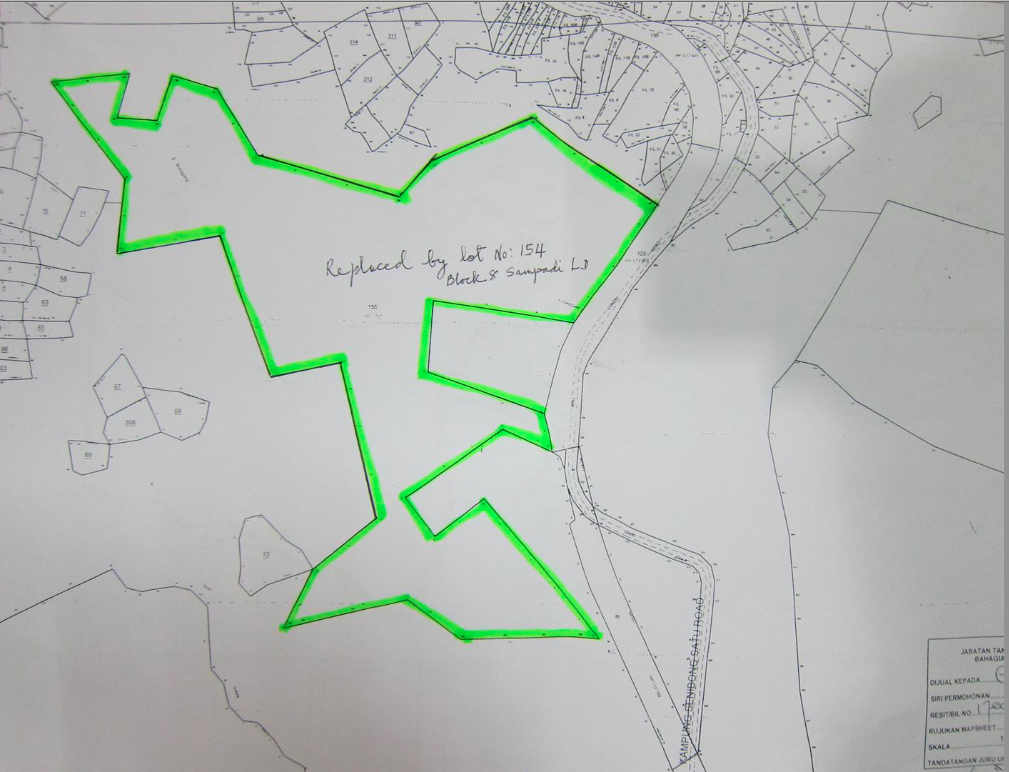
Encouraged by the prospect of the sale and following the advice of the Land & Survey Department, the villagers spent a considerable sum of money to get their land properly mapped and surveyed and they were informed by the Land & Survey Department that their plot was 155 Block 8 Sampadi District.

'Block 154′ – expensive mapping that was to prove a waste of money!

Raziah got there first!

However, as the parties set out to finalise their transaction concerning the purchase of Lot 155 Block 8 Samapadi Land District, they made a discovery that was shocking to both sides.

'Replaced' by Lot 154 – the Lot 155 which used to belong to the villagers has been absorbed without notification or of course payment!

It seemed that Lot 155 had suddenly disappeared from the records!

After much research and many weeks it emerged that the lot had somehow become "replaced".  According to a note in the Land Registry, this meant it was now part of the neighbouring Lot 154.

And it turned out that this very much larger Lot 154 had already been granted by the Land & Survey Department to another company in 2010.

This meant that the villagers are no longer the officially registered owners of their NCR land. Yet they had never been told a thing about it and had even been encouraged to go ahead spending money on useless plans!

So, who was the influential person that was able to achieve such an alteration to the Land Registry without even a notification being made to the rightful owners?

"Replaced" – the scribbled alteration in the Land Registry that removed these people's land and gave it to Raziah Mahmud!

A search of the Land Registry shows that in 2010 Lot 154 (now including the old Lot 155) was sold by the Department in the guise of 'state owned land' to the company Saradu Plantation, which grows bananas.  The company used to be named Emerald Discovery:

READ MORE HERE


Why does the Muslim world suffer from deficits of freedom, development and knowledge?

Posted: 22 Nov 2012 05:15 PM PST

In his seminal book Muslim Society, Ernest Gellner boldly asserts: "By various obvious criteria – universalism, scripturalism, spiritual egalitarianism, the extension of full participation in the sacred community, not to one, or some, but to all, and the rational systemization of social life – Islam is, of the three great Western monotheisms, the one closest to modernity" (Gellner, 1983: 7). He goes on to say that had the Arabs won at Poitiers and gone on to conquer and Islamize Europe, we should all be admiring Ibn Weber's The Kharejite Ethic and the Spirit of Capitalism that would conclusively demonstrate how the modern rational spirit and its expression in business and bureaucracy could only have arisen in consequence of neo-Kharejite puritanism in northern Europe and not if Europe had stayed Christian "given the inveterate proclivity of that faith to a baroque, manipulative, patron-ridden, quasi animistic and disorderly vision of the world" (Gellner, 1983: 7).

But that's not how it turned out. Today, any observer would have little difficulty assembling volumes of data from the United Nations and World Bank Development Reports to demonstrate the acute development and freedom deficits in the Muslim world. This has given rise to a contentious debate about the causes of these deficits. The culprits identified by social scientists include Islamic theology and culture, oil, Arab-specific culture and institutions, Palestinian-Israel conflict, "desert terrain and institutions", weak civil society and the subservient status of women.

Development Deficit

Perhaps the most contested debates on the causes of economic backwardness and democratic deficit in the Muslim world center on whether Islam is the main cause of these twin deficits. In regard to economic backwardness the evidence shows that before the balance of power had shifted after the European expansion in the 17th century, the Middle East was economically just as dynamic as Europe. Muslim merchants were just as successful in carrying their commerce and faith to far corners of the world as their European counterparts. According to economic historian Angus Maddison, in the year 1000 AD the Middle East's share of the world's Gross Domestic Product was larger than Europe's – 10 percent compared with 9 percent. By 1700 the Middle East's share had fallen to just 2 percent and Europe's had risen to 22 percent. Among Western scholars, the standard explanations for this decline are that Islam is hostile to commerce and bans usury. But these are unsatisfactory because Islamic scripture is more pro-business than Christian texts, and as for usury the Torah and Bible say the same. The Prophet Muhammad and his first wife Khadija were both successful merchants. Many Muslims, however, blame their economic backwardness on Western imperialism. But then why did a once mighty civilization succumb to the West?

Turkish-American economist Timur Kuran (2011) persuasively discards these and related explanations. He marshals impressive empirical evidence to show that what slowed the economic development in the Middle East was not colonialism or geography or incompatibility between Islam and capitalism but laws covering business partnerships and inheritance practices. These institutions had benefited the Middle Eastern economy in the early centuries of Islam but starting around the tenth century they began to act as a drag on economic development by slowing or blocking the emergence of central features of modern economic life – private capital accumulation, corporations, large-scale production and impersonal exchange.

Islamic partnership, the main organizational vehicle for businesses of the Muslim merchant classes, could be ended by one party at will and even successful ventures were terminated on the death of a partner. As a result most businesses remained small and short-lived. Most durable and successful business partnerships in the Muslim world were operated by local non-Muslims. Inheritance customs hindered business consolidation because, when a Muslim merchant died, his estate was split among surviving family members which prevented capital accumulation and stymied long-lasting capital-intensive companies. According to Kuran, then, the resulting organizational stagnation prevented the Muslim mercantile community from remaining competitive with its Western counterparts.

Democratic Deficit

Research by the Harvard economist Eric Chaney (2011) debunks the theories that its root cause is Islam or Arab cultural patterns, oil, Arab-Israeli conflict or desert ecology. Chaney shows the democratic deficit, as reflected in the prevalence of autocracies in the Muslim-Arab world, is real. But it is a product of the long-run influence of control structures developed in the centuries following the Arab conquests. In the ninth century rulers across this region began to use slave armies as opposed to the native population to staff their armies. These slave armies allowed rulers to achieve independence from local military and civilian groups and helped remove constraints on the sovereign in pre-modern Islamic societies. In this autocratic environment, religious leaders emerged as the only check on the power of the rulers. This historical institutional configuration which divided the power between the sovereign backed by his slave army and religious elites was not conducive to producing democratic institutions. Instead, religious and military elites worked together to develop and perpetuate what Chaney calls "classical" institutional equilibrium – which is often referred to as Islamic law – designed to promote and protect their interests.

Ostensibly, religious leaders devised "equilibrium institutions" to protect the interests of the general public but in effect this institutional configuration cast an autocratic shadow across centuries. Rulers came to rely on slave armies, freeing themselves from dependence on civil institutions. Religious leaders cooperated with the army to design a system that proved hostile to alternative centers of power. This concentration of power and weak civil societies are the enduring legacy of this historical institutional framework in regions conquered by Arab armies and which remained under Islamic rule from 1100 AD onwards.

However, regions incorporated into the Islamic world after they were conquered by non-Arab Muslim armies, such as India and the Balkans and where Islam spread by conversion (e.g. Indonesia, Malaysia, and sub-Saharan Africa), did not adopt this classical framework. Their institutions continued to be shaped by local elites which preserved their political and cultural continuity. Consequently, the democratic deficit has remained an enduring legacy in the Arab world and in lands conquered by the Arab armies that remained under Islamic rule from 1100 AD onwards. But in the Islamic countries incorporated into the Islamic world by non-Arab Muslim armies or by conversions, democratic developments have followed a more progressive trajectory.

Knowledge Deficit

In the recent 2012 Times Higher Education world rankings of universities, not a single university from 49 Muslim majority countries with a population of 1.2 billion or 17 per cent of world's population found a place in the top 200 universities in the world. This has been a recurrent pattern over many years and signifies a serious academic and intellectual crisis. By comparison the United States, with less than 5% of the world population, had 75 universities in the top 200.

Several factors can account for this crisis, the most important being the meager resources allocated by Muslim countries to research and development. The science budgets of the Organization of Muslim Countries (OIC) are near the bottom of the world league. According to a recent estimate, based on the UNESCO and the World Bank data, between 1996 and 2003 the average annual research and development for OIC countries spending was 0.34% of GDP, much lower than the global average of 2.36% over the same period. Many OIC countries, particularly the richest, spend more on armaments than on science or health. Six of the world's top ten military spenders as a share of public spending are OIC countries: Kuwait, Jordan, Saudi Arabia, Yemen, Syria and Oman spent over 7% of their GDP on arms. While the science spending is among the lowest, spending on education is more variable. Malaysia, Saudi Arabia, Yemen, Morocco, Tunisia and Iran were among the top 25 spenders on education in 2002 (Butler, 2006).

READ MORE HERE


Kemampuan Kewangan Luar Biasa Ahli Parlimen Ampang Sejak Bergelar YB Empat Tahun Lepas

Posted: 21 Nov 2012 04:15 PM PST

Sebelum di pilih sebagai Ahli Parlimen Ampang pada tahun 2008 Zuraida adalah seorang penjual buah di kawasan Ampang. Selain menjual buah beliau juga secara sampingan turut menjual ubat-ubatan tradisional termasuk minyak angin.

Penglibatannya dalam PKR bermula selepas dia menyertai sebuah pertubuhan pro pembangkang yang dikenali sebagai Gerakan Mansuhkan ISA. Hasil pergaulan dan perkenalan beliau dengan orang-orang pembangkang dalam pertubuhan itu membawa beliau menyertai PKR. Kebetulan pada masa itu PKR berada dalam keadaan hidup segan mati tak mahu dan tidak ramai orang yang sanggup menerima jawatan -jawatan dalam parti. Kesempatan itu di ambil oleh Zuraida untuk menonjolkan dirinya dengan suara-suara lantangnya yang akhirnya membawa beliau berjaya memegang jawatan Ketua Wanita PKR.

Zuraida yang terkenal dengan bau badan yang masam di kalangan orang-orang PKR telah dipilih oleh PKR untuk menjadi calon mereka di Ampang dalam PRU ke 12 memandangkan pada waktu itu tidak ramai orang-orang PKR yang berminat untuk jadi calon. Tuah ayam nampak di kaki tuah manusia siapa yang tahu. Zuraida menang di Ampang dan dalam masa yang sama PKR berjaya membentuk kerajaan di Selangor. Ramai orang-orang PKR yang terlopong melihat orang yang selalu diperli dengan bau badan masam sebelum itu diangkat sebagai ahli parlimen oleh pengundi-pengundi Ampang.

Bermula Mac 2008 kehidupan Zuraida sekeluarga berubah setelah bergelar wakil rakyat di sebuah negeri yang diperintah PKR. Zuraida tidak perlu lagi menjual buah. Selain sibuk sebagai ahli parlimen Zuraida juga sibuk memenuhi undangan-undangan ceramah di seluruh negara untuk membongkar 'penyelewengan dan rasuah Umno'.

Sebelum menjadi wakil rakyat di negeri yang diperintah oleh PKR Zuraida hanya menggunakan kenderaan Perodua Myvi yang dibelinya pada tahun 2005. Itulah satu-satunya kenderaan yang dimiliki beliau pada masa itu.

  • No kenderaan : WNL 8994
  • No enjin : E94A84B
  • Model : Perodua Myvi 1.3 Ezi (Auto)
  • Tarikh daftar : 31.10.2005
  • Pemilik : Zuraida Bt Kamaruddin
  • KP : 580314 71 5206

Namun seperti yang kami katakan diatas tuah ayam nampak di kaki tuah manusia siapa yang tahu. Daripada seorang penjual buah dan ubat-ubatan tradisional yang hanya menggunakan kenderaan Perodua Myvi kehidupan Zuraida berubah sekelip mata selepas menjadi wakil rakyat.

Beberapa bulan selepas diangkat sebagai ahli parlimen dan PKR membentuk kerajaan di Selangor Zuraida telah membeli sebuah kenderaan baru seperti berikut.

  • No kenderaan : WRL 575
  • No enjin : B5254 T2 A027402
  • Model : VOLVO XC90 2.5 T
  • Tarikh daftar : 01.07.2008
  • Pemilik : Zuraida Bt Kamaruddin
  • KP : 580314 71 5206
  • Harga kenderaan : RM 355,000.00

Bayangkan daripada Perodua Myvi yang berharga RM 40k terus melonjak kepada Volvo yang berharga RM 355k. Itulah yang dinamakan rezeki.

Tahun 2009 tidak ada sebarang kenderaan baru yang dibeli oleh Zuraida. Manakala pada tahun 2010 Zuraida membeli sebuah lagi kenderaan seperti berikut.

  • No kenderaan : WTY 1547
  • No enjin : 2KD650 8915
  • Model : Toyota Hilux Double Cab 2.5 AT
  • Tarikh daftar : 31.05.2010
  • Pemilik : Zuraida Bt Kamaruddin
  • KP : 580314 71 5206
  • Harga kenderaan: RM 99,000.00

Mungkin dua kenderaan baru belum mengcukupi untuk menggantikan Perodua Myvi yang dimilikinya sebelum itu, maka pada tahun 2011 Zuraida membeli lagi sebuah kenderaan seperti berikut.

READ MORE HERE


Dato’ Onn Jaafar – the man who defined “Malay”

Posted: 21 Nov 2012 04:01 PM PST

Here is the man who, according to his nephew, Professor Dr Syed Muhammad Naquib al-Attas, gave the definition of "Melayu" in the Federation of Malaya Agreement 1948. The same definition is then adopted in our Federation Constitution (article 160) which stands till to date. Here is also the man who requested the good Professor to draw up the UMNO logo. That logo was apparently adopted at a meeting attended by, among others, Dato' PanglimaBukit Gantang, Dato' Zainal Abidin Abas, Colonel Musa, who was also known as Pak Lomak, who was the originator of the Malay ghazal. That logo too stands as UMNO logo till to date.

Perhaps Dato' Onn's humility and his tireless fight for freedom and independence could be gleaned from the advice that he gave the author when the latter was a teenager. He said the "Malays should never "sembah" anyone except God." And when somebody from a higher social order meets with somebody from a lower social order, the latter should not be ignored.

He did not only say that but he actually practised what he said. In 1927, Dato' Onn was told to leave Johor by HRH the Sultan for criticising the Sultan. As a result he spent almost 9 years in exile. On this, Dato' Onn said:

"I opposed my own Ruler because his actions towards his subjects, and as a result, I was dismissed from government service. Later, because of my subsequent opposition to the Ruler for his injustice towards his subjects, I was once again removed from my government and was banished from the State of Johor.... Are such actions the actions of one chasing after wealth and grandeur for himself?"

In 1936, he was recalled to Johor by HRH Sultan Ibrahim. He did come back. However, after the war, when he was the Chief Minister of Johor and the drive for independence was taking shape, HRH the Sultan gave him an ultimatum. He was told to choose whether to remain as the CM or accept the post of UMNO President.

Dato' Onn resigned as CM of Johor and took the position of UMNO President. He then moved to Kuala Lumpur, living in a single story house at Stonor Drive. Even though he was appointed to a post which was equivalent to the current Home Minister by the British Government and the country was in the middle of an emergency, he did not have any police protection. He said "even if you have many bodyguards, when it is time to go, you will go!"

He was clear in his direction. His understanding and appreciation of the duties and responsibilities that came with his position as a leader would put many  leaders and civil servants to shame. On the UMNO Presidency, which he held from the formation of UMNO in May 1946, he said:

"The post of President of UMNO is not one that I desire, it is one entrusted to me by the representatives. I do not wish for this or that. I was willing to shoulder the responsibility because I was aware of my responsibility, as long as the Malay people and the members of UMNO placed their trust in me."

Again, Dato' Onn practised what he said. In 1950, when accusations were made that he was not doing enough for the party and the Malays, he willingly resigned from the post. The post of UMNO Presidency, to him, is not one which is to be cavorted and held on, especially when one is not wanted. He said:

"Had I known that there were some from amongst the UMNO members and the Malay people, who did not have faith in me, it would have been appropriate for me to resign, in order that the post be held by one more qualified and skilled..."

After resigning, he went back to Johor. However, appeals were made for him to retract his resignation. Thousands of UMNO members marched to his house. Finally, on 27.8.1950, he was once again elected as the President of UMNO.

Clearest in his mind was the concept of fiduciary duties owed by the people in power. And the duties, in his mind, are owed to the people of the nation as a whole, and not to any particular race or people. To him a Minister is subject always to the law. And he or she must discharge his responsibilities solely for the benefit of the country and the people. He said:

READ MORE HERE


Skandal AES: Syarikat Ditubuh Lepas Dapat Kontrak AES

Posted: 21 Nov 2012 12:07 PM PST

MP Pokok Sena, Datuk Mahfuz Omar mendakwa kontraktor Sistem Penguatkuasaan Automatik (AES) hanya mendaftarkan syarikat tersebut selepas memperoleh kontrak untuk memasang sistem itu.

Beliau membuat kesimpulan itu berdasarkan butiran syarikat Beta Tegap Sdn Bhd dan ATES Sdn Bhd yang diperolehi dari Suruhanjaya Syarikat Malaysia (SSM).

Menurut Mahfuz, butiran pada pendaftaran syarikat itu menunjukkan syarikat berkenaan memperoleh kontrak tersebut sebelum syarikat itu didaftarkan lagi.

Satu dokumen yang ditunjukkan Mahfuz kepada pemberita, didakwa daripada SSM, menunjukkan ATES Sdn Bhd mendaftarkan syarikat tersebut pada 12 Februari 2009, manakala Beta Tegap Sdn Bhd pula pada 7 Februari 2004.

"Bagaimana dua syarikat ini tahu mereka dapat jaminan kerajaan sedangkan Kabinet meluluskan AES pada tahun 2006 dan saringan tender dilakukan pada 2006?

"Mereka daftar syarikat semata-mata nak dapatkan tender.

"Ini menunjukkan ada perkara yang tak kena. Ini bukan untuk selamatkan nyawa manusia tetapi untuk mengayakan kroni," dakwanya dalam sidang media di bangunan Parlimen hari ini.

Read more at: http://www.idhamlim.com/2012/11/skandal-aes-syarikat-ditubuh-lepas.html 

Kredit: www.malaysia-today.net

Malaysia Today - Your Source of Independent News

0 ulasan
Klik GAMBAR Dibawah Untuk Lebih Info
Sumber Asal Berita :-

Malaysia Today - Your Source of Independent News


Selangor Land Grab by BN

Posted: 21 Nov 2012 11:59 AM PST

http://www.themalaysianinsider.com/images/sized/images/uploads/07/12/sel-idrus-240x187.8.jpg 

Despite all attempts at "transforming" UMNO and Barisan Nasional to be "people first", and all the rhetoric on accountability and integrity under the Prime Minister, Datuk Seri Najib Abdul Razak's Government Transformation Programme, UMNO leaders still regard the tax-payers' monies as their own. After all "UMNO is rakyat" and hence there is nothing wrong with UMNO robbing what belongs to the rakyat.
 
Tony Pua 
 
It did not come as a shock to anybody when DAP State Assemblyman for Sekinchan, Ng Swee Lim exposed on Tuesday that Barisan Nasional (BN) component parties secured at least 24 pieces of valuable land from the state government while they were in power between 2000 to 2008. These pieces of land which are mostly in commercial areas, amounting to 34.5 acres were "sold" to UMNO, MCA, MIC and Gerakan for a pitiful RM1 per square feet.
 
What is perhaps more surprising is that such information was somehow kept under wraps for such a long time after they lost their hold on power.
 
But what is most shocking is the response by Selangor UMNO Information Chief Abdul Shukor Idrus, who is also the state assemblyman for Kuang who argued that "what's wrong with giving the land to UMNO" as reward for the "contributions by UMNO in fighting for indepedence and developing this country".
 
His response to Ng during the sitting as recorded in the Hansard was "…Kalau dipandangkan jasa UMNO menuntut kemerdekaan dan akhirnya Sekinchan (Ng) boleh jadi lawa macam ni, kalau tak kerana UMNO menuntut kemerdekaan dan memajukan negari ini, saya ingat Sekinchan (Ng) pakai baju daun sekarang ini… apa halnya kalau diberi kepada UMNO"
 
Abdul Shukor attempted to control the fallout with a press conference yesterday (Wednesday), only to dig a deeper hole for UMNO and himself.  He tried to justify that "UMNO is rakyat" and hence there's absolutely nothing wrong in giving state land to an "organisation that represents 400,000 people".
 
The above proves that despite all attempts at "transforming" UMNO and Barisan Nasional to be "people first", and all the rhetoric on accountability and integrity under the Prime Minister, Datuk Seri Najib Abdul Razak's Government Transformation Programme, UMNO leaders still regard the tax-payers' monies as their own. After all "UMNO is rakyat" and hence there is nothing wrong with UMNO robbing what belongs to the rakyat.
 
UMNO and Barisan Nasional leaders clearly has no moral sense of right and wrong, and are completely uneducated in the ability to differentiate between what belongs to the government/people as opposed to what belongs to the political parties.
 
The response by UMNO leaders tells Selangorians that if UMNO were to be elected back into power in the coming general election, then they will continue to rape the state by carving out valuable pieces of state land to be alienated to UMNO, MCA, MIC and Gerakan at dirt cheap prices.
 
Datuk Seri Najib Razak, as the Selangor UMNO Chief who had declared that Selangor must be "returned" to BN "at all costs" must state his stand on the land grab by the coalition he leads.  Does the Prime Minister also condone the land grab exercises and agree with his Selangor UMNO Information Chief? Or does Datuk Seri Najib hold the "transformed" belief that such blatant land grab by BN is corrupt, an abuse of power and a serious breach of the people's trust?
 
If Datuk Seri Najib wants Malaysians to believe that BN has really "transformed" and can be trusted, then he must declare that such land grab exercises by BN component parties must not only be banned, all land that has previously been alienated to them on the cheap, must be returned to the state.
 
Otherwise, Datuk Seri Najib Razak will be exposed as a "transformation" fraud – where it talks about integrity, transparency and accountability on the one hand but continues to allow his party and coalition to rob the rakyat blind on the other.


Police Budget formula helps BN to remain in Government more than it helps prevent crime

Posted: 21 Nov 2012 11:56 AM PST

http://dinmerican.files.wordpress.com/2012/03/liew-chin-tong.jpg?w=545 

DAP MP for Bukit Bendera Liew Chin Tong  


As Parliament concludes the debate on Budget 2013 this afternoon with the debate on allocation to the Home Ministry, it is very sad to note that budgetary figures of 2010, 2011, 2012 and 2013 show that the Barisan Nasional government is more interested in using the police to maintain power than to fight crime.


Prime Minister Datuk Seri Najib Razak became Prime Minister in April 2009 and Budget 2010 was his first budget. Since then Najib has full power to change the course of history and hence should take full responsibility for the crime situation in the country. 


In the context of the heightened crime situation nationally, it is high time for the nation to examine the priorities of the police through its budgetary arrangements.


It is important to note that the police force executes the policies of ruling politicians. There is no point to blame the police for misplaced priorities. Ultimately, the policy directions of the police reflect the choices made by the ruling government.


The Police Force was given an allocation of RM 4.5 billion in 2010, RM 5.8 billion in 2011, RM 6.3 billion in 2012 and RM6.5 billion for 2013 respectively. There is an increase of RM 1.8 billion or 44% between 2010 and 2013. (Budget 2013 documents show that actual spending in 2012 will reach RM6.78 billion, beyond the original budgeted RM6.3 billion).  


Consistently in the past four years, the criminal investigation department receives only 8% of the total allocation.


Management and logistics jointly consume 59% of allocation in 2010, 55% in 2011 and 2012 and 54% in 2013.


Internal Security and Public Order category's share of allocation is 22% in 2010, 25% in 2011, 27% in 2012 and 28% in 2013. 


Indeed, Internal Security and Public Order category increased its allocation from RM975 million in 2010 to RM1.46 billion in 2011, RM1.68 billion in 2012 and RM1.79 billion in 2013.


Between 2010 and 2013, allocation given to Internal Security and Public Order increased by 84% while the total financial allocation for the police increased by 44% during the period. 


While Internal Security and Public Order includes the traffic police and border patrol, the bulk of allocation goes to police units that deal with the security of the government than the security of the people, such as the paramilitary unit General Operations Force, as well as Federal Reserve Unit and other categories of riot police. 


Likewise, Intelligence (in particular Special Branch) receives 6% of the allocation. A spy agency like the Special Branch is not needed in a democracy. 


Elaborating on the roles of "Intelligence", Budget 2013 says that it is  "to safeguard the security of the nation by gathering intelligence through secret and open means on communist, subversive and extremist elements and (shielding the nation) from intelligence and spying of local and foreign threats." Two decades after the Hatyai Accord, it is comical to target the communists, even more so in view of Umno's recent exchange partnership with the Chinese Communist Party.  


The budgetary figures on the police during Najib's premiership speak for itself. The government is more interested to maintain power through the police than to fight crime.


Do Your Job Right, PTPTN

Posted: 21 Nov 2012 11:52 AM PST

http://www.freemalaysiatoday.com/wp-content/uploads/2012/03/kee-thuan-chye.jpg 

Kee Thuan Chye   

It's unbelievable how lackadaisical the National Higher Education Fund Corporation (PTPTN) is in collecting loan payments. These, after all, constitute the rakyat's money, and it is the responsibility of the corporation to be accountable for it. And yet its chief executive officer, Agos Cholan, can say, in an interview with Malaysiakini, that it tells its debtors to pay whatever they can.

Whatever they can! What kind of an attitude is that? Isn't it encouraging defaulters?


Is PTPTN not concerned about getting back the money because the money belongs to others? Is it plainly incompetent? Is it poorly run? If so, it reflects badly on the government we have.

In fact, the least the Government could do now is crack the whip on the people heading PTPTN to ensure that they do their job well, and if they don't, it should have them replaced.

After all, we are talking about huge sums of money being loaned out. As it is, the total amount stands at RM45.41 billion, and by the end of the year, it will reach RM50 billion.

That's not small pickings. It's money that could be used for the good of the rakyat – a lot of good. If some of it is not recovered when the loans are due, more money will have to be pumped into the fund. Where will that money come from?

Of course, we can say that PTPTN money is for the good cause of higher education so it might be all right if the recipients don't pay back or take their time to do so, but a loan is a loan. Its terms and conditions have to be respected. If you tak berani tanggung, you shouldn't take a loan. You can't say afterwards that paying back will cause you to be in debt. You should know what you'll be in for.

Of course, if the Government decides to scrap PTPTN and write off the loans, that's a totally different matter. But until that happens, the loan agreement is sacrosanct.

Even for a scholarship, there is usually the condition of the recipient being bonded by employment to the Government after graduation, which he or she must respect. If they renege, they must pay back in cash.

But more than the issue of money, what is important to consider here is that this is not the way to run a government agency. By not doing its job the way it should, PTPTN is showing a bad example of government operations.

As for Agos Cholan, the things he said in the interview reflect an unseemly attitude. If he brings that to bear in his job, he should seriously reconsider his position.

He said PTPTN wants to do things "the nice way", i.e. it refuses to come down hard on debtors. How could he say that? It's not the role of PTPTN to be "nice".

How could he also say, "So far, we have been quite nice and moderate. We advertise in newspapers, on billboards and hold awareness campaigns to tell the people, 'Pay back lah'".

That sounds utterly unprofessional. And of course if PTPTN puts it that way, nobody's going to pay lah. So perhaps we could say, "Agos Cholan should step down lah."

He said 130,000 or so debtors have been blacklisted, and of these, only 20 percent have started paying back. "The rest have not come forward yet. We are still waiting," he added.

Still waiting? If creditors were to just wait for their debtors to come to them, they'd be out of business in a flash! Sure, PTPTN is not a commercial enterprise or a profit-making organization, but it is a trustee of the rakyat's resources.

PTPTN should be proactive instead and go after the debtors. But wait! There is a problem. According to sources quoted by Malaysiakini, many of the students to whom PTPTN gave out loans cannot be traced.

This is incredulous. It reeks of incompetency of the highest order. Keeping track of one's debtors is the most basic of functions. Otherwise, how can you ensure getting back your money? So how could PTPTN be so lax about keeping proper records and updating them continually?

Agos Cholan is a former banker; he should know better than most people that you can't lend money and later lose contact with the people you lent it to. What's his excuse?

Apparently, PTPTN's database suffered a disaster when it was converted into electronic data under a system that didn't work well and was then tinkered with under a different system that made it worse. It is now being rebuilt based on the first system, "running on an old engine". The process has of course cost a lot of money – and a lot of misplacement of data. And "running on an old engine" doesn't sound like a good prospect.

Agos admits that there was a time when PTPTN couldn't justify RM5 billion worth of loans – "we didn't know who took out loans or who has paid; the numbers weren't there". This sounds harrowing when so much money is at stake. But he assures us that "it has all been rectified".

Rectifying it is one thing; using it to spring to action to recover the money is another. Agos eschews using debt collection agencies because he's worried they might "not be professional enough".

How about using the legal recourse? After all, there is no excuse for the debtors not to pay. When they signed the loan agreement, they knew what they were in for and they agreed to the terms. So those who have not been paying need to be jolted into honoring those terms. Indeed, if a few debtors were to be hauled to court on this account, it might spook other defaulters into paying up.

But one suspects that PTPTN's reluctance to enforce legal compliance stems from a fear of offending its loan recipients. These are the youths who will be voting at the upcoming general election. The ruling Barisan Nasional (BN) would be worried about losing their votes. Especially with Pakatan Rakyat pledging, if it captures Putrajaya, to write off PTPTN loans and provide free tertiary education.

Furthermore, the 'Occupy Dataran' campout staged by university students in April to call for the loans to be scrapped has added pressure on BN.

Be that as it may, the BN government will not endear itself to the rakyat if it is seen to be incompetent, inefficient and cavalier about the people's resources. It might end up being rejected instead.

In any case, nothing beats doing a job right. If PTPTN cannot do its job right, the Government will be held accountable. Then no amount of appeasing the young voters will be of help to the BN cause.

The point of reckoning may ironically be the ballot box.


* Kee Thuan Chye is the author of the bestselling book No More Bullshit, Please, We're All Malaysians, available in bookstores together with its Malay translation, Jangan Kelentong Lagi, Kita Semua Orang Malaysia. 


Nation-building or undermining?

Posted: 21 Nov 2012 11:49 AM PST

http://aliran.com/wp-content/uploads/2010/10/Najibs-budget-2011.jpgNajib: Empty talk about 'transformation' 

In an open letter to the Prime Minister, P Ramakrishnan takes to task Najib's cakap-tak-serupa-bikin rhetoric.

My dear PM,

You sounded like a great statesman when you urged Malaysians "to disregard political difference and work toward nation-building".

That was simply fantastic!

It was very heart-warming to hear you say, "We must build the nation together. Irrespective of the political differences that we have, at the end of the day this country is ours."

That was simply unbelievable!

How we wish that you really meant what you said. If that was your philosophy, by now you would have been proclaimed as the greatest Prime Minister this country has ever had. If that had happened, you need not now scramble around the country desperately trying to get the Barisan Nasional returned to power.

If you had put this rhetoric into practice, this country would have moved forward in leaps and bounds, astounding the rest of the world. We would have achieved so much during your three and a half years of premiership that would have helped you to walk through the coming 13th General Election without a sweat.

But when we assess you and try to match you with what you said at the launch of the Genovasi Challenge in Kuala Lumpur on 14 October 2012, we are gravely disappointed. You come across as a hollow politician who is not capable of living up to your words.

If you truly meant that "at the end of the day this country is ours" why is it that a vast majority of citizens are not made to feel that way? Why do you tolerate and refuse to take to task those narrow-minded Umno petty politicians and Perkasa poison-spewing ultras who refer to the rest of the citizens as 'pendatang'? This is as much the country of the ordinary citizens and they have as much right as these name-calling despicable and loud-mouthed politicians who claim sole ownership to this right.

If you truly meant that "we must build the nation together", why is it others are not given their chance to contribute as well? Why is it that those outside the Barisan Nasional circle are excluded and denied their legitimate right to voice their opinions and articulate their policies and promises?

Why do you punish those had voted for the Opposition by denying their MPs and state assembly members the allocations that you lavishly make available to your BN MPs and assembly members? Aren't these elected opposition representatives also citizens of this country? Don't the voters who elected these opposition representative have the same voting rights to choose whoever they prefer – just like those who elected the BN MPs and assembly members – without being punished for their choice? Why then this discrimination? What has party affiliation to do with the democratic process and the benefits that are due to the citizens?

And yet, hypocritically you declare, "We must build the nation together." How do we do that when you don't reach out to the others; when you completely shut them off and punish them?

You don't even bother to consult the Leader of the Opposition before introducing new Bills to parliament as is done in mature democracies. You don't give sufficient time for citizens to comment on these policies that are bound to impact them in various ways. Very often you rush through these Bills with super speed and with very little debate. How do we build this nation together? It has always been only your way and no other way! If there is no room for inclusion or co-operation, how then do we work together?

"Irrespective of the political differences that we have, at the end of the day this country is ours," you say. But how is it that others are not allowed to work together with you for the common good of the nation? Why are you so divisive in your policy and approach?

You have done nothing to stop Utusan from spreading its venom and lies. You have never reprimanded them or replaced the editorial staff responsible for creating discord and hatred. They seem to have a field day. How do we "disregard political differences and work toward nation-building" when we are constantly bombarded with vile and vicious and divisive commentaries without any let up?

How is that those who disagree with or who have different views from you are hardly given the space to operate democratically? They have to contend with the police and the hooligans who turn up to disrupt Opposition events and activities. How do we "build the nation together…. Irrespective of the political differences that we have"?

How do we bring the various communities together and strengthen our national unity for the good of the country when the entire fabric of BN policy is racial? It is never based on justice irrespective of ethnicity – it is always based on racial quotas and racial handouts. It is a policy designed to keep the poor and the helpless dependent on the BN charity and not to rescue them from their poverty to lead a life of dignity. That is how the BN has thrived as a saviour of the rakyat for more than half a century, deluding the people that they don't have a life and hope beyond the BN.

But you are not partial even to all the Malays even though you claim to represent the Malays. You only look after the cronies and the elites in Umno. When the Malays don't belong to these groupings, they don't get any benefits. But Umno will always speak in the name of the Malay community as if it is the benefactor of all Malays. The reality is that the Malays in Pas are almost completely ignored when it comes to receiving benefits; the Malays in Parti Keadilan Rakyat are treated as enemies. They get hardly any goodies.

How do we work together? How do we believe you when you say "at the end of the day this country is ours"? Do we all equally have a share in the wealth of this nation?

In spite of the much touted BR1M magic that you introduced, in spite of the greatly proclaimed 1Malaysia delusion that you created, Malaysians are not brimming with joy!

If after more than half a century of nationhood, we can't rise above our racial identities and political differences and work together as citizens of this country then we have failed ourselves miserably. For this the BN must be solely held responsible. It is their divisive policies that have kept us apart and never brought us together.

The BN policy has failed this country and its people. They are not capable of any alternative policy that will benefit every citizen. The wealth of the nation really has not been equally distributed among the people – only cronies and certain leaders at the top have harvested benefits beyond the wildest dreams of the ordinary, common man.

The BN's so-called nation-building efforts have not yielded the results this country deserves. We have to turn to an alternative policy to achieve this and this opportunity will be available at the 13th General Election.

P Ramakrishnan is the immediate past president of Aliran 

Bruno Manser Fund report slams plans for 50 new dams in Malaysian Borneo

Posted: 21 Nov 2012 11:47 AM PST

Sarawak's indigenous people to pay the price for US$ 105 billion industrialization scheme

A new Bruno Manser Fund report exposes the Sarawak state government's excessive hydropower plans for the Malaysian part of Borneo - Bruno Manser Fund is calling for a moratorium on all dam construction after Bakun and for the withdrawal of foreign consultants from socially and environmentally damaging hydropower plans

 
(KUCHING, MALAYSIA) Tens of thousands of indigenous people from the rainforests of Borneo are facing forced displacement from their traditional lands on the basis of hydropower plans drawn up by the state government of Sarawak in Malaysian Borneo.
 
A report released today by the Bruno Manser Fund entitled "Sold Down the River. How Sarawak Dam Plans Compromise the Future of Malaysia's Indigenous Peoples" examines the dam plans that form part of SCORE, Southeast Asia's most ambitious and most expensive energy project, with planned investments of up to US$ 105 billion by 2030.
 
 
Cultural genocide
 
Under the guise of "development", the Sarawak state government under Chief Minister Taib Mahmud is planning to virtually dam all the rivers in the state's interior, irrespective of the social and environmental implications. The dam plans, which are being pushed ahead under a cloak of secrecy, constitute the core element of the so-called Sarawak Corridor of Renewable Energy, SCORE. If implemented, they would entail the cultural genocide of a significant part of Sarawak's rich indigenous culture.
 
Indigenous cultures from Sarawak's interior, such as the Kayan, Kenyah, Penan and Kelabit, are likely to face extinction if the dam plans are implemented in full. But the dams are also likely to have serious negative repercussions on downstream Iban and Bidayuh communities. For centuries, the rivers of Borneo have been the lifeline of Sarawak's indigenous people. The planned Baram dam alone is estimated to be displacing 20,000 Borneo natives and flooding over 40,000 hectares of rainforests and farmlands.
 
A first series of 12 dams is currently being implemented by Sarawak Energy, the state's power monopolist.  The report stresses the fact that Sarawak is already confronted with a power excess: the current peak demand in Sarawak is around 1000 megawatts (MW) and is thus far less than the power that can be produced by the recently completed Bakun dam alone, which, with a capacity of 2400 MW, is Asia's largest dam outside China.
 
 
Foreign corporate actors' pact with the devil
 
The Bruno Manser Fund report discloses that many companies involved in the dam plans are closely linked to the family of Sarawak's long-term Chief Minister Taib Mahmud and to Cahya Mata Sarawak (CMS), the flagship of the Taib family's business empire. Taib is currently under investigation for corruption by Malaysia's corruption watchdog, MACC.
 
In order to benefit from the strong investments linked to the Sarawak dam plans, foreign corporate actors, such as Australia's Hydro Tasmania, Snowy Mountains Engineering Company (SMEC), GHD, the US consultant MWH Global, Norway's Norconsult, Germany's Fichtner and construction companies such as China's Three Gorges Corporation and Sinohydro have concluded a "pact with the devil" and are assisting the Taib government with its momentous dam projects.
 
Key managerial positions within Sarawak Energy, the implementing agency of the dams, are held by foreigners, such as by the Norwegian CEO Torstein Dale Sjøtveit and by the Australian dam project director Andrew Pattle, who has been seconded by Hydro Tasmania.
 
Funding agencies behind the Sarawak dam plans include Malaysian banks, such as RHB Bank, EON Bank and AmInvestment Bank, as well as Kuwait Finance House and Kenanga Investment Bank, which is a joint venture between the Taib family's Cahya Mata Sarawak (CMS) and Deutsche Bank.

 
Bruno Manser Fund calling for a moratorium
 
The Sarawak state government and Sarawak Energy as the implementing agency are facing increasing opposition from the affected communities against their excessive dam plans. Representatives of SAVE Rivers, a Sarawak network set up to fight the Taib government's dam plans, are currently embarking on a tour through Australia. The "Hydro Tasmania out of Sarawak" tour is aimed at increasing the pressure on publicly-owned Hydro Tasmania, one of the most important corporate actors involved in the Sarawak dam plans.
 
The Bruno Manser Fund is calling for a moratorium on all Sarawak dam construction and for an independent external review of the Bakun, Bengoh and Batang Ai dams. Sarawak Energy is asked to sack its chairman, Hamed Abdul Sepawi, the cousin of Chief Minister Taib Mahmud, and to provide full transparency of its finances, contracts and funders. Foreign corporate actors are asked to shun SCORE, as any involvement in the Taib government's hydropower program is inextricably linked to corruption, environmental damage and human rights violations.
 
The full report entitled "Sold Down the River. How Sarawak Dam Plans Compromise the Future of Malaysia's Indigenous Peoples" is now available online at:http://www.stop-corruption-dams.org/resources/
 
For daily updates on the "Hydro Tasmania out of Sarawak tour", please consult:
http://www.savesarawakrivers.com


Book Launch and Forum: Prelude to the Post-Lee Kuan Yew Era

Posted: 21 Nov 2012 11:25 AM PST

http://www.malaysia-chronicle.com/images/stories/lky-prelude-wahpiow.jpg 

Date: Saturday 24 Nov 2012
T
ime: 2-4pm
Venue: Selangor Chinese Assembly Hall
1 Jalan Maharajalela, Kampung Attap, Kuala Lumpur, Transit: Maharajalela

Books 

Smokescreens & Mirrors by Tan Wah Piow

Escape from the Lion's Paw edited by Teo Soh Lung & Low Yit Leng

These two books on Singapore will be launched by Mr Tan Yew Sing & Dr Kua Kia Soong


Followed by a panel discussion:

Prelude to the Post-Lee Kuan Yew Era
Moderator : Maria Chin Abdullah

Dr G Raman is a well respected Singapore tax and commercial lawyer with over 40 years practice behind him. In the 1970s he gallantly served as the legal advisor to the student unions at the University and Polytechnic which were under attack by the authorities. G Raman was himself detained without trial in 1977 by Lee Kuan Yew. Despite his years of suffering under repression, he remains a sharp critic of the PAP government.

Mr Tan Wah Piow is former student leader who fell on the wrong side of politics in Singapore. He was jailed in 1975. In 1976 he went into exile in the UK, where he now practices law. In 1987 Singapore accused him of being a "marxist" mastermind, an allegation he refutes in his book Smokescreens & Mirrors. Tan calls for a campaign to restart, rejuvenate and reclaim the Constitution.

Dr Wong Chin Huat is a political scientist by training. He serves as a steering committee member of Bersih 2.0 He campaigns for electoral reform and civil and political rights. He also writes political commentaries. for The Nut Graph, Selangor Times, Malaysiakini amongst others.


--------------------------------------------------------------------------------

Tan Wah Piow, the author of Smokescreens & Mirrors, will be in Kuala Lumpur to launch the book on the 24th November.

Smokescreens & Mirrors is not only a powerful rebuttal of the Singapore government's allegations against him in 1987 as the "Mastermind of a Marxist Plot" to overthrow the PAP, it is, in the words of one Singaporean reviewer:

Smokescreens, however, is not simply a historical analysis of the political machinations that took place in 1987. It closes in the present with a call to action: Tan pushes for a re-examination of Operation Spectrum as "an initial education process to mobilise public opinion to Restart, Rejuvenate and Reclaim the Constitution" (p.72, capitals his). He establishes the foundation of his arguments upon the Singapore Constitution, which he avers "has to be the first point of reference in any political debate where liberties are at stake" (p.30). G. Raman states in his foreword that "the book contains Wah Piow's agenda for a true democratic society in Singapore". Smokescreens is thus polemical – and openly so.

In Escape from the Lion's Paw edited by Teo Soh Lung and Low Yit Leng, Wah Piow published his long awaited account of his escapade from Singapore in 1976. The chapter The Making of an Outlaw is a mini-autobiography of this former student leader who was thrown into prison in 1975 following a fabricated charge. Immediately following his release, he had to devise his escape routes to avoid being inducted into the military. It became an enormous blow to the authorities when he managed to escape from the the Lion's Paw, and and sought political asylum in the United Kingdom where he now resides and has his own legal practice. His citizenship was revoked in 1987.

This book also carries stories of escapades published for the first time of other dissidents who had to flee from LKY's iron-fist rule, among them, the late Francis Khoo and Wah Piow's colleagues during the University days, Tsui Hon Kwong from Hong Kong and ex-detainee, Ms Tang Fong Har.

These two books are published this year in Singapore to coincide with the 25 anniversary of the infamous Operation Spectrum in 1987. At the time 22 social activists, lawyers, journalists and church workers were detained without trial. Many Singaporeans till today do not believe in the PAP government's claim of a Marxist Plot, and despite the lapse of time, the issue continues to haunt the political credibility of the regime, and a lingering embarrassment to the more liberal elements within the ruling PAP.

Dr G Raman has been a practising lawyer in Singapore since 1969. His doctorate thesis is titled "Law as an Instrument of Social Change in Singapore". It deals with how the PAP used law to perpetuate its hegemony in Singapore.

Raman was the legal adviser to the University of Singapore Students' Union in 1969 and later in 1974. He represented one of the two workers charged with its student leader, Tan Wah Piow on the trumped-up charge of rioting in 1974. He was detained for more than a year in February 1977 for alleged subversive activities under the Internal Security Act.

Author of a book on probate practice in Singapore and Malaysia, Raman has contributed articles to the Journal of Contemporary Asia and other local publications."

In the Forward to Smokescreens & Mirrors, G Raman wrote:
"Twenty-five years later (from 1987), Wah Piow's dreams may not have been realised. But the dreams are taking shape and it is a matter of time before the ideals that Wah Piow espoused become a reality… It will be an opportunity missed and a road to their downfall if the PAP does not take note of the winds of change that are blowing so strongly amongst Singaporeans, especially the young".

The call for the revamp of the way politics are managed in Singapore is inevitable, and this is becoming more pressing especially after the 2010 general elections and the 2011 Presidential Elections when the ruling PAP, though still safely in power, nevertheless suffered strategic defeats in public perception as a party which could do no wrong.

The speakers will address these issues in Prelude to the Post-Lee Kuan Yew Era. 


Kredit: www.malaysia-today.net
 

Malaysia Today Online

Copyright 2010 All Rights Reserved